//
For internal use only
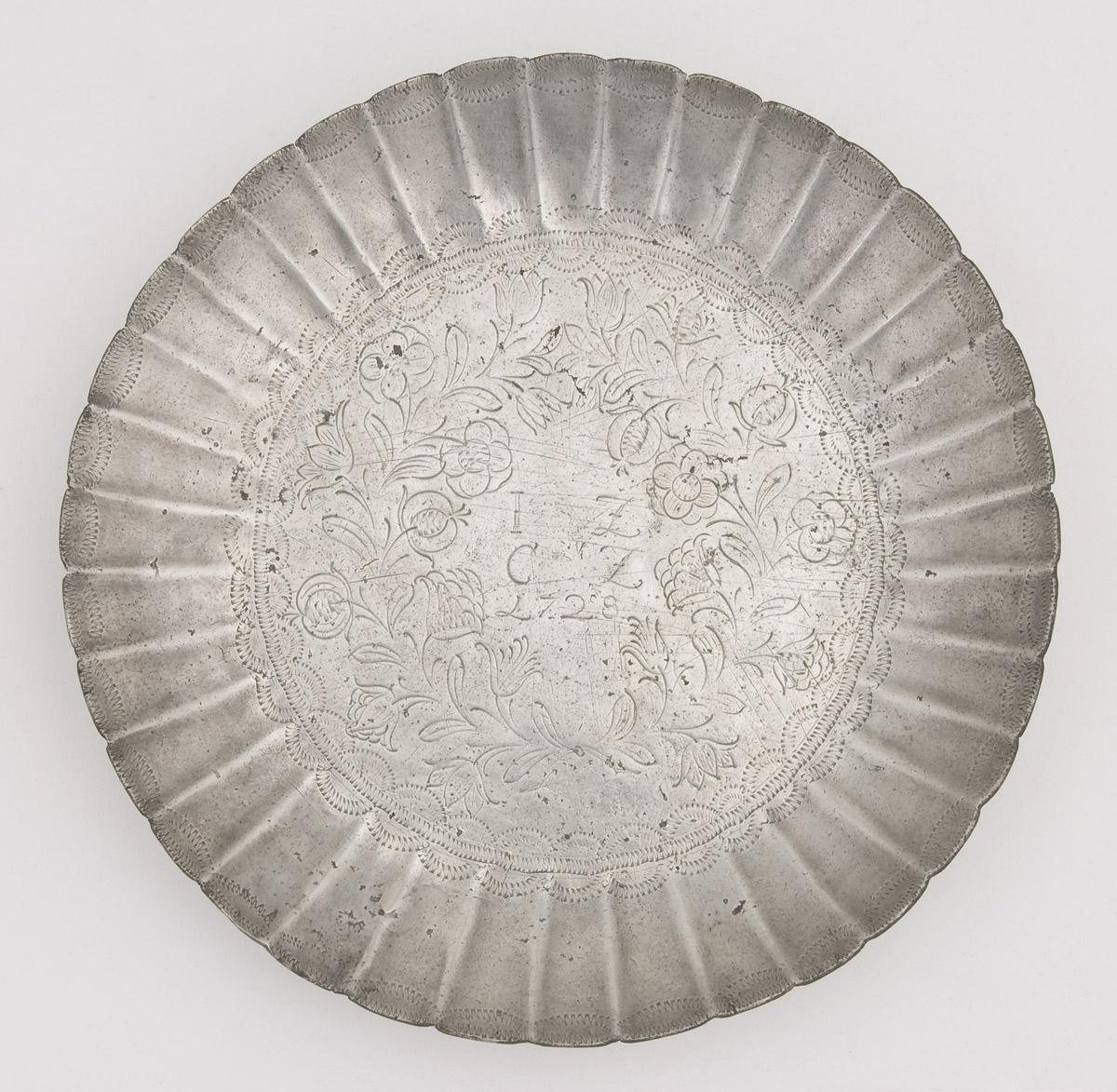
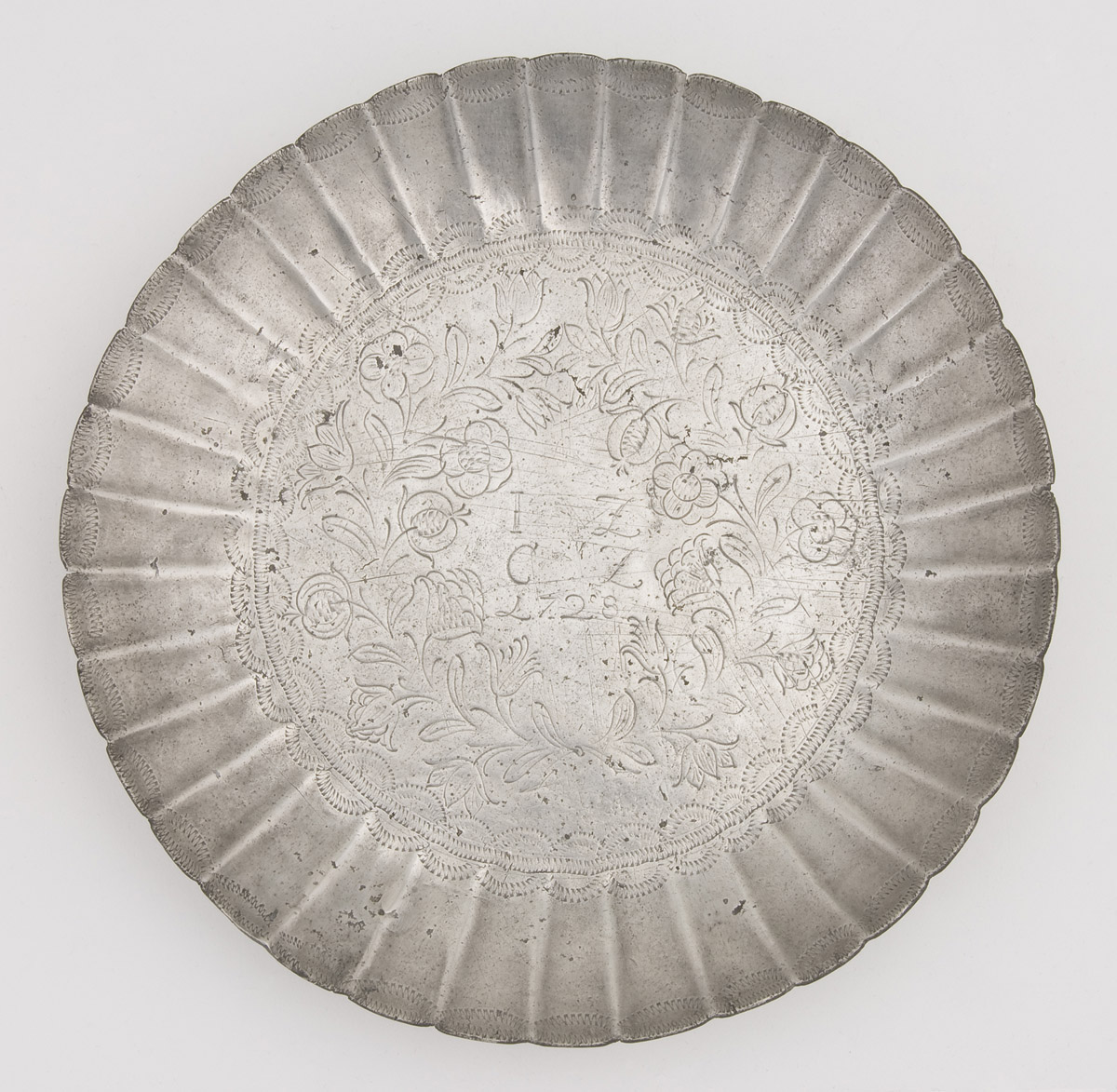
On Display: House - Hardenbergh Bedroom
Dish
1728 (1715-1730)
Description
This large dish's fluted form is known but not common in European and British pewter, and resembles the more plentiful scallop-edged, low "sallet" (salad), strawberry or sweetmeat dishes made of silver and imported Chinese porcelain during the first three decades of the 1700s. Surviving pewter in this form includes several Continental and English examples with Hebrew inscriptions and others bearing armorial devices in the center well. Only one other American fluted dish is known, dated 1732 with the mark of Francis Bassett I, now in the National Museum of American History (1986.0027). It is that similar, but not identical, dish that previous publications have cited to support an attribution of this 1728-dated dish to Francis Bassett I of New York. Exerting great visual appeal, the lushly engraved ornament is not at all typical in surviving examples of American pewter (and most often occurs on pewter with a religious use). The specialized form of the dish is slightly at odds with the rather less-refined style of engraved and chased ornament; the latter may support a possible attribution to a colonial American engraver. It is probable this is an English-made dish later engraved for a colonial American owner. The colonial-era ownership history is known: The initials belong to Joost Zabriskie/ Zaborowskij (1687-1756) and his wife Christina Casparus Mabie (d. 1733) of New York, who married on November 1, 1712 and settled in Hackensack, New Jersey. They had at least seven children: Machtelt, Casparus, Elizabeth, Fytje, Antje, Albert, and Rachel. Several of their children were baptised in the Dutch Reformed Church in Schraalenburgh, New Jersey. Their daughter Antje was born in 1728, but no other commemorative purpose for the date on the pewter dish is known. Joost was the son of Albrecht (Albert) Zaborowskij (Zabriskie) (1638-1711) of Insterburg, Prussia and Machitelt (Machtelt) Van Der Linde (1661-1725) of New York who settled im the Hackensack area and had at least five sons: Jacob, Jan, Joost, Christian and Hendrick. Joost was presumably named for his mother's father and his early colonial roots extend to a maternal grandmother, Sophie Roelof van Gelder, who was born in New York City in 1634. The Zabriskie family also owned an engraved pewter tankard (probably English) bearing the same initials and date, "J Z / C Z / 1728," and the inscription: "WHEN THIS YOU SEE REMEMBER ME". The maker of that tankard remains obscure, despite a partially legible [crowned rose] mark impressed on the interior. It was inherited by Joost's daughter Machtelt (b. 1715).
Category
Metals
Place of Origin
England or America; Europe
Materials
- pewter
Museum Object Number
2009.0020
Credit Line/Donor
Museum purchase with funds drawn from the Centenary Fund and provided by the Henry Francis du Pont Collectors Circle.
Share Object
Complete Details
Object Number
2009.0020
Object Name
Dish
Category
Metals
Place of Origin
England or America; Europe
Origin Notes
Origin likely England or New York.
Date
1728 (1715-1730)
Mark/Signature/Inscription/Label
Type: Mark
Location: Underside
Inscription: illegible oval outline with a triangular stem, nearly entirely effaced
Type: Inscription
Location: Interior, center
Inscription: "IZ / CZ / 1728" engraved
Mark/Signature: Yes
Materials
- pewter
Techniques
- Cast
- Hammered
- Engraved
Dimensions (inches)
8.75 (Diam)
Dimensions (centimeters)
22.225 (Diam)
Bibliography and Bibliographic Notes
Book: Laughlin, Ledlie Irwin. 1970 Pewter in America: Its Makers and Their Marks. I thru III.
• Published: fig. 691Book: Montgomery, Charles F. 1973 A History of American Pewter.
• Published: fig. 8-9, p. 142Article: Fennimore, Donald L. 04//1977 A True American Stuart Tankard -- Maybe. Pewter Collectors Club of America Bulletin. 7 (5)
• Published: fig. 12, p. 172Book: Blackburn, Roderic H. & Piwonka, Ruth. 1988 Remembrance of Patria: Dutch Arts and Culture in Colonial America, 1609-1776. 318 p.
• Related object,fig. 155, p. 157.Article: Deming, Oliver Wolcott. 01/01/1949 A Bassett Discovery: A Unique Piece of American Pewter. Antiques. 55 (1): 40-41.
• Related dish published: p. 40.Book: Thomas, John Carl. 197 American and British Pewter An Historical Survey.
• Reprint of 1949 Antiques, p. 96.