//
For internal use only
Not On Display
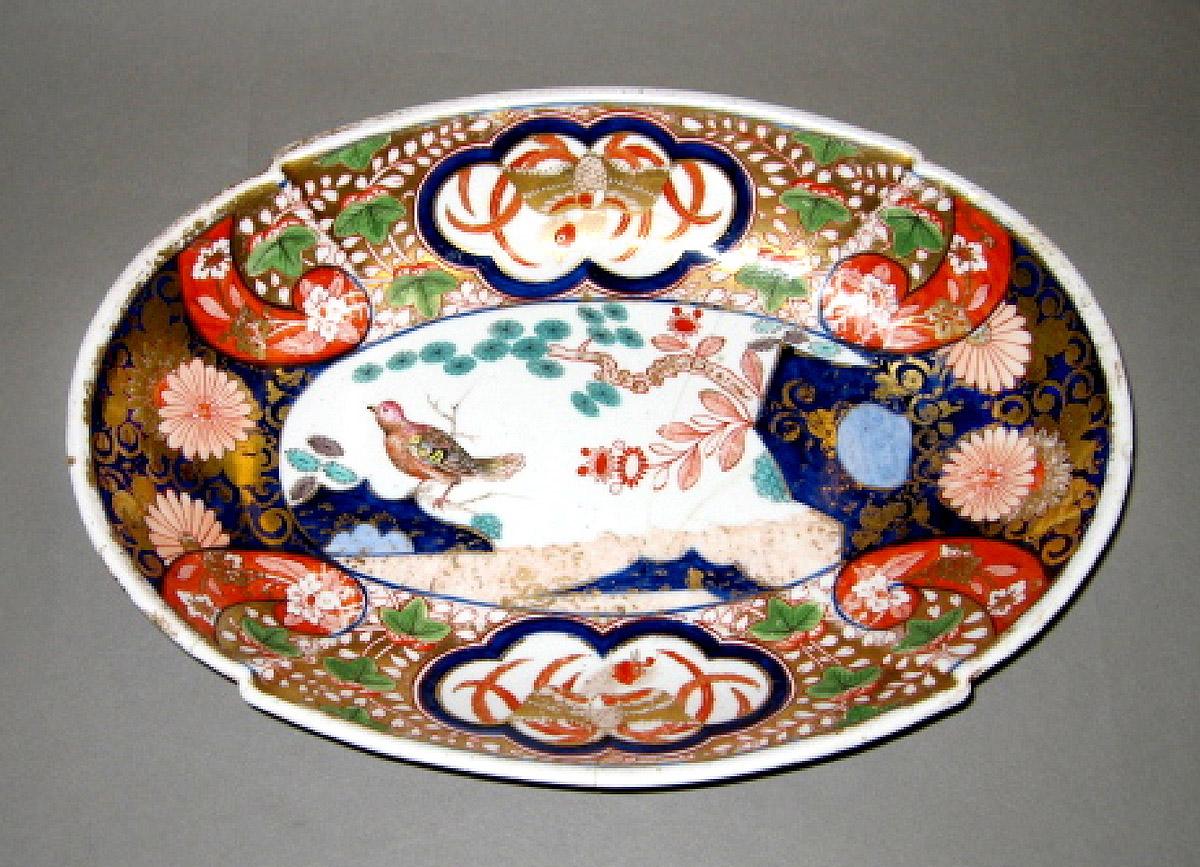
Dish
Spode factory
1808-1820
Category
Ceramics
Creator/Artist/Maker
Spode factory (Maker)
Place of Origin
Stoke-On-Trent; Staffordshire; England; United Kingdom; Europe
Materials
- Porcelain (soft paste, bone china)
- Lead glaze
Museum Object Number
2004.0058.003
Credit Line/Donor
Gift of Starr Moore
Share Object
Complete Details
Object Number
2004.0058.003
Object Name
Dish
Category
Ceramics
Creator (Role)
Spode factory (Maker)
Place of Origin
Stoke-On-Trent; Staffordshire; England; United Kingdom; Europe
Date
1808-1820
Mark/Signature/Inscription/Label
Type: Mark
Location: Underside
Inscription: "Spode No. 1291" is painted in iron- red
Mark/Signature: Yes
Materials
- Porcelain (soft paste, bone china)
- Lead glaze
Techniques
- Molded
- Painted
- Gilded
Dimensions (inches)
1.8 (H) x 7.4 (W) x 10.5 (L)
Dimensions (centimeters)
4.5 (H) x 18.7 (W) x 26.6 (L)
Bibliography and Bibliographic Notes
Book: Wilkinson, Vega. 2002 Spode-Copeland-Spode: The Works and its People 1770- 1970.
• Spode mark dated as around 1800-20: p. 280, "1291" pattern date listed as first used 1808-9: p. 282Book: Ayers, John, et al. 1990 Porcelain for Palaces: The Fashion for Japan in Europe.
• Meissen dish as prototype for border and central reserve designs: p. 268, no. 307, c. 1740, noting direct imitation of Japanese Imari dish. Crossed swords and "K" underglaze blue mark.Book: Ayers, John, et al. 1990 Porcelain for Palaces: The Fashion for Japan in Europe.
• Japanese porcelain dish as prototype for border and central reserve designs: p. 224, no. 237, 1710-30Book: Emerson, Julie, et al. 2000 Porcelain Stories: From China to Europe.
• Late 17th century Imari (Arita) porcelain dish painted in similar style: p. 180, pl. 12.29, showing inspiration for Winterthur dish style gilding, scrolls, etc.Book: Pietsch, Ulrich. 2011 Early Meissen Porcelain: The Wark Collection from the Cummer Museum of Art & Gardens.
• Two dining plates and oval dish bearing very similar style ornament: pp. 322-23, nos. 347-48, c. 1740, noting similar wares made in faience at Warsaw factory.Book: Cummer Gallery of Art. 1984 The Wark Collection of Early Meissen Porcelain.
• Meissen dish as prototype for border and central reserve designs: p. 272, no. 689, blue crossed-swords and impressed 26 marks, c. 1740.Book: Castelluccio, Stephanie. 2013 Collecting Chinese and Japanese Porcelain in Pre-Revolutionary Paris.
• Discussion of Japanese kakiemon-style enameled decoration: pp. 76-85