//
For internal use only
On Display: House - Shipley Room
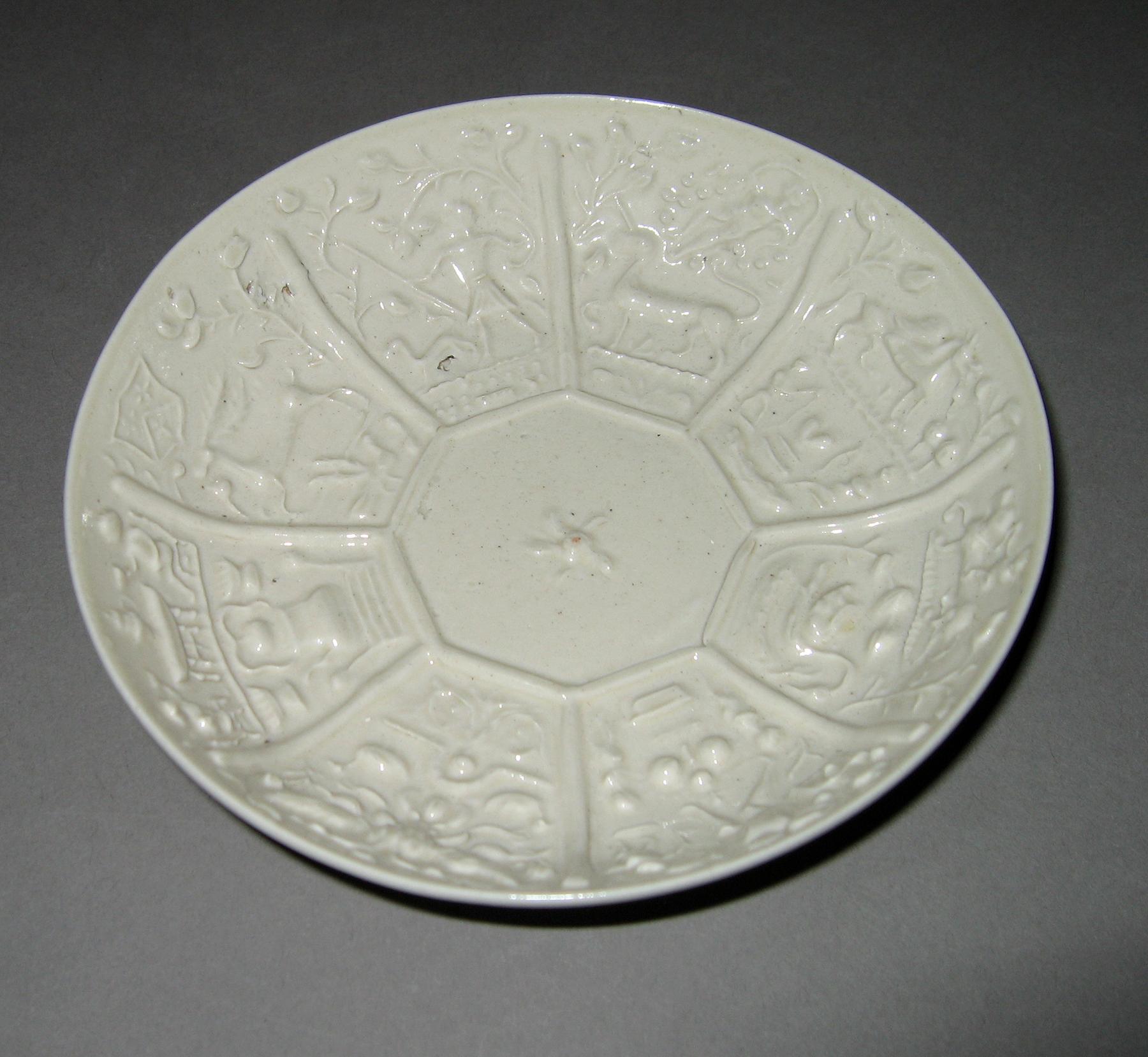
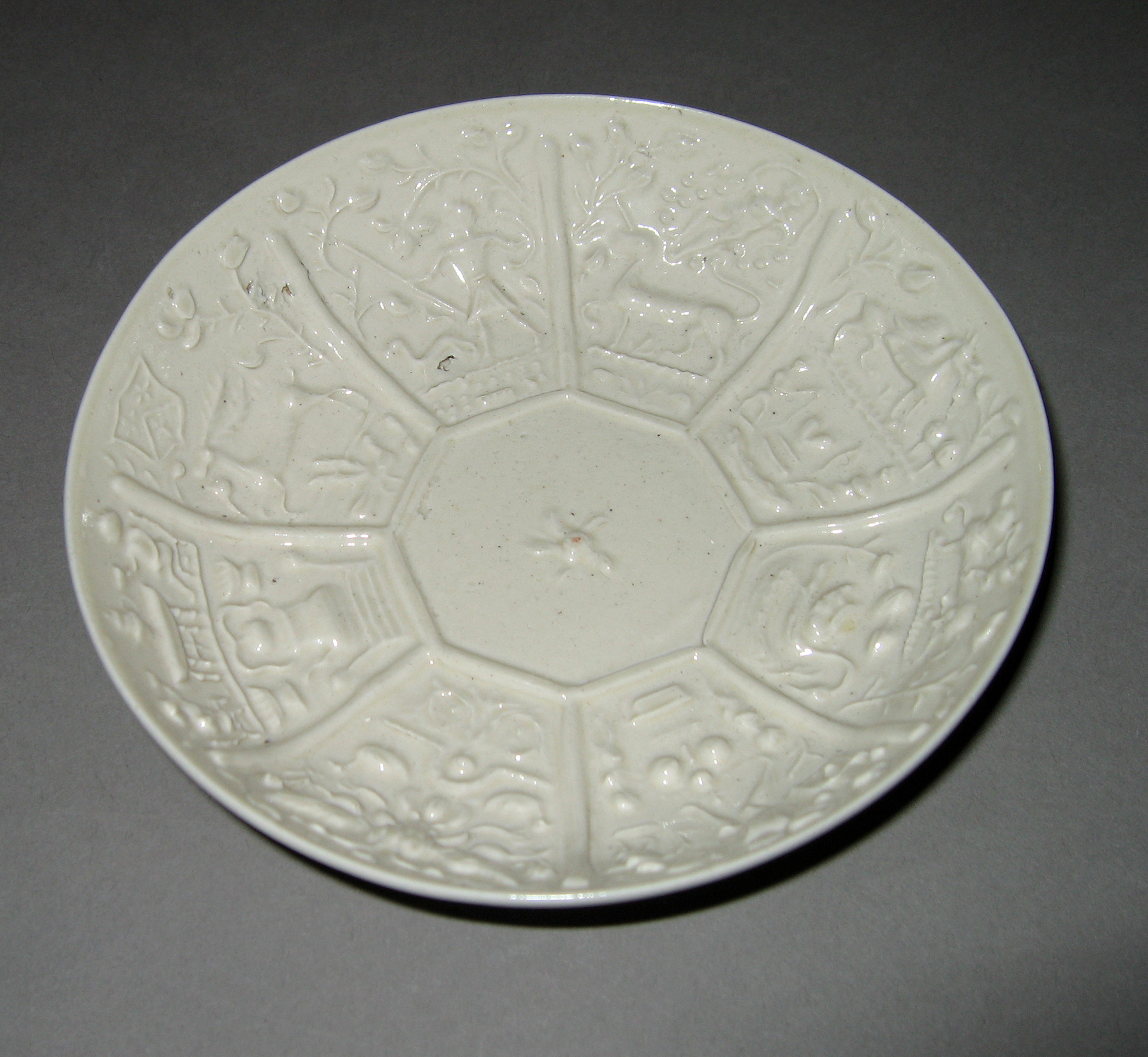
Saucer
1740-1750
Description
This object fits into a large group of salt-glazed white stoneware created in Staffordshire, England, during the mid 1700s. Commonly in coffee- and teaware forms, such ceramics were created by slip-casting into molds that allowed for wonderful, typically vertically-oriented panels filled with allegorical themes in relief. Although numerous factories created such objects, the design themes often were repeated, though not necessarily in the same order. On such ceramics, simplified imagery often is drawn from Aesop’s Fables (such as a scene from “The Fox and the Crane [or Stork]”), biblical references (such as to Samson), and traditional English tales (“Darby and Joan”). Symbolic imagery is exemplified by two-headed eagles (representing the Holy Roman or Prussian empires). A reclining nude “virgin” near a unicorn is a medieval and later reference to innocence. Cupid astride a lion represents Love taming the Savage Beast. Based on archaeological evidence, English wares of this type made their way across the Atlantic to colonial America. A so-ornamented fragmentary coffee or chocolate cup was excavated at Mount Vernon and probably was owned by George Washington’s half-brother Lawrence, before George took over the property. Other archaeological evidence was unearthed at the Anderson site in Williamsburg, Virginia and at Fort Frederick in Maine. For Winterthur salt-glazed stoneware beverage-related forms featuring many of the same allegorical motifs in relief, see 1958.0873-1958.0885, 1970.0424, 1992.0120, and 2024.0014.060.
Category
Ceramics
Place of Origin
Staffordshire; England; United Kingdom; Europe
Materials
- Stoneware (salt-glazed)
- Salt glaze
Museum Object Number
1958.0879
Credit Line/Donor
Bequest of Henry Francis du Pont
Share Object
Complete Details
Object Number
1958.0879
Object Name
Saucer
Category
Ceramics
Place of Origin
Staffordshire; England; United Kingdom; Europe
Date
1740-1750
Subject(s)
- Fable
- Armorial device
- Eagle
- Morality
- Literary scene
- Literature
- Aesop
- Aesop's Fable
- Biblical scene
- Bible
Materials
- Stoneware (salt-glazed)
- Salt glaze
Techniques
- Molded
Dimensions (inches)
1.25 (H) x 4.75 (Diam)
Dimensions (centimeters)
3.18 (H) x 12.065 (Diam)
Bibliography and Bibliographic Notes
Book: Edwards, Diana & Hampson, Rodney. 2005 White Salt-glazed Stoneware of the British Isles.
• Published: p. 51, col. pl. 32, Shipley Room table setting photoBook: Luxmoore, Chas. F. C. 1924 English Saltglazed Earthenware.
• Blocks for similarly patterned teabowl (pl. 45), sugar bowl lid (pl. 47), teapot (pl. 48), flask (pl. 51), bowl and cover (pl. 53), teabowl (pl. 63), and coffee cup (pl. 76).Book: Grigsby, Leslie B. 1990 The Henry H. Weldon Collection: English Pottery, Stoneware and Earthenware 1650-1800.
• For same general type of ornament, see p. 86 (no. 20 a-d)Book: Mountford, Arnold R. 1971 The Illustrated Guide to Staffordshire Salt-Glazed Stoneware.
• For saucer block with same general type of ornament, see nos. 96-99.Article: Grigsby, Leslie B. 06//1994 Aesop's Fables on English Ceramics. Antiques. CXLV (6): 867-877.
• For related fables as inspiration.Book: Skerry, Janine E. & Hood, Suzanne Findlen. 2009 Salt-Glazed Stoneware in Early America.
• Salt-glazed white stoneware alleghorical wares (with Aesop's Fables) in America: see pp. 117-19, no. 28, including archaeological references.Book: Grigsby, Leslie B. 1990 The Henry H. Weldon Collection: English Pottery, Stoneware and Earthenware 1650-1800.
• Salt-glazed stoneware coffeecup, teabowl and jug with related allegorical scenes: pp. 86-87, no. 20 a-d, Staffordshire, c. 1745