//
For internal use only
On Display: Galleries
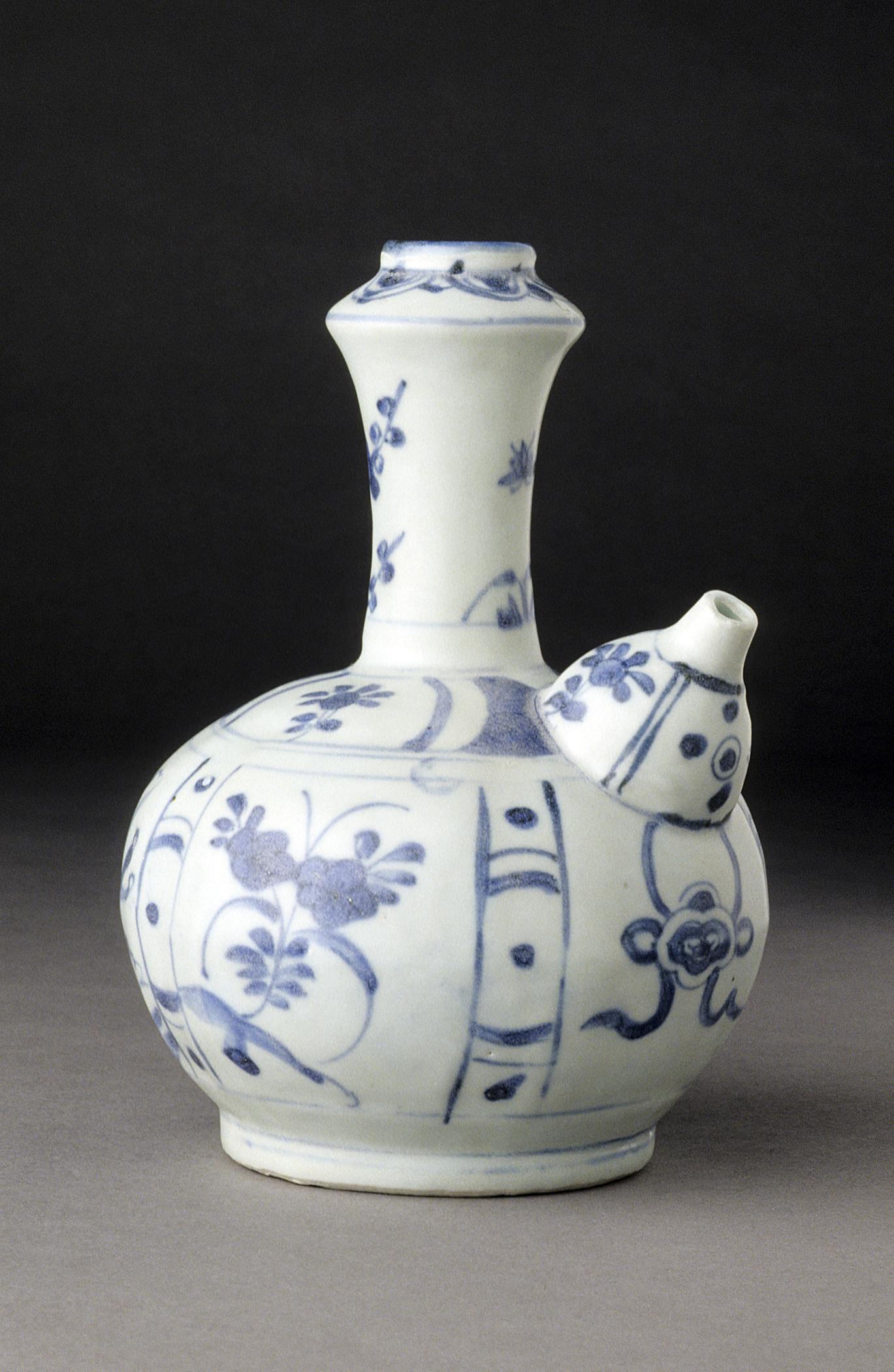
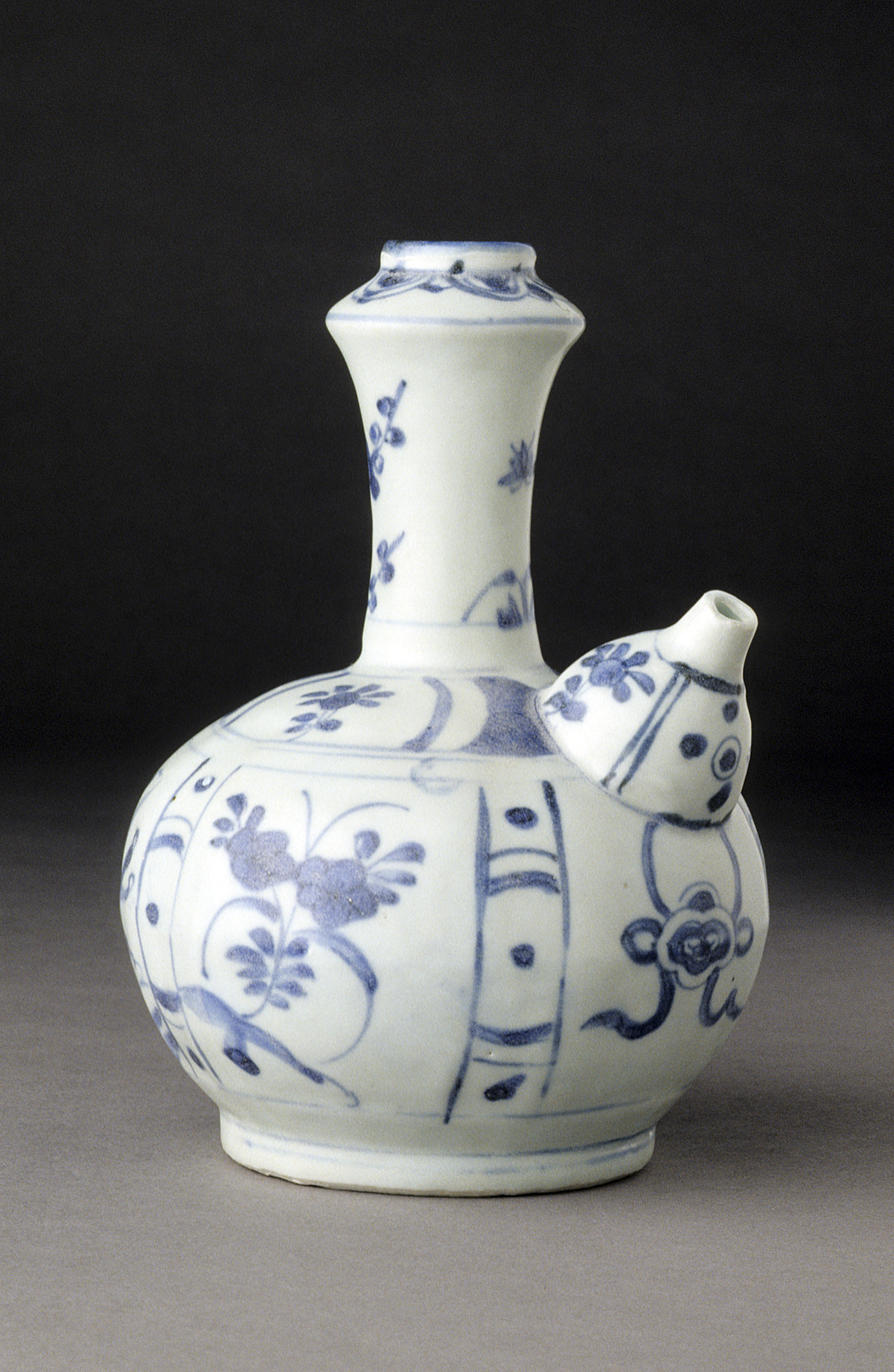
Kendi (Bottle or jug)
1635-1645
Category
Ceramics
Place of Origin
Jingdezhen; China; Asia
Materials
- Porcelain (hard-paste)
- Lime (alkaline) glaze
Museum Object Number
2000.0061.076
Credit Line/Donor
Gift of Leo A. and Doris C. Hodroff
Share Object
Complete Details
Object Number
2000.0061.076
Object Name
Kendi (Bottle or jug)
Category
Ceramics
Place of Origin
Jingdezhen; China; Asia
Date
1635-1645
Mark/Signature/Inscription/Label
Type: Label
Location: Underside
Inscription: Blue, rounded rectangular paper label with "75" in white lettering
Type: Label
Location: Underside
Inscription: White, rectangular paper label with "THE/ HATCHER/ COLLECTION/ Axel/ Vervoordt" in black print
Type: Label
Location: Underside
Inscription: White, rectangular paper label with "TEA KENDIS- 8" HT./ CHINESE PORC. SQUAT/ BODY- BULBOUS SPOUT/ PAINT W/FLYING HORSES/ "HATCHER" "KRAAK/ CIRCA 1640 1424" handwritten in black and red ink
Mark/Signature: No
Subject(s)
- Religion associated
- Muslim religion
Materials
- Porcelain (hard-paste)
- Lime (alkaline) glaze
Techniques
- Molded
- Painted
Dimensions (inches)
7.756 (H) x 5.748 (L) x 5.591 (Diam)
Dimensions (centimeters)
19.7 (H) x 14.6 (L) x 14.2 (Diam)
Measurement Notes
The length measurement is the diameter plus the spout.
Bibliography and Bibliographic Notes
Chapter: Grigsby, Leslie B. The Kendi as a Source of Worldwide Fascination. Book: Aronson Antiquairs of Amsterdam & Aronson Antiquairs of Amsterdam. 09//2021 140th Anniversary Publication, Delftware, Collections, Volume II; Dining à la Française, Asian Influences & Interior Decorations. II. 38-39.
• Published: p. 38, fig. 1Electronic: Grigsby, Leslie B. 11/07/2022 The Kendi as a Source of Worldwide Fascination. Aronson Antiquairs of Amsterdam 08/08/2023 https://www.aronson.com/the-kendi-as-a-source-of-worldwide-fascination/
• Published: Digital version of above article.Book: Howard, David Sanctuary. 1994 The Choice of the Private Trader: The Private Market in Chinese Export Porcelain Illustrated from the Hodroff Collection.
• Published: p. 203, fig. 236, c. 1640.Book: Welsh, Jorge. 2008 Kraak Porcelain: The Rise of Global Trade in the late 16th and early 17th Centuries.
• Two kendis resembling Winterthur's in form: pp. 204-7, no. 32, Ming dynasty, Chongzhen period (1628-44), noting this is most common form. Discusses shipwreck finds from San Diego (1600), Witte Leeuw (1613), Wanli (1625), and Hatcher (c. 1643).Book: Rinaldi, Maura. 1989 Kraak Porcelain: A Moment in the History of Trade.
• Kendi form, evolution over time, c. 1590-1645: p. 166, an p. 175, pl. 223 (left) for c. 1640-45 example much like 2000.61.76 in form (somewhat similar style, different details to decoration).Book: Welsh, Jorge. 2008 Kraak Porcelain: The Rise of Global Trade in the late 16th and early 17th Centuries.
• Kendis and history details: pp. 180-207 passim, illustration of similar form in cat. no. 32, pp. 204-207.Book: Welsh, Jorge. 2008 Kraak Porcelain: The Rise of Global Trade in the late 16th and early 17th Centuries.
• Kendi of somewhat similar form, differently decorated: pp. 248-51, no. 42Book: Sargent, William R. 2012 Treasures of Chinese Export Ceramics at the Peabody Essex Museum.
• Similar form kendi with different decoration on p. 88, cat. no. 19.Book: Sargent, William R. 2014 Chinese Porcelain in the Conde Collection.
• Different model underglaze blue-painted pair of kendi: p. 69, no. 5, noting "kendi" comes from Sanskrit "kundika" refering to an Indian ritual bottle, a type known as early as the 3rd century BC. Kendi primarily used for drinking water.