//
For internal use only
On Display: House - Architects Room
Sector (Ruler)
Michael Butterfield
1670-1700
Description
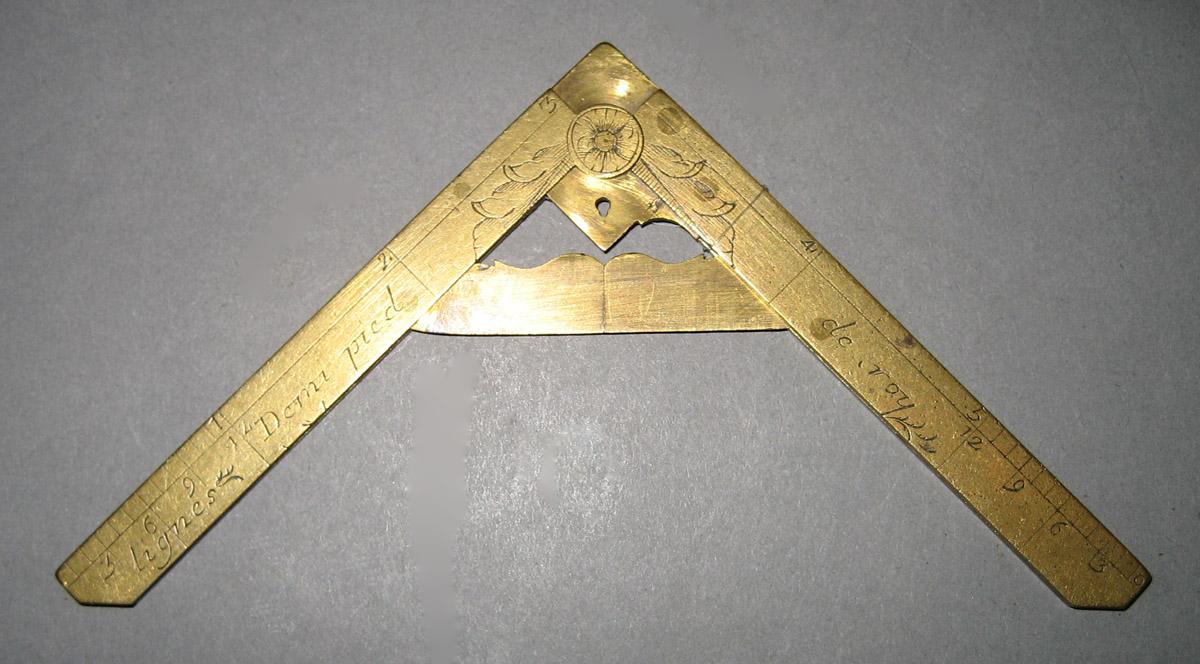
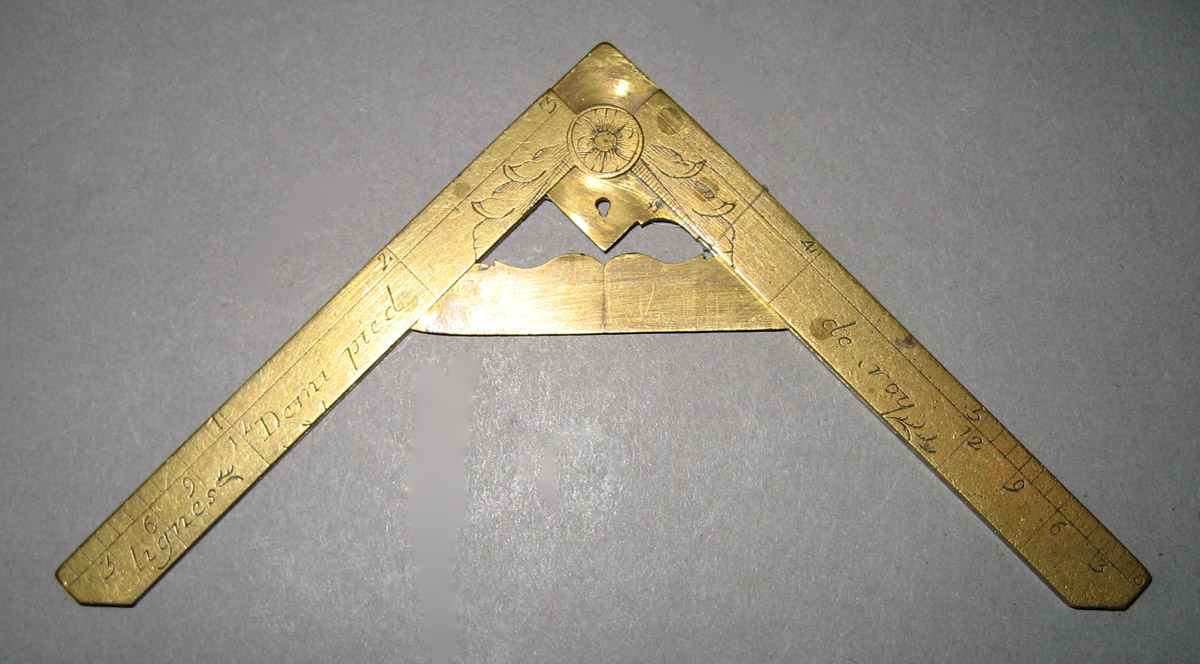
This folding brass instrument is a sector with two flat arms made from two layers of riveted sheet metal joined at one end on a pivot hinge that allows them to open and extend flat or to be fixed at 90-degrees with a pivoting inset crossarm affixed inside one arm. The tips of the arms are angled at the corners, allowing it to stand vertically when opened to 90-degrees so that the drilled hole in the hinge plate may function as a level with gravity, a thread, and a plumb bob. The cross arm has a scalloped edge and is engraved with a center line to index the plumb bob line. The upper surface of this sector is engraved to function as a measured rule with a scale of inches from one to six, three on each arm and with gradations of 12 engraved within inches one and six. The pivot hinge has a circular ornament engraved as a rose with leafy designs flowing into the inner edge of the arms on both surfaces. The ruled surface is engraved in script with the inscription "lignes Demi pied de roy" on one arm and "de roy" on the other. This inscription indicates the tool is lined to one-half of the royal foot, one of many concurrent French units of measurement. The unruled surface is engraved in script with a maker's name "Butterfield" on one arm and "a Paris" on the other. Michael Butterfield was an acclaimed English instrument maker working in Paris from about 1670-1700. Folding rules or sectors of this size with the plumb bob level feature were often included within pocket cases enclosing sets of scientific equipment or drawing tools used by architects, navigators, engineers, and surveyors among others.
Category
Clocks, Watches, and Scientific Instruments
Creator/Artist/Maker
Michael Butterfield (Maker)
Place of Origin
Paris; France; Europe
Materials
- Brass
Museum Object Number
1998.0002
Credit Line/Donor
Gift of Dwight and Lorri Lanmon
Share Object
Complete Details
Object Number
1998.0002
Object Name
Sector (Ruler)
Category
Clocks, Watches, and Scientific Instruments
Creator (Role)
Michael Butterfield (Maker)
Place of Origin
Paris; France; Europe
Date
1670-1700
Mark/Signature/Inscription/Label
Type: Signature
Location: Surface, unruled side
Inscription: "Butterfield / a Paris" engraved in script
Type: Inscription
Location: Surface, ruled side
Inscription: "lignes Demi pied de roy" engraved in script
Mark/Signature: Yes
Subject(s)
- Science
Materials
- Brass
Techniques
- Engraved
Dimensions (inches)
1.575 (W) x 0.75 (D) x 6.417 (L)
Dimensions (centimeters)
4 (W) x 1.905 (D) x 16.3 (L)