//
For internal use only
On Display: House - Georgia Dining Room
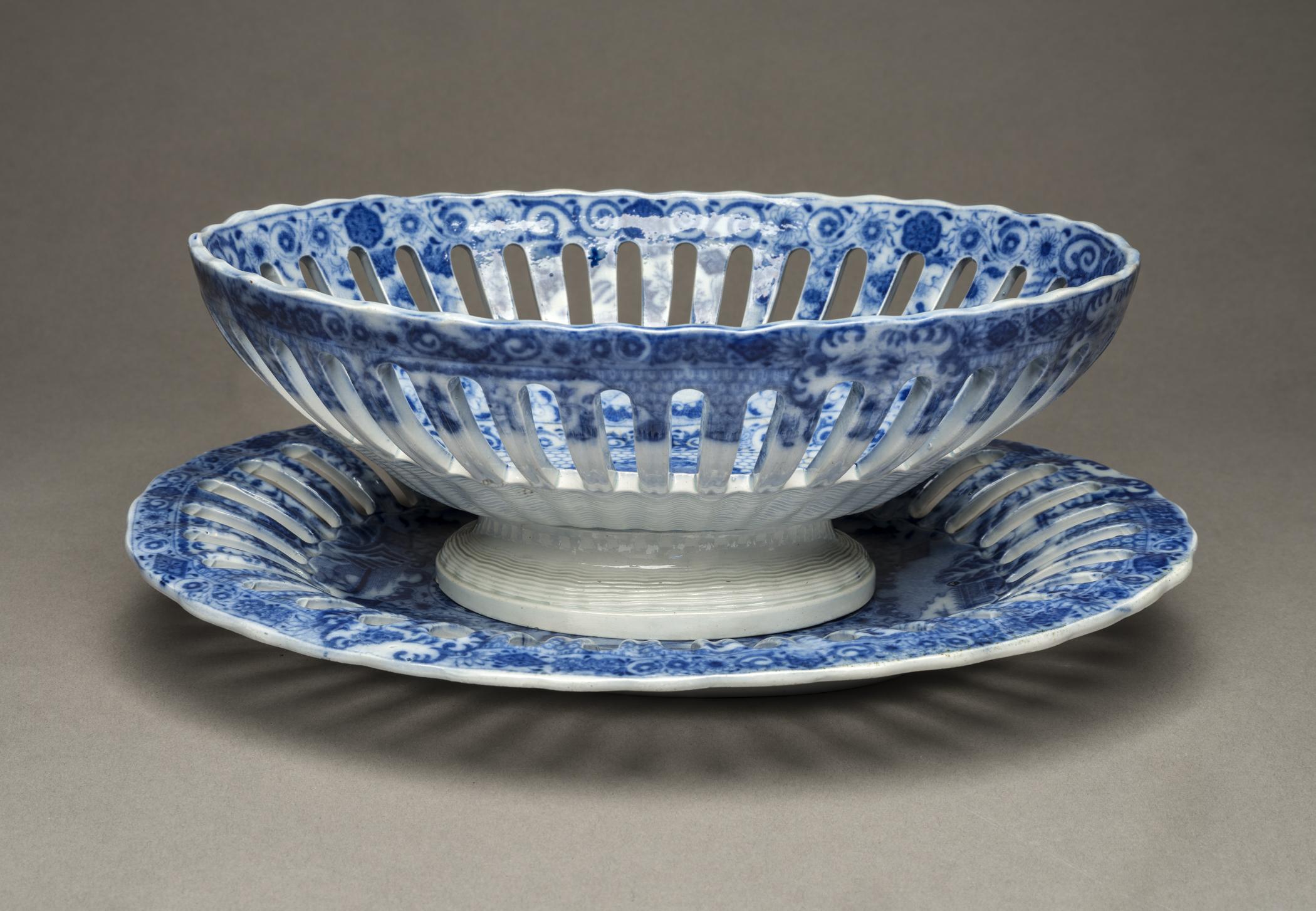
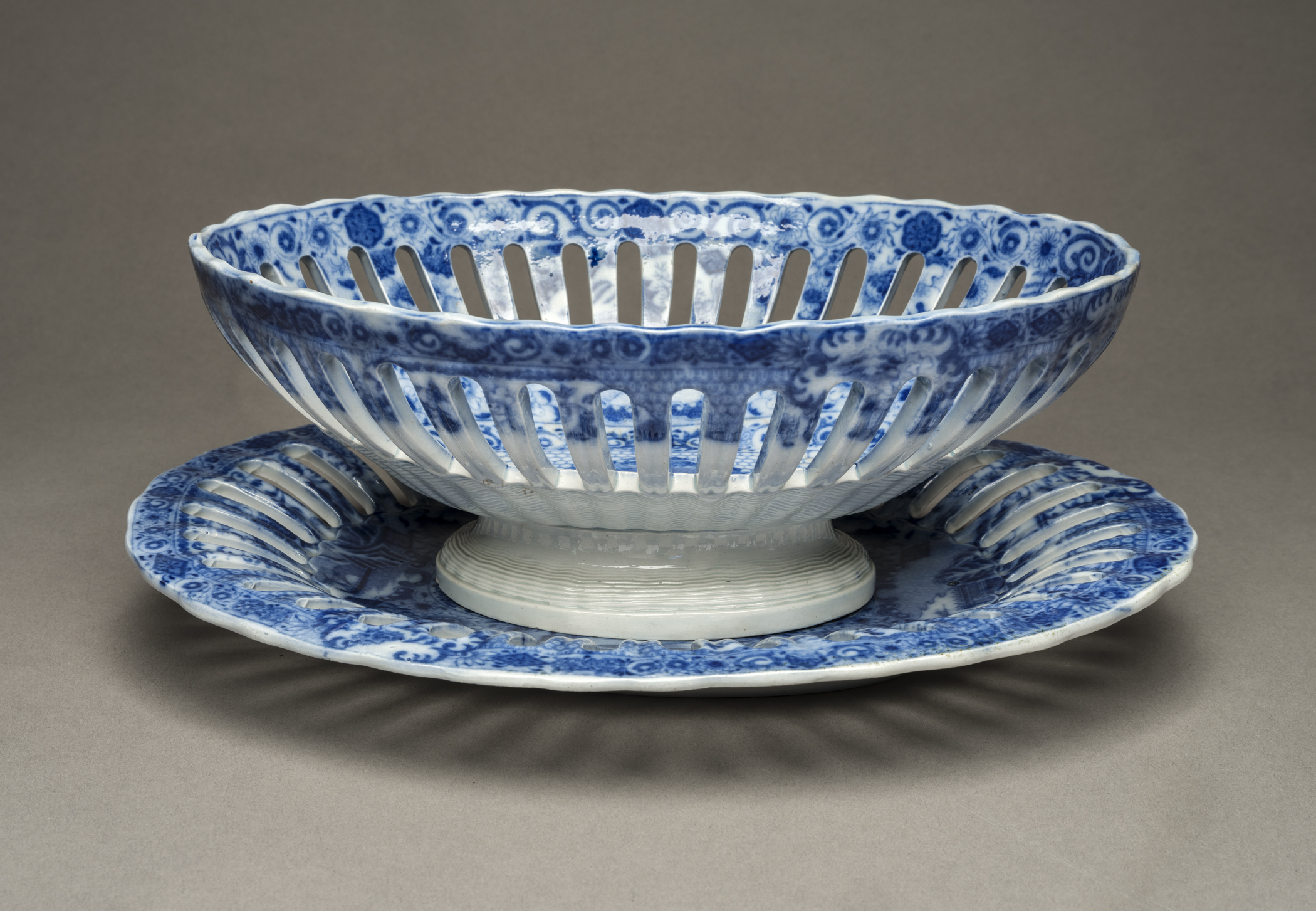
Fruit or chestnut basket and stand
Net Pattern
Herculaneum Factory
1809-1820
Description
Pierced "baskets" including the example shown here, would have been appropriate for use during the second course of a dinner--which often included sweet dishes and/or fruit and nuts--or at the dessert course. Objects of this type were produced in nearly all types of refined ceramics, whether earthenware, stoneware or porcelain. As well as in Britain, such wares were made in Continental Europe and Asia. In terms of its printed ornament, variations on the "Net Pattern," featuring netted grounds as well as floral motifs, chinoiserie pavilions-in-landscapes reserves and floral borders were made at several factories in England. In Staffordshire, the Spode, Job Ridgeway, John and William Ridgeway, John Denton Bagster (or Baxter), and other factories created versions of the design. Factories in Liverpool, Lancashire, also created Net Patterns, including at the Seacombe and Herculaneum potteries. The example shown here is from Herclaneum and features the impressed mark of that factory. (Winterthur is grateful to The Transferware Collectors Club for research support provided by the Paul and Gladys Richards Research Grant Program for Studies in British Transferware.)
Category
Ceramics
Creator/Artist/Maker
Herculaneum Factory (Maker)
Place of Origin
Liverpool; Lancashire; England; United Kingdom; Europe
Materials
- Earthenware (pearlware)
- Lead glaze
Museum Object Number
1996.0027.009.001 A, B
Credit Line/Donor
Gift of Mr. and Mrs. John A. Herdeg in memory of Donald Fell & Louise Coolidge Carpenter and Marcus Allen & Ethel Warren Coolidge
Share Object
Complete Details
Object Number
1996.0027.009.001 A, B
Object Name
Fruit or chestnut basket and stand
Title
Net Pattern
Category
Ceramics
Creator (Role)
Herculaneum Factory (Maker)
Place of Origin
Liverpool; Lancashire; England; United Kingdom; Europe
Date
1809-1820
Mark/Signature/Inscription/Label
Type: Mark
Location: Underside
Inscription: Impressed "HERCULANEUM."
Type: Inscription
Location: Underside
Inscription: "H1304" is written in black ink
Type: Inscription
Location: Underside
Inscription: "837" is painted in red
Type: Mark
Location: Underside of basket
Inscription: Impressed "HERCULANEUM/ 11"
Type: Inscription
Location: Underside
Inscription: "H1303" is written in black
Type: Inscription
Location: Underside
Inscription: "837" is painted in red
Mark/Signature: Yes
Materials
- Earthenware (pearlware)
- Lead glaze
Techniques
- Molded
- Printed
Dimensions (inches)
1.22 (H) x 8.071 (W) x 10.472 (L)
Dimensions (centimeters)
3.1 (H) x 20.5 (W) x 26.6 (L)
Measurement Notes
Above measurements are for stand only.
Basket measurements:
H- 3.5"
L- 9.35"
W- 6.614"
Bibliography and Bibliographic Notes
Book: Coysh, A. W. 1970 Blue and White Transfer Ware 1780-1840.
• Description of the "Net" pattern: pp.82-83Book: Coysh, A. W. & Henrywood, R. K. 1982 The Dictionary of Blue and White Printed Pottery 1780-1880. 1.
• Description of the "Net" pattern: p. 259Book: Drakard, David & Holdway, Paul. 2002 Spode Transfer Printed Ware 1784-1833.
• Same impressed mark: p. 319, mark 1, noting several sizes of same mark, 1785-90.Electronic: Transferware Collectors Club. Transferware Collectors Club Database of Patterns & Sources. Transferware Collectors Club 03/13/2024 https://www.transferwarecollectorsclub.org/members/database
• Spode "Net" Pattern: pattern title listed as Net (Alternate name: Net pattern), pattern no. 128. Spode, 1770-1833, Stoke-on-Trent, Staffordshire, England.Electronic: Transferware Collectors Club. Transferware Collectors Club Database of Patterns & Sources. Transferware Collectors Club 03/13/2024 https://www.transferwarecollectorsclub.org/members/database
• Net pattern wares from several identified factories: also listing versions from unidentified factories, the database includes examples from Job Ridgway (no. 11001), Spode (no. 128), John Denton Bagster (or Baxter, no. 16315), John & William Ridgway (no. 16316), and Herculaneum (no. 9849).