//
For internal use only
On Display: Galleries
Tureen
Ignaz Sebastian Wurth
1780-1781
Description
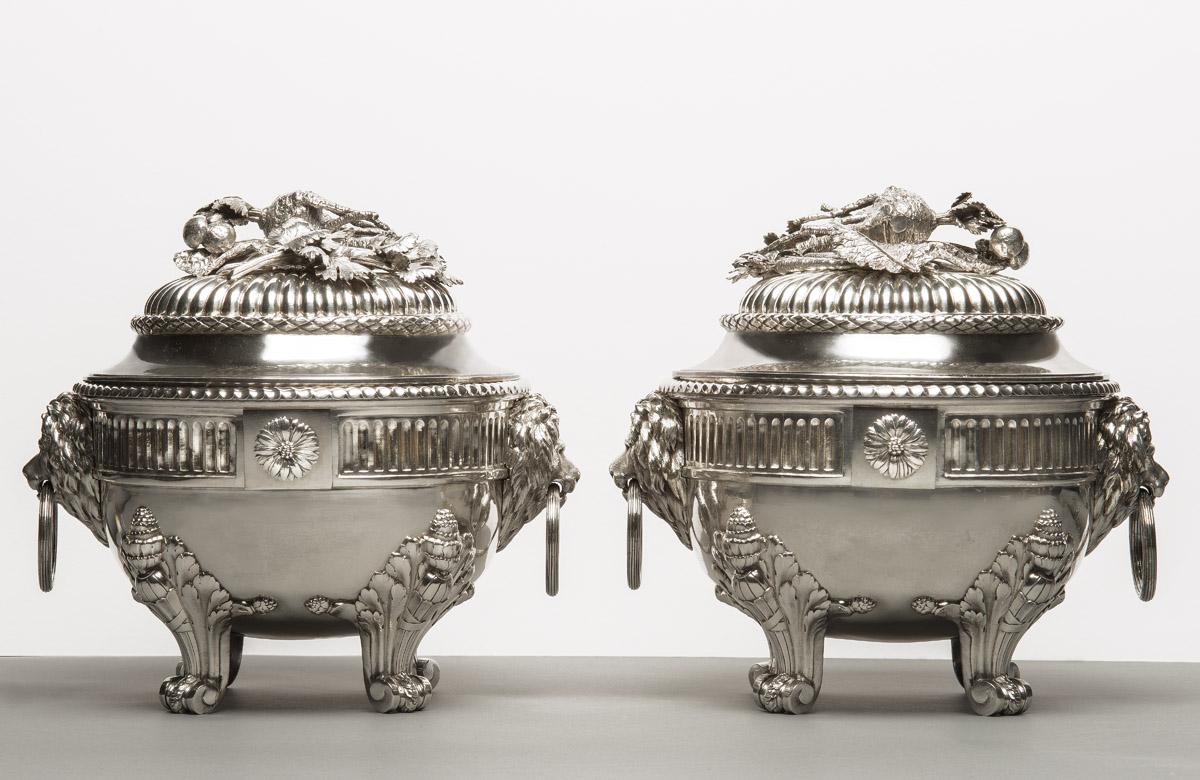
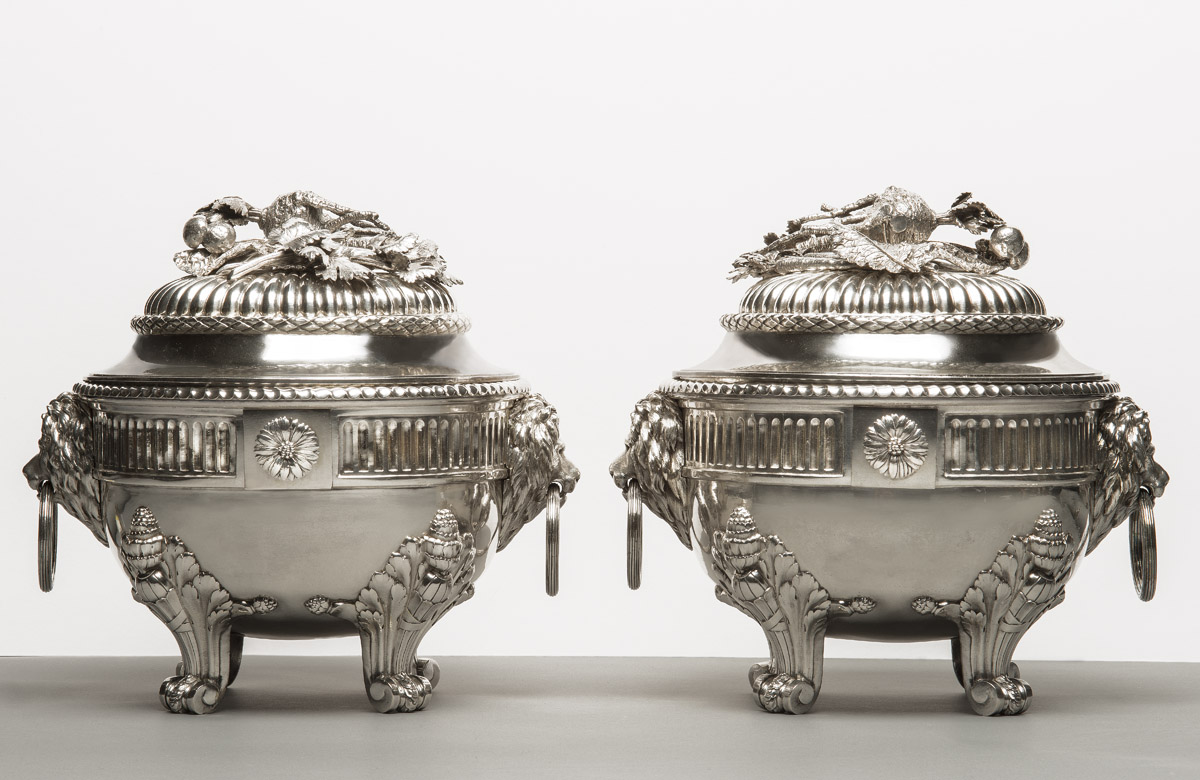
This round tureen and a second similar one were previously attributed to Johann Sebastian Würth, but the maker's mark represents Ignaz Sebastian Würth (1746-1834) a gold and silversmith active from 1769 until about 1815. His father, goldsmith Franz Xaver Caspar Würth, brothers Johann Nepomuk Würth and Franz Xaver Würth, and cousin Ignaz Joseph Würth all worked in metals trades in Vienna. Ignaz Sebastian Würth made items for the Austro-Hungarian court including several commissions for members of Empress Maria Theresa's family and a splendid dinner service for the Esterhazy family beginning in 1791. A few years later he contributed silver items to expand the Hanover table service originally made for King George III by Robert-Joseph Auguste's workshop. In 1809 Würth ceded his workshop to his son Franz, formally relinquishing his license by 1815. He was elevated to hereditary nobility by the Austrian emperor in 1827. The two tureens once were part of a sizable aristocratic table service. They originally had interior liners to hold the hot stew or pot-a-oille contents and were placed upon circular silver stands (présentoir), now missing. The naturalistic vegetables grouped on the lid, the lion ring handles, and rosettes on each side are fastened in place with threaded posts. The tureens' overall style is conservative, reminiscent of mid-1700s Parisian silver, with ornaments probably cast from molds shared amongst the Würth family workshops. Surprisingly, although each tureen and lid is engraved simply with an inventory number (I or II) there are no armorial devices or owners' names visible. Both bear the Viennese hallmark for 81.25 % standard purity and the year 1781. It is nearly certain that these tureens were first commissioned for the Duke of Saxe-Altenburg (via Hildburghausen). The Dukes of Saxe-Altenburg kept a palatial Residence in Altenburg, Germany. Household inventories of the family's silver chamber record in 1782 and again in 1836 an extensive Viennese silver table service with items that featured artichoke lid ornaments and included two round tureens and four oval tureens with interior liners and stands. In 1910 an Austrian publication pictured one large oval tureen with an artichoke finial on an oval stand described as from the treasury in the Residence palace in Altenburg. Subsequent scholarship regarding Würth's round tureens, including Winterthur publications, has mis-associated them with the more illustrious Albertine branch of the Sachsen-Teschen family. There is no evidence of intermarriage or inheritance of silver between these branches of the families. The table service remained within the household of Ernst II, Duke of Saxe-Altenburg until after the First World War. In 1966 the Campbell Museum acquired these tureens from Parisian antiques dealer Jacques Kugel, which may account for the French import marks stamped on the handles. Kugel identified the previous owner as the family of Charles, Prince Radziwill (1886-1968) of Poland, but this is not yet confirmed. In 1996 the Campbell Museum transferred by gift their significant collection of tureens and soup related items to Winterthur Museum.
Category
Metals
Creator/Artist/Maker
Ignaz Sebastian Wurth (Maker)
Place of Origin
Vienna; Austria; Europe
Materials
- Silver
Museum Object Number
1996.0004.230.001 A, B
Credit Line/Donor
Campbell Collection of Soup Tureens at Winterthur
Share Object
Complete Details
Object Number
1996.0004.230.001 A, B
Object Name
Tureen
Category
Metals - Campbell Collection
Creator (Role)
Ignaz Sebastian Wurth (Maker)
Place of Origin
Vienna; Austria; Europe
Date
1780-1781
Mark/Signature/Inscription/Label
Type: Mark
Location: Tureen, underside
Inscription: "IS / W" in an oval, stamped
Type: Mark
Location: Tureen, underside
Inscription: Pictorial mark with "13" over a cross enclosed by a circle flanked by "17/81", stamped
Type: Mark
Location: Tureen body, side on backplate
Inscription: Swan, facing left in an oval, stamped
Type: Mark
Location: Tureen, foot
Inscription: Swan, facing left in an oval, stamped
Type: Mark
Location: Tureen, lion handle ring, underside
Inscription: Swan, facing left in an oval, stamped
Type: Mark
Location: Tureen, lion handle ring, underside
Inscription: Swan, facing left in an oval, stamped
Type: Mark
Location: Tureen, lion handle ring, surface
Inscription: Insect (partial) bigorne, stamped
Type: Mark
Location: Lid, bezel exterior
Inscription: Swan, facing left in an oval, stamped
Type: Mark
Location: Lid, underside edge
Inscription: Triangular ridged bigorne, stamped
Type: Inscription
Location: Lid, underside
Inscription: "I" engraved
Type: Inscription
Location: Lid, underside
Inscription: "11 / 7" engraved
Mark/Signature: Yes
Materials
- Silver
Techniques
- Wrought
- Cast
Dimensions (inches)
12 (H) x 13.125 (L) x 10.875 (Diam)
Dimensions (centimeters)
30.48 (H) x 33.338 (L) x 27.623 (Diam)
Dimensions (oz)
174.1
Measurement Notes
XRF alloy testing indicates the tureen and lid have apparent silver content ranging from 90.1% to 97.6%, averaging between 94-95%, possibly as a result of pickling and cleaning. The Viennese silver standard of the late 1700s was 81.25%.
Height of body: 19.4 cm; Diameter of body at opening: 25.4 cm. Overall weight recorded in 2000: 174 oz. 10 dwt. troy. Weight of lid alone: 50 oz. 9 dwt. 17 gr. troy or 60 7/8 oz (AVP). Weights were measured again on May 3, 2013 by Ann Wagner using a Cuisinart scale from the Textiles Conservation lab: Tureen .001 body = 8.3 lbs AVP and lid 3.9 lbs AVP; total = 12.2 lbs. AVP (5,534 grams or 177.9 oz. troy.). Tureen .002 body = 8.4 lbs. AVP and lid 3.8 lbs. AVP, total = 12.2 lbs. AVP (5,534 grams or 177.9 oz. troy). These weights are remarkably identical or slightly more than reported in the Campbell Collection of Soup Tureens at Winterthur (2000).
Bibliography and Bibliographic Notes
Book: Fennimore, Donald L. & Halfpenny, Patricia A. 2000 The Campbell Collection of Soup Tureens at Winterthur.
• Published: p. 11, fig. 2; No. 2, p. 225, No. 3, p. 226Catalogue: 1990 Selections from the Campbell Museum Collection (Suntory Museum Exhib. Cat.).
• Published: Suntory Museum of Art, Tokyo, loan exhib. cat., p. 31, no. 56Book: Selections from the Campbell Museum Collection (multiple editions).
• Published: 1969, no. 19; 1972, no. 17; 1976, no. 17; 1978, no. 18; 1983, no. 5.Book: Koeppe, Wolfram. 2010 Vienna Circa 1780 An Imperial Silver Service Rediscovered. 112.
• Published: Fig. 18, p. 26Article: Buhler, Kathryn C. 01//1970 The American Connoisseur: The Campbell Museum Collection of Silver. Connoisseur. 173 (695): 51-60.
• Published: p. 56, no. 7Book: Banister, Judith. Silver Soup Tureens in the Campbell Collection.
• p. 103, fig. 2Article: Buhler, Kathryn C. 06//1970 Silver Tureens in the Campbell Museum Collection. Antiques.
• p. 908, fig. 12