//
For internal use only
On Display: Galleries
Tureen, stand, liner
Ignace-Joseph Craisme
1787-1788
Description
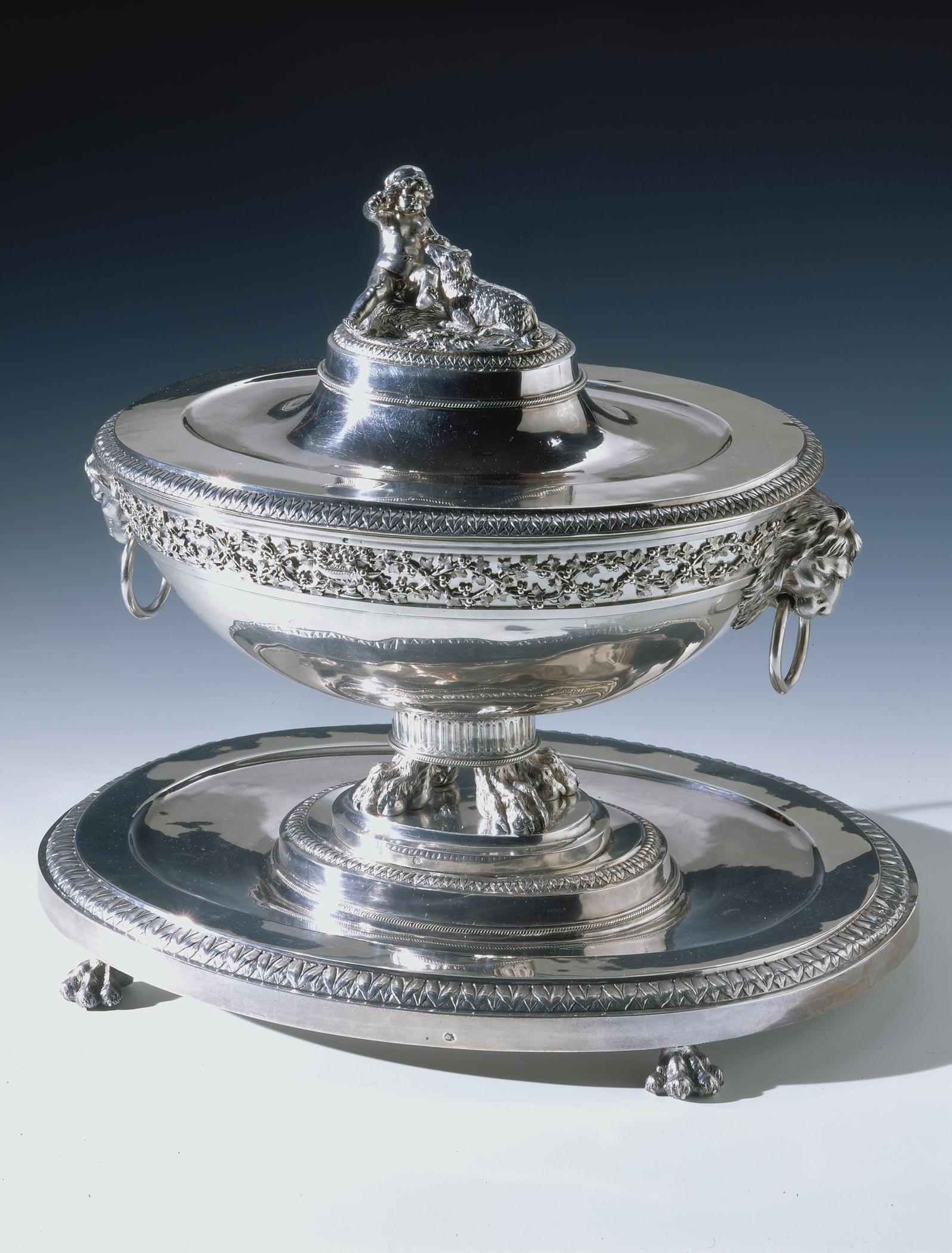
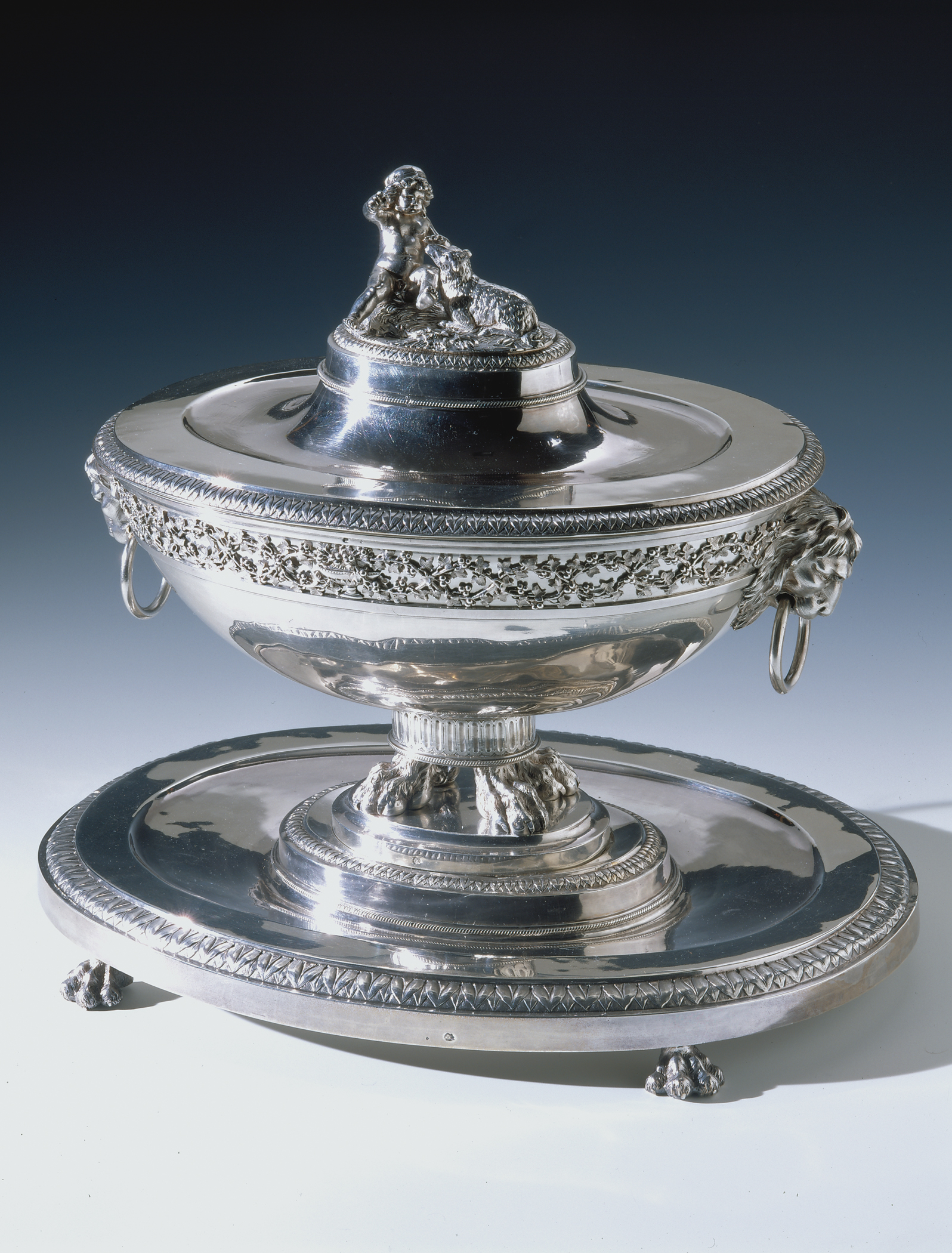
This elliptical-shaped shallow silver tureen on a proportionately shaped presentation stand was originally one of a stylish pair for a table service made in Paris not long before the French Revolution. Classical style cast ornament punctuates the smooth surfaces, combining a putti with a resting sheep on the lid, lion head ring handles on the bowl, and four hairy paw feet supporting the delicate foot ring and also the stand. Garlands of berries and leaves crisscross the frieze section of the bowl, nearly obscuring a lidded urn at the midpoint. Much of the ornament is fixed in place with threaded bolts, necessitating an interior liner to contain the stew contents. This tureen is unusual in that the original liner is still nestled within the bowl. Two related coats of arms are engraved into the underside of the lid, the bottom of the liner, and beneath the stand. One belongs to Angélique-Aimée de Rostaing (d.1842) and her first husband, Mathieu de Montholon, comte de Lee, called the Marquis de Montholon (d.1788) who married in 1773. The other armorial device belongs to Angélique and her second husband, Charles-Louis Huguet de Montaran, comte de Sémonville (d. 1839). Two young sons from the first marriage, Charles-Tristan and Louis-Desire de Montholon-Sémonville (d.1863), were adopted by Huguet. One likely inherited this tureen and stand. In 1966 the Campbell Museum acquired this tureen from Parisian antiques dealer Jacques Kugel. In 1996 the Campbell Museum transferred by gift their significant collection of tureens and soup related items to Winterthur Museum.
Category
Metals
Creator/Artist/Maker
Ignace-Joseph Craisme (Maker)
Place of Origin
Paris; France; Europe
Materials
- Silver
Museum Object Number
1996.0004.227 A- D
Credit Line/Donor
Campbell Collection of Soup Tureens at Winterthur
Share Object
Complete Details
Object Number
1996.0004.227 A- D
Object Name
Tureen, stand, liner
Category
Metals - Campbell Collection
Creator (Role)
Ignace-Joseph Craisme (Maker)
Place of Origin
Paris; France; Europe
Date
1787-1788
Mark/Signature/Inscription/Label
Type: Mark
Location: Lid, bowl, stand, and liner
Inscription: "J J / C within a cartouche, stamped
Type: Mark
Location: Lid, bowl, stand, and liner
Inscription: Crowned "A" in conforming surround, charge mark 1783-89, stamped
Type: Mark
Location: Lid, bowl, stand, and liner
Inscription: Crowned warden's symbol for 1787-88 in conforming surround, stamped
Type: Mark
Location: Lid, bowl, stand, and liner
Inscription: Dog's head in profile left, discharge mark 1783-89, in conforming surround, stamped
Type: Mark
Location: Lid, bowl, stand, and liner
Inscription: Parrot's head in profile left, discharge mark 1786-89, in conforming surround, stamped
Type: Inscription
Location: Lid, tureen, and stand on undersides
Inscription: Armorial device
Type: Inscription
Location: Lid, tureen, and stand on undersides
Inscription: Armorial device
Type: Mark
Location: Lid, bowl, stand, and liner
Inscription: Crab in conforming surround, assay mark as second-hand after 1838, stamped
Mark/Signature: Yes
Subject(s)
- Armorial device
Materials
- Silver
Techniques
- Wrought
- Cast
Dimensions (inches)
13.5 (H) x 12.875 (W) x 16.875 (L)
Dimensions (centimeters)
34.29 (H) x 32.703 (W) x 42.863 (L)
Dimensions (oz)
153
Measurement Notes
Troy weight overall is 153 oz. 10 dwt.
Bibliography and Bibliographic Notes
Article: Buhler, Kathryn C. 06//1970 Silver Tureens in the Campbell Museum Collection. Antiques.
• Published: p. 907, fig. 8Book: Selections from the Campbell Museum Collection (multiple editions).
• Published: 1969, no. 18; 1972, no. 20; 1976, no. 20; 1978, no. 21; 1983, no. 81.Book: Fennimore, Donald L. & Halfpenny, Patricia A. 2000 The Campbell Collection of Soup Tureens at Winterthur.
• Published: pp. 20-21, fig. 7Catalogue: 1990 Selections from the Campbell Museum Collection (Suntory Museum Exhib. Cat.).
• Published: Suntory Museum of Art, Tokyo, loan exhib. cat., p. 15, no. 13Article: Buhler, Kathryn C. 01//1970 The American Connoisseur: The Campbell Museum Collection of Silver. Connoisseur. 173 (695): 51-60.
• Published: p. 57, no. 10