//
For internal use only
On Display: Galleries
Tureen
Zacharias Deichmann
1766-1776
Description
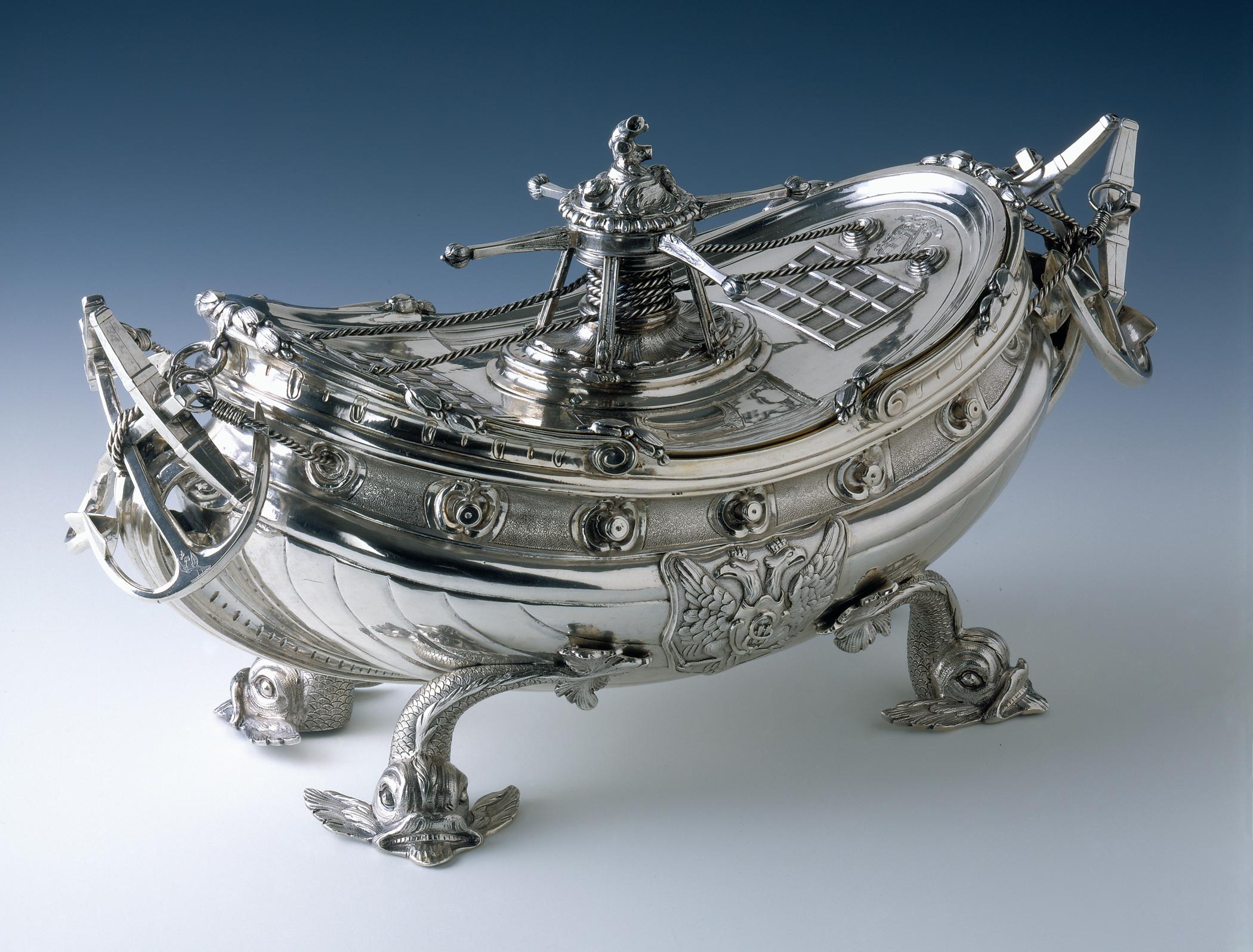
This silver ship borne on the tails of grimacing sea monster feet is one element from a fantasy flotilla of possibly one dozen tureens commissioned by Catherine II, Czarina (Empress) of Russia. The functional tureen is a loose interpretation (with two bows and no stern) of a ten-gun ship. In low relief on the vessel's side the two-headed eagle holding an orb and scepter and emblazoned with the initial of Catherine II (Ekaterina II), who was empress between 1762 and 1796, suggests it was commissioned for governmental purposes. Scholars have speculated that the full set of tureens was first used in 1766 by the Baltic Sea Admiralty at Kronstadt or in St. Petersburg, but then transferred between 1783-87 to the Black Sea Fleet under Grand Admiral Prince Gregory Potemkin. The tureen's body and lid are both wrought, with cast ornament soldered in place including the spinning capstan and silver cables to raise the anchors. The interior is mercury gilded and both tureen and lid are engraved with the number "10." Possibly by the early nineteenth century, this tureen was brought to England and the coat of arms and motto "EA LIBERTE" (liberty) used by the Ackers family of Moreton Hall in Chester, England were engraved on each end of the lid. The Ackers' crest was engraved on each of the four anchors. Traditionally, this ownership was assigned to George and Harriott-Dell (Hutton) Ackers, but their son George Holland Ackers and his wife Harriet Susan Hutton are the owners likely to have engraved the family armorial on the tureen. The weight in Russian units, 16 funts 16 zolotniki, is engraved on the underside of the tureen, indicating it is the smaller of the two sizes known to have been made. In 1966 the Campbell Museum acquired this tureen from Parisian antiques dealer Jacques Kugel, which may account for the French import marks stamped on the body and lid. In 1996 the Campbell Museum transferred by gift their significant collection of tureens and soup related items to Winterthur Museum.
Category
Metals
Creator/Artist/Maker
Zacharias Deichmann (Maker)
Place of Origin
St. Petersburg; Russia; Europe
Materials
- Gilded silver
- Silver
- Parcel-gilt silver
Museum Object Number
1996.0004.209 A, B
Credit Line/Donor
Campbell Collection of Soup Tureens at Winterthur
Share Object
Complete Details
Object Number
1996.0004.209 A, B
Object Name
Tureen
Category
Metals - Campbell Collection
Creator (Role)
Zacharias Deichmann (Maker)
Place of Origin
St. Petersburg; Russia; Europe
Date
1766-1776
Mark/Signature/Inscription/Label
Type: Mark
Location: Lid and tureen
Inscription: "D[reversed} Z" in rectangle, stamped
Type: Mark
Location: Lid and tureen
Inscription: "0" "8" in individual rectangles, stamped
Type: Mark
Location: Lid and tureen
Inscription: "HO" in Cyrillic (?) in rectangle, stamped
Type: Mark
Location: Lid and tureen
Inscription: Pictorial shield on side, stamped
Type: Inscription
Location: Lid and tureen
Inscription: "No 10", engraved
Type: Mark
Location: Lid and tureen
Inscription: Swan standing, profile left, in oval, stamped (French import after 1893)
Type: Inscription
Location: Tureen, underside
Inscription: "16" funts and "16" zolotniki, engraved (weight),engraved
Type: Inscription
Location: Tureen, both sides
Inscription: Two-headed eagle and "E" for Romanov family and Catherine the Great,cast and engraved
Type: Inscription
Location: Lid, both ends
Inscription: Armorial device for Ackers and Hutton family, engraved
Type: Inscription
Location: Anchors, each one
Inscription: Armorial crest for Ackers and Hutton family, engraved
Mark/Signature: Yes
Subject(s)
- Naval history
- Political figure
- Monarchs and nobility
- Maritime
Materials
- Gilded silver
- Silver
- Parcel-gilt silver
Techniques
- Wrought
- Cast
Dimensions (inches)
10.25 (H) x 8.5 (W) x 18.75 (L)
Dimensions (centimeters)
26.035 (H) x 21.59 (W) x 47.625 (L)
Dimensions (oz)
210
Measurement Notes
The overall weight is 210 oz. 10 dwt. troy. The original weight in Russian units, 16 funts 16 zolotniki, is engraved on the underside of the tureen.
Bibliography and Bibliographic Notes
Catalogue: 1990 Selections from the Campbell Museum Collection (Suntory Museum Exhib. Cat.).
• Published: Suntory Museum of Art, Tokyo, loan exhib. cat., p. 34, fig. 64Article: Buhler, Kathryn C. 06//1970 Silver Tureens in the Campbell Museum Collection. Antiques.
• Published: Fig. 11, p. 908Article: Hodgson. 03//1980 Soup...Soup. Silver Magazine. 13 (2)
• Published: p. 7Book: 1969 Selections from the Campbell Museum Collection.
• Published: 1969, no. 15; 1972, no. 15; 1976, no. 15; 1978, no. 16; 1983, no. 130.Article: Taylor, Nora E. 03//1973 The Campbell Collection. National Antiques Review. 4: 20-23.
• Published: No. 9. p. 21Book: Fennimore, Donald L. & Halfpenny, Patricia A. 2000 The Campbell Collection of Soup Tureens at Winterthur.
• Published: pp. 64-65, fig. 30Article: Jenkins, Basil W.R. 03//1998 Early Russian Gold, Silver, and Enamelwork. Silver Magazine. March-April: 34-47.
• Published: p. 36.Article: Beem, Barbara & Beem, Ken. 11//2014 Collector's Corner Perfect 10: Rating Tureens. New England Antiques Journal. 30-31.
• Published: p. 31.Article: Buhler, Kathryn C. 01//1970 The American Connoisseur: The Campbell Museum Collection of Silver. Connoisseur. 173 (695): 51-60.
• Published: p. 53, no. 5