//
For internal use only
On Display: Galleries
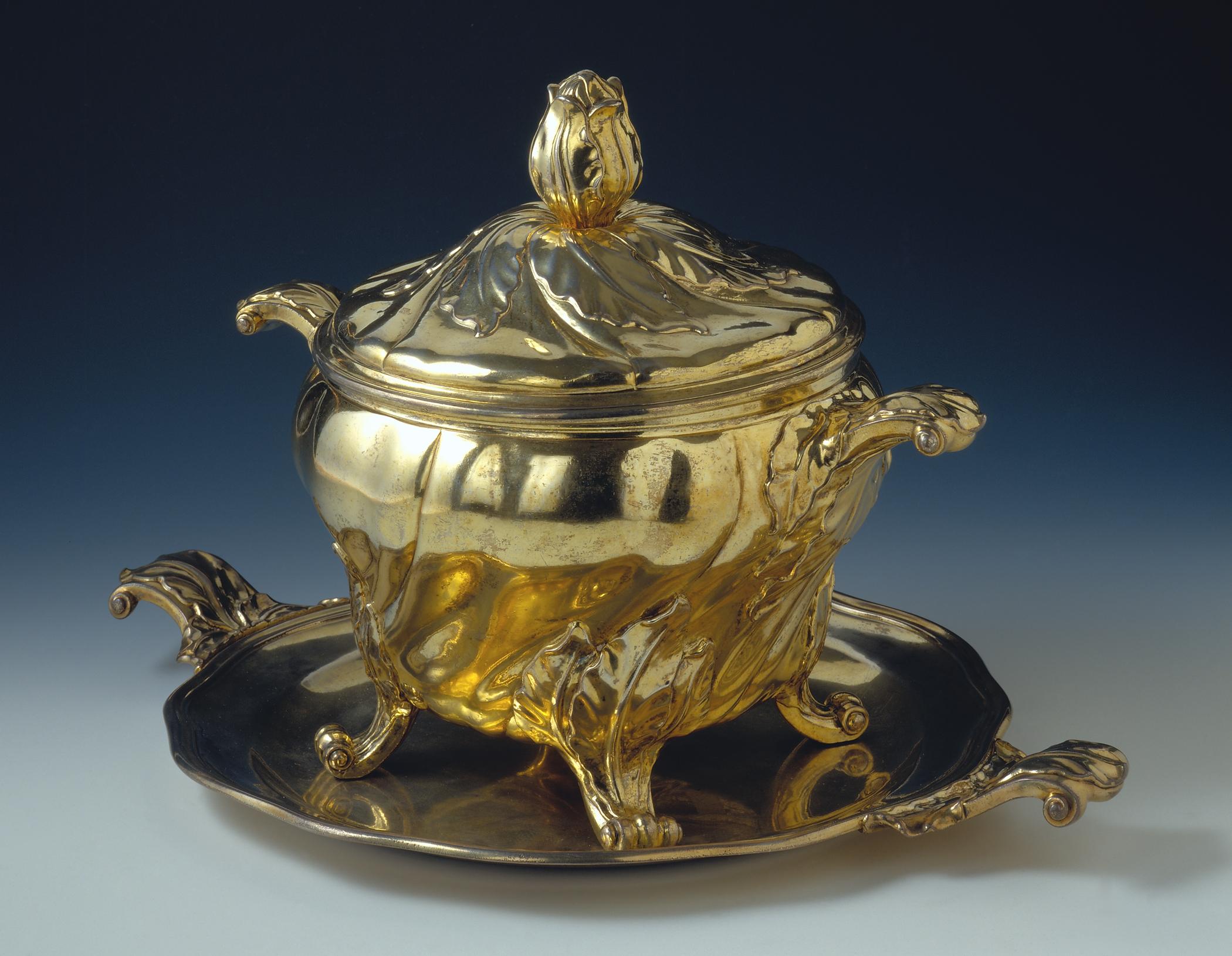
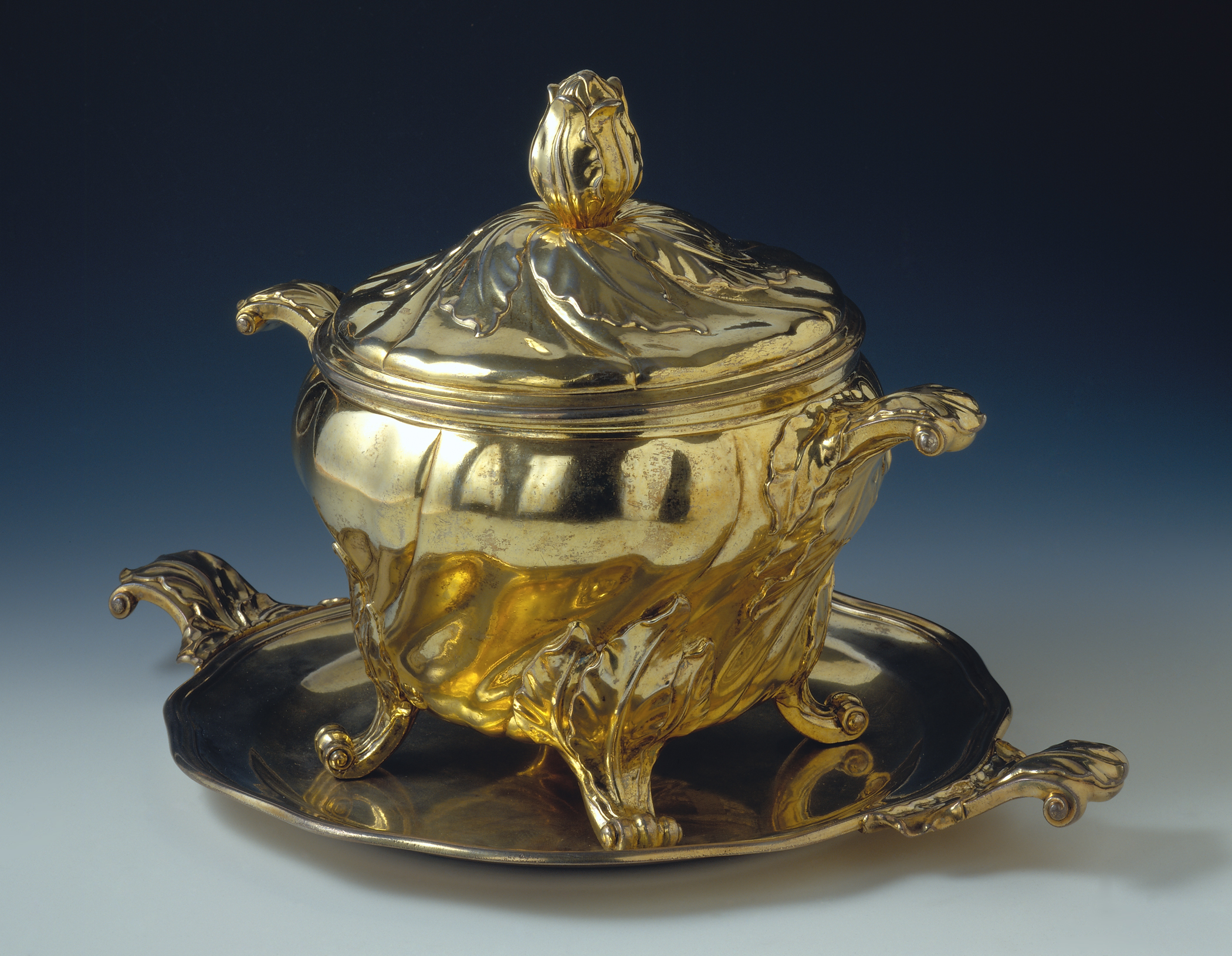
Tureen and stand
Paul Ingermann
1733-1739
Description
This mercury gilt silver tureen on a stand is one of a pair made as part of a table service for the court of Frederick Augustus, who in 1733 became Elector of Saxony and by 1736, King of Poland. Augustus' father had a foundational role in the Meissen porcelain manufactory and his taste for rococo forms established splendid court dining environments. This dainty tureen on four scrolling feet incorporates low relief, chased leaves and undulating curves in the lid and body that characterize the naturalism of the nascent rococo style. The supporting presentation stand with scrolling foliate handles has been modified from its original larger diameter, likely by the maker at a date sometime after manufacture. The tureen and its mate were delivered to the Dresden treasury by 1739, possibly as early as 1733-35. The maker, Paul Ingermann, first qualified as a master goldsmith in Dresden in 1698 and by 1717 he oversaw the city goldsmiths' guild marking process. He served as warden and was elevated to serve as the guild's supervising inspector in 1738-1739. The guild hallmark on this tureen with "13" represents the silver standard equivalent to 81.25% pure, a standard used by many European goldsmiths. This tureen and its mate appear in a photograph of the Dresden court's table silver in about 1904. The mate was acquired by a collector prior to 1938 when it was published within the Falk Simons silver collection and given to a museum in Gothenburg (Goteborg), Sweden. In 1966 the Campbell Museum acquired this Ingermann tureen from Parisian antiques dealer Jacques Kugel, which may account for the French import marks stamped on all three elements. In 1996 the Campbell Museum transferred by gift their significant collection of tureens and soup related items to Winterthur Museum.
Category
Metals
Creator/Artist/Maker
Paul Ingermann (Maker)
Place of Origin
Dresden; Saxony; Germany; Europe
Materials
- Silver
- Gilt
Museum Object Number
1996.0004.204 A- C
Credit Line/Donor
Campbell Collection of Soup Tureens at Winterthur
Share Object
Complete Details
Object Number
1996.0004.204 A- C
Object Name
Tureen and stand
Category
Metals - Campbell Collection
Creator (Role)
Paul Ingermann (Maker)
Place of Origin
Dresden; Saxony; Germany; Europe
Date
1733-1739
Mark/Signature/Inscription/Label
Type: Mark
Location: Tureen
Inscription: "P I" / (6-pointed star)" in heart, stamped
Type: Mark
Location: Stand
Inscription: "P I" / (6-pointed star)" in heart, stamped
Type: Mark
Location: Stand
Inscription: "13 / (crossed swords) / D" in oval, stamped (Dresden standard mark)
Type: Mark
Location: Tureen
Inscription: "13 / (crossed swords) / D" in oval, stamped (Dresden standard mark)
Type: Mark
Location: Lid, tureen, and stand (twice)
Inscription: Swan standng in profile left within an oval, stamped (French import mark after 1893)
Type: Inscription
Location: Tureen, stand, on undersides
Inscription: "AR / 3" interlaced, engraved
Type: Inscription
Location: Lid, tureen, stand, on undersides
Inscription: "1", engraved
Mark/Signature: Yes
Subject(s)
- King
Materials
- Silver
- Gilt
Techniques
- Wrought
- Cast
Dimensions (inches)
11.625 (H) x 20.875 (W) x 15 (D)
Dimensions (centimeters)
29.528 (H) x 53.023 (W) x 38.1 (D)
Measurement Notes
Overall weight is 231 oz. troy.
Bibliography and Bibliographic Notes
Book: Selections from the Campbell Museum Collection (multiple editions).
• Published: 1969, no. 1; 1972, no. 34; 1976, no. 34; 1978, no. 34; 1983, no. 90.Book: Arnold, Ulli. Dresdner Hofsilber of the 18th century.
• Published: p. 19, fig. 9Book: Fennimore, Donald L. & Halfpenny, Patricia A. 2000 The Campbell Collection of Soup Tureens at Winterthur.
• Published: pp. 22-23, fig. 8Article: Buhler, Kathryn C. 01//1970 The American Connoisseur: The Campbell Museum Collection of Silver. Connoisseur. 173 (695): 51-60.
• Published: pp. 54-55, (e) bottom leftArticle: Buhler, Kathryn C. 06//1970 Silver Tureens in the Campbell Museum Collection. Antiques.
• p. 19, fig. 9