//
For internal use only
Not On Display
Spoon (Teaspoon)
Richard Humphreys
1771-1796
Description
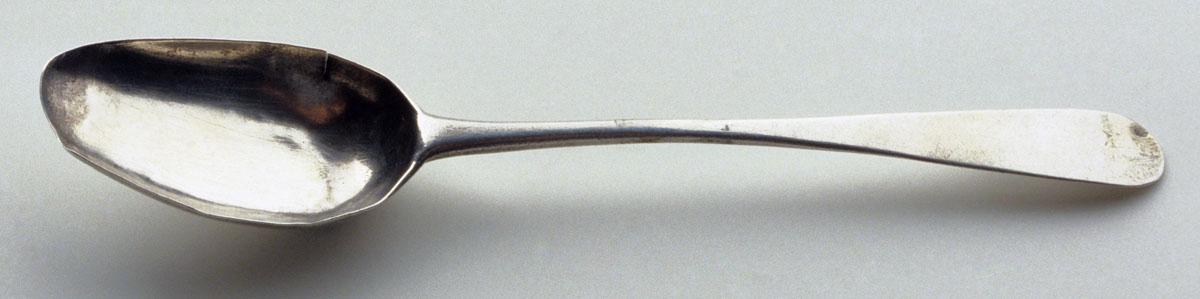
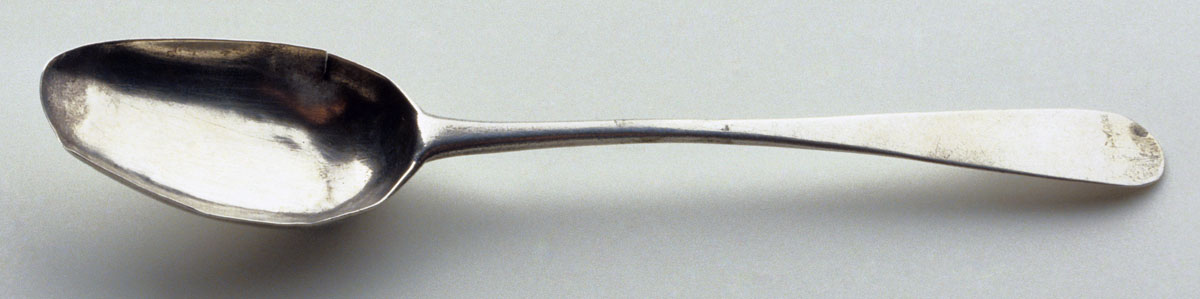
This very worn teaspoon, likely one from a set, has a bowl decorated on the underside in low-relief with a bird in profile holiding a leafy branch. The fashion for decorated silver spoon bowls persisted through several centuries, but by the mid-1700s pictorial motifs with religious, political, allegorical, and personal meaning were created with regularity in Britain and colonial America. The bird (or dove) with an olive branch in its beak was internationally recognized symbol of peace. This spoon's maker, silversmith Richard Humphreys was born in Tortola (West Indies), but following his parents' deaths, he moved to Wilmington, Delaware to be raised by Quaker relatives. By 1765 he apprenticed to silversmith Bancroft Woodcock who also produced spoon bowls depicting this dove. Humphreys worked on his own in Wilmington, Delaware and then established a shop with his own apprentices in Philadelphia at 54 High Street from 1772 until at least 1796. His surviving work includes the impressive hot water urn given to Charles Thomson in 1774 by the Continental Congress and table silver made for General George Washington. By 1797 Richard Humphreys diversified his business to become a merchant in the China trade and he died quite wealthy. His bequest notably left $10,000 the Philadelphia Society of Friends to establish an educational "Institute for Colored Youth." This was founded in 1837 and the Society of Friends administer it as trustees to present times, now called the Richard Humphreys Foundation.
Category
Metals
Creator/Artist/Maker
Richard Humphreys (Maker)
Place of Origin
Philadelphia; Pennsylvania; Philadelphia; Mid-Atlantic; United States; North America
Materials
- Silver
Museum Object Number
1989.0013.058
Credit Line/Donor
Bequest of Constance Andrew Jones
Share Object
Complete Details
Object Number
1989.0013.058
Object Name
Spoon (Teaspoon)
Category
Metals - Ineson-Bissell Collection, In memory of Constance Andrews Jones
Creator (Role)
Richard Humphreys (Maker)
Place of Origin
Philadelphia; Pennsylvania; Philadelphia; Mid-Atlantic; United States; North America
Origin Notes
Possibly Wilmington, Delaware.
Date
1771-1796
Mark/Signature/Inscription/Label
Type: Mark
Location: Handle, underside
Inscription: "RH" in script inside conforming shape, stamped
Mark/Signature: Yes
Subject(s)
- Birds
- Quaker
Materials
- Silver
Dimensions (inches)
1.024 (W) x 4.961 (L)
Dimensions (centimeters)
2.6 (W) x 12.6 (L)
Dimensions (oz)
0.3175
Bibliography and Bibliographic Notes
Book: Belden, Louise C. 1980 Marks of American Silversmiths in the Ineson-Bissell Collection. 506 p.
• An illustrated glossary of spoon terms, pp. 467-488Book: Fennimore, Donald L. & Bartlett, Louisa D. 2008 Delaware Silver the Col. Kenneth P. & Regina I. Brown Collection. 355 p.
• Biography p. 124.Book: Fennimore, Donald L. 2000 Flights of Fancy: American Silver Bird-Decorated Spoons.
• Comparison: Fig. 10, p. 9.