//
For internal use only
On Display: House - Shop Lane
Pitcher (Ewer)
Moritz Furst, William Thomson, Garret Forbes
1826
Description
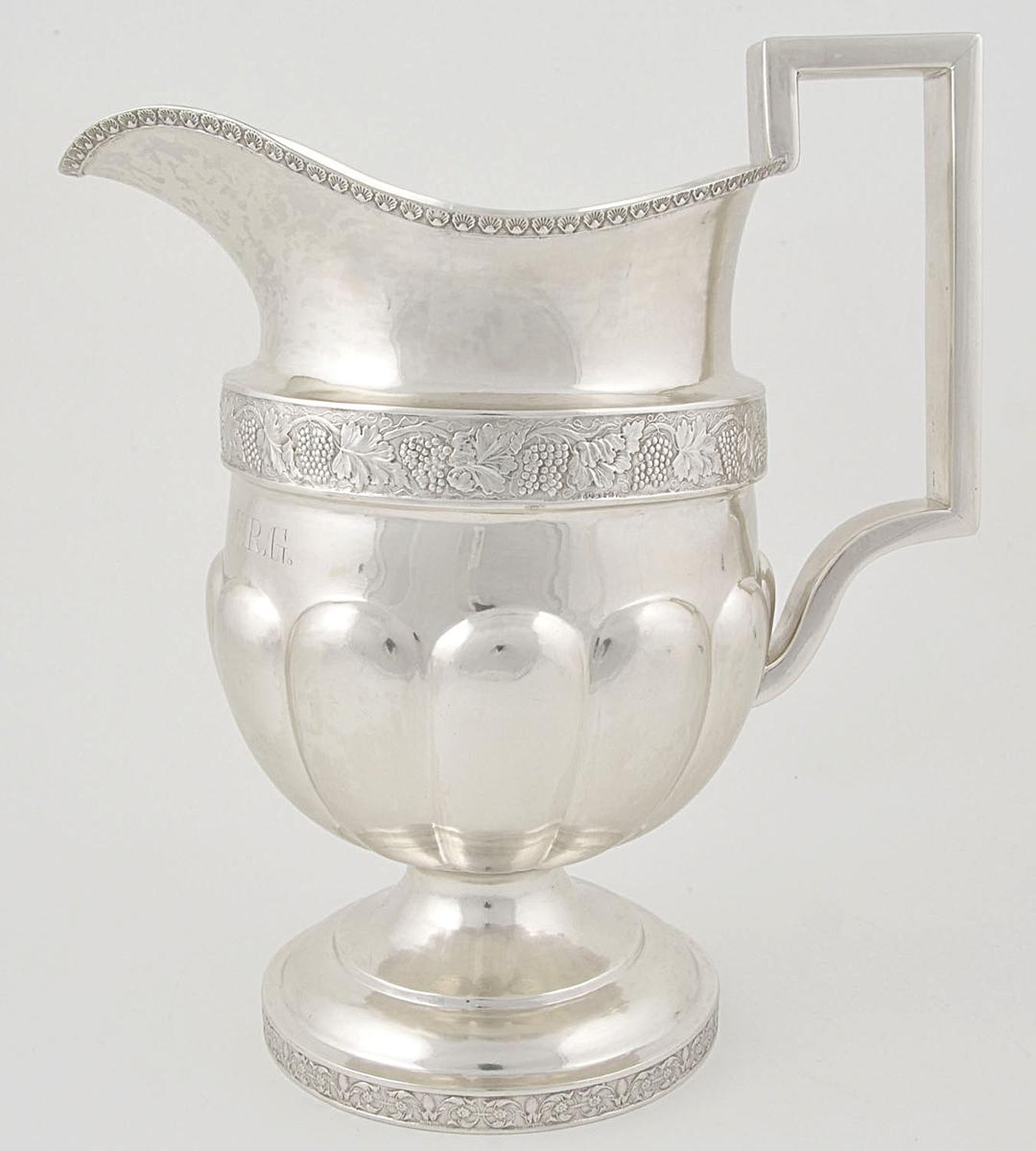
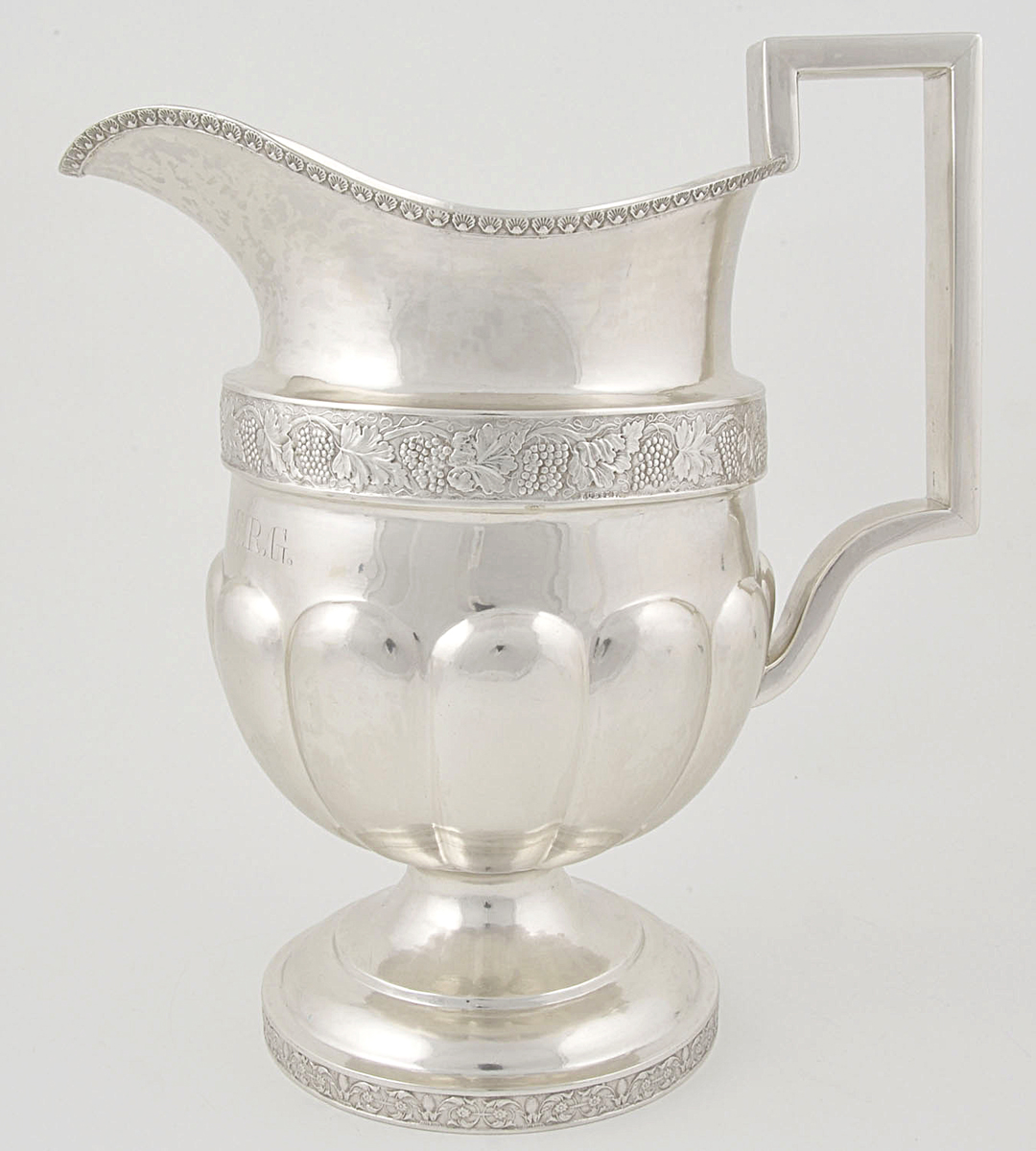
A silver pitcher or ewer with a vase shape body having an integral and slightly proud die-rolled border of a grapevine on a stippled ground above lobes chased into the lower bowl, a wide pouring spout, and rectangular hollow handle all supported by a domed pedestal base. The neck of the pitcher curves inwards and then flares outward at the rim and tall pouring lip which is encircled with a small die-rolled border of scallop shells. The pitcher base has an integral die-rolled border with a floral vine and pineapple motif as the foot rim. The inscription "M.C. TO C.R.G." engraved in cross-hatched block and italic letters is centralized on the body exterior beneath the pouring lip. The date "1826" is engraved below the initials. A name is included at the lower edge of the grapevine border: "FURST F" in Roman relief lettering. Moritz Furst, an engraver and die sinker, cut the die that was used to make the grapevine border for this pitcher; he was not a silversmith. Although it is unmarked, this pitcher's design supports an attribution to silver manufacturer William Thompson. Other examples of New York silver with signed borders by Moritz Furst include: A three-piece tea set made by John or Allen Armstrong now in the Yale University Art Gallery (1984.24); a teapot marked "BOGERT" at The Brooklyn Museum of Art (1991.142.1); a tea set offered by Christie's New York on January 23, 1988, sale #6536, lot 71; and a cream pitcher sold at Freeman's Auctions on November 19, 2011. One hypothesis for the initials engraved on this pitcher is Dr. Chandler Robbins Gilman (1802-1865) who resided in New York and spent much of his career as a professor of obstetrics at the New York College of Physicians and Surgeons.
Category
Metals
Creator/Artist/Maker
Moritz Furst (Designer)
Place of Origin
New York; New York; Mid-Atlantic; United States; North America
Materials
- Silver
Museum Object Number
1986.0046
Credit Line/Donor
Museum purchase with funds provided by the Special Fund for Collection Objects
Share Object
Complete Details
Object Number
1986.0046
Object Name
Pitcher (Ewer)
Category
Metals
Creator (Role)
Moritz Furst (Designer); William Thomson (Possible maker); Garret Forbes (Possible maker)
Place of Origin
New York; New York; Mid-Atlantic; United States; North America
Date
1826
Mark/Signature/Inscription/Label
Type: Mark
Location: Die-rolled border
Inscription: "FURST F" in relief as part of ornament
Type: Inscription
Location: Body, under spout
Inscription: "M.C. TO C.R.G." engraved
Type: Inscription
Location: Body, under spout
Inscription: "1826" engraved
Mark/Signature: Yes
Subject(s)
- Medical
Materials
- Silver
Techniques
- Die-rolled
- Wrought
- Engraved
- Chased
Dimensions (inches)
11.102 (H) x 6.457 (W) x 9.921 (L)
Dimensions (centimeters)
28.2 (H) x 16.4 (W) x 25.2 (L)
Dimensions (oz)
30.3003