//
For internal use only
On Display: House - Fraktur Room
Chalice
William Will
Description
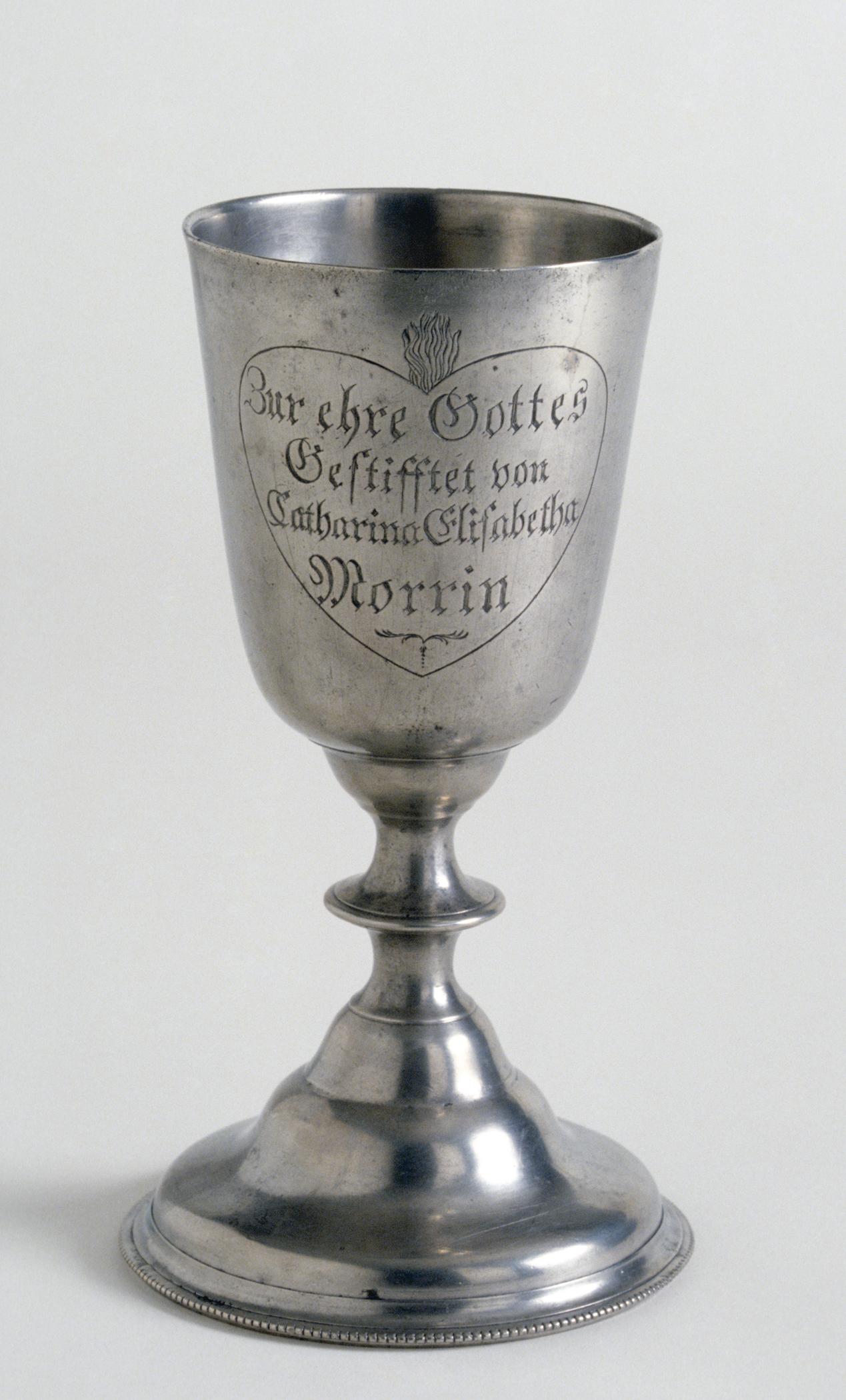
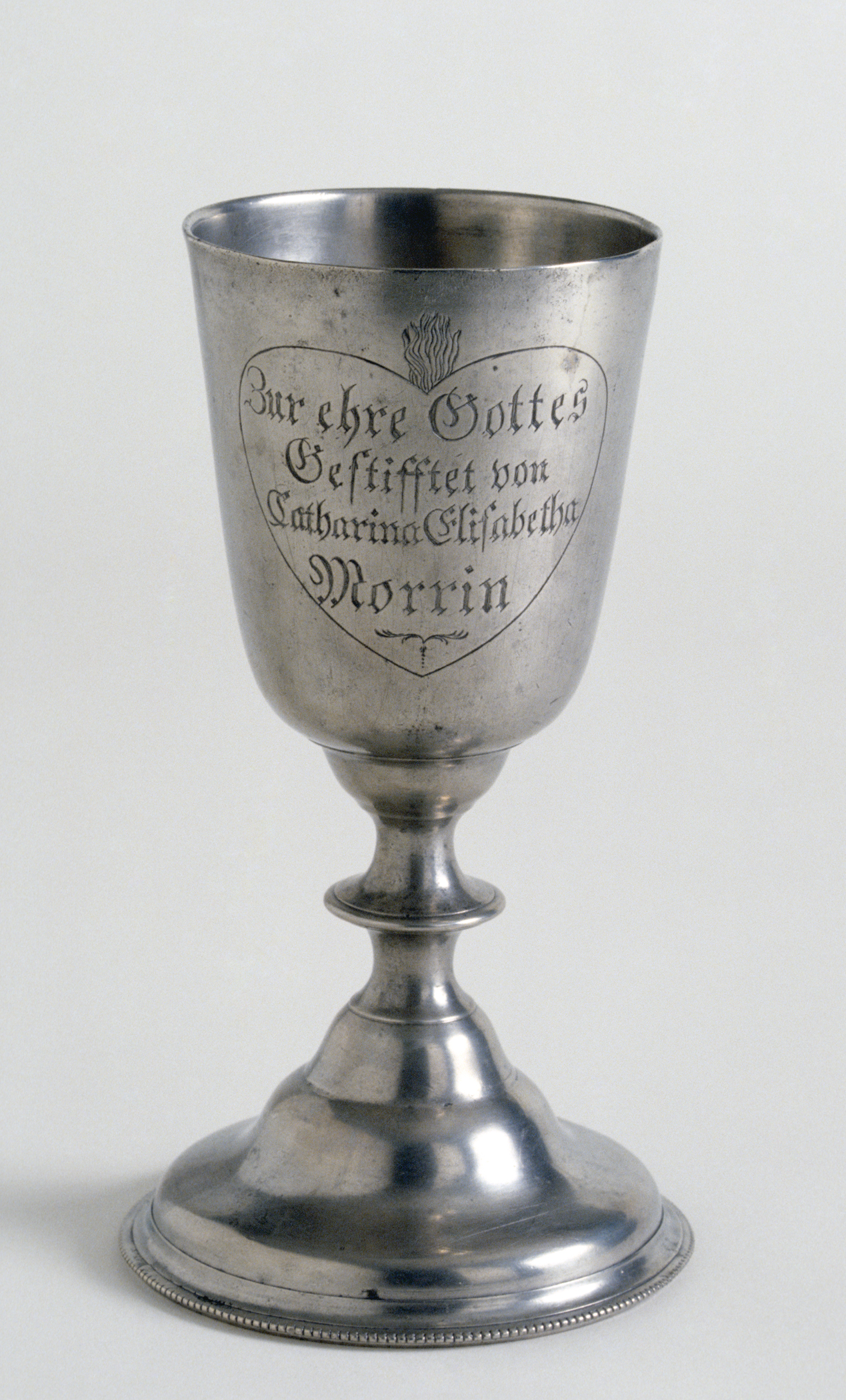
This religious vessel, a communion chalice made around 1795, is unmarked but attributed to Philadelphia pewterer William Will. Standing just under eight inches tall, the deep flared cup rises from an elegantly turned baluster stem on a stepped circular base edged with rounded beading favored by early classical taste. Engraved on the cup’s front is a German inscription reading, “To the glory of God, presented by Catharina Elisabetha Morr[in].” The text appears encircled by heart topped by flames, an atypical motif in early American Lutheran church iconography. Its inclusion gives the chalice an unusual decorative character within Pennsylvania German religious material culture. Commissioned alongside a matching flagon (Yale University Art Gallery, 2007.214.1), the cup was donated to Zion Lutheran Church in Freeburg, Pennsylvania, a congregation rooted within the German immigrant community. Its worn surfaces and carefully repaired cracks testify to long, regular use in the celebration of the Eucharist. Will was known for creatively interchangeable casting molds, and this chalice reflects that practice: its cup, stem, and base were likely cast separately and then refined on a lathe before engraving. Pewter was widely used in early American churches, and this chalice stands as a testament not only to regional practices of faith in early America but also to the collaboration of one of the nation’s most accomplished pewterers and an unknown engraver.
Category
Metals
Creator/Artist/Maker
William Will (Attributed Maker)
Place of Origin
Philadelphia; Pennsylvania; Philadelphia; Mid-Atlantic; United States; North America
Materials
- Pewter
Museum Object Number
1958.0024
Credit Line/Donor
Museum purchase with funds provided by Joseph France
Share Object
Complete Details
Object Number
1958.0024
Object Name
Chalice
Category
Metals
Creator (Role)
William Will (Attributed Maker)
Place of Origin
Philadelphia; Pennsylvania; Philadelphia; Mid-Atlantic; United States; North America
Mark/Signature/Inscription/Label
Type: Inscription
Location: Side of cup
Inscription: "Zur ehre Gottes/ Gestifftet von/ Catharina Elisabetha/ Morrin", incised
Mark/Signature: Yes
Materials
- Pewter
Techniques
- Cast
Dimensions (inches)
7.87 (H) x 4.409 (Diam)
Dimensions (centimeters)
20 (H) x 11.2 (Diam)
Bibliography and Bibliographic Notes
Catalogue: Garvan, Beatrice B. & Hummel, Charles F. 1982 The Pennsylvania Germans: a celebration of their arts, 1683-1850. An exhibition organized by the Philadelphia Museum of Art and the Henry Francis du Pont Winterthur Museum.
• Published: plate 124, p. 172.Book: Hutchins, Catherine E., et al. 1983 Arts of the Pennsylvania Germans.
• Published: fig. 208, p. 217.Article: Hamilton, Suzanne C. 1972 The Pewter of William Will: A Checklist. Winterthur Portfolio. 7: 129-160.
• Published: p. 134, fig. 10.Book: Montgomery, Charles F. 1973 A History of American Pewter.
• Published: fig. 4-31, p. 76. Attribution to Will, p. 73.Catalogue: Northeast Auctions, Portsmouth NH (auction catalogue).
• Flagon from same set: February 24, 2007, lot 459Book: Herr, Donald M. 1995 Pewter in Pennsylvania German Churches. 29.
• Published: fig. 54, p. 41.Article: Minardi, Lisa. 2013 Philadelphia, Funriture, and the Pennsylvania Germans: A Reevaluation. American Furniture. 196-292.
• Published: p. 244, fig. 71.Catalogue: Minardi, Lisa. 2015 A Colorful Folk: Pennsylvania Germans & the Art of Everyday Life.
• Published: fig. 55, p.43