//
For internal use only
On Display: House - Architects Room
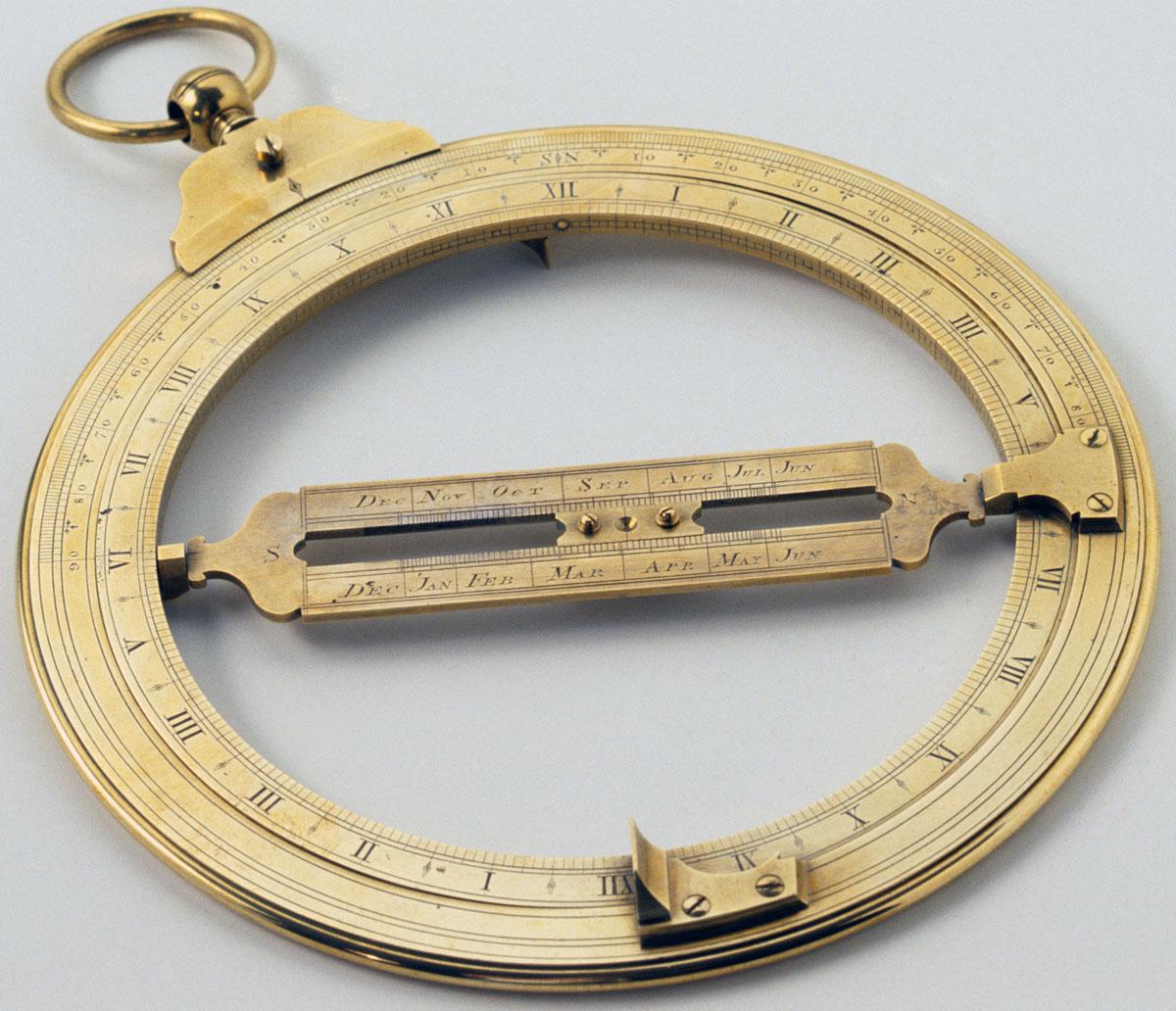
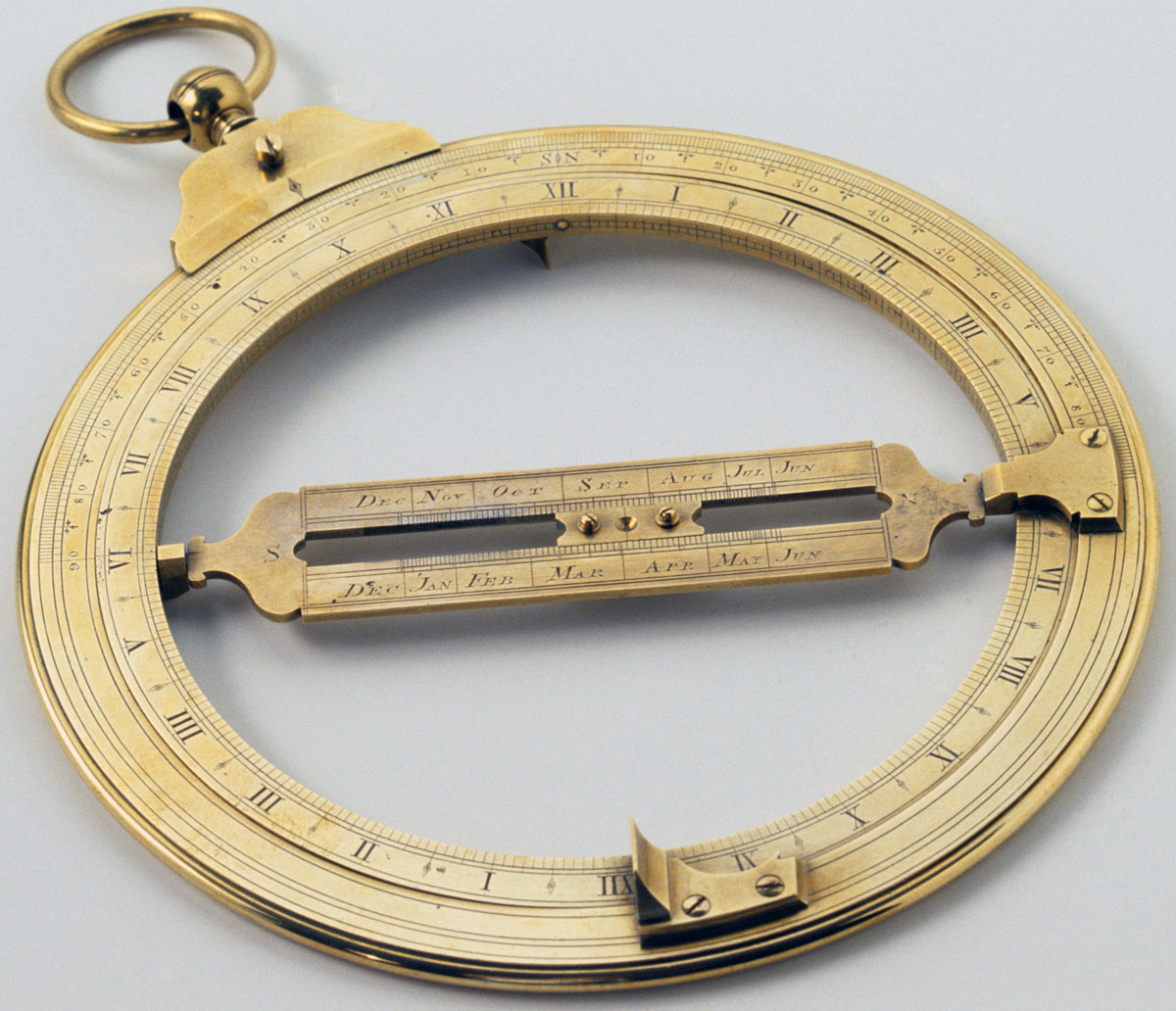
Equinoctial ring
Thomas Jones
1810-1815
Description
The equinoctial ring, also called a universal dial ring, is used to tell time with the sun at different latitudes. It is composed of two graduated circular, flat brass scaled rings nested together and bridged in the diameter by a flattened rectangular bar with a pierced mid-section and shaped ends that are screwed onto the outermost ring. The instrument is suspended by a brass ring mounted on a moveable bracket that screws tightly onto the outer ring and there is a brass bracket screwed at a 90-degree angle to act as a stopper to keep the hinged inner ring perpendicular to the outer ring when opened for use. The surfaces of both rings and the bridge are engraved with measured scales; the outer ring has two 90-degree scales engraved on one side, representing the meridians or degrees of latitude of the northern and southern hemispheres. The smaller inner ring is engraved with twelve hour units in Roman numerals for the time of day. The central bar or diameter bridge has a pierced section holding an adjustable scale indicator engraved with the abbreviated names of the months and signs of the zodiac on the reverse. The maker's name is engraved in script on the outer dial: "Tho\s Jones N\o 20 Kenton Street". The trade card for this optical and mathematical instrument maker, Thomnas Jones, is pasted inside the red leather carrying case fitted to this equinoctial ring. It identifies him as the pupil of the late Mr. Ramsden who now worked on Oxendon Street in London's Haymarket and highlights his patent for a sectograph to aid with mathematical drawings. If the carrying case associated with the instrument is original, it suggests a date of manufacture post-dating the patent for Jones' sectograph; possibly 1811 or 1812.
Category
Clocks, Watches, and Scientific Instruments
Creator/Artist/Maker
Thomas Jones (Maker)
Place of Origin
London; London; England; United Kingdom; Europe
Materials
- Brass
Museum Object Number
1970.0725 A
Credit Line/Donor
Bequest of Henry Francis du Pont
Share Object
Complete Details
Object Number
1970.0725 A
Object Name
Equinoctial ring
Category
Clocks, Watches, and Scientific Instruments
Creator (Role)
Thomas Jones (Maker)
Place of Origin
London; London; England; United Kingdom; Europe
Date
1810-1815
Mark/Signature/Inscription/Label
Type: Signature
Location: Outer ring
Inscription: "Tho\s Jones N\o 20 Kenton Street" in script engraved in script
Mark/Signature: Yes
Materials
- Brass
Techniques
- Engraved
Dimensions (inches)
8.386 (H) x 6.102 (W) x 5.236 (Diam)
Dimensions (centimeters)
21.3 (H) x 15.5 (W) x 13.3 (Diam)
Bibliography and Bibliographic Notes
Book: Fennimore, Donald L. 1996 Metalwork in Early America: Copper and Its Alloys from the Winterthur Collection.
• Published: cat.194, p.298