//
For internal use only
Not On Display
Quilt (Wholecloth quilt with border)
1750-1800
Description
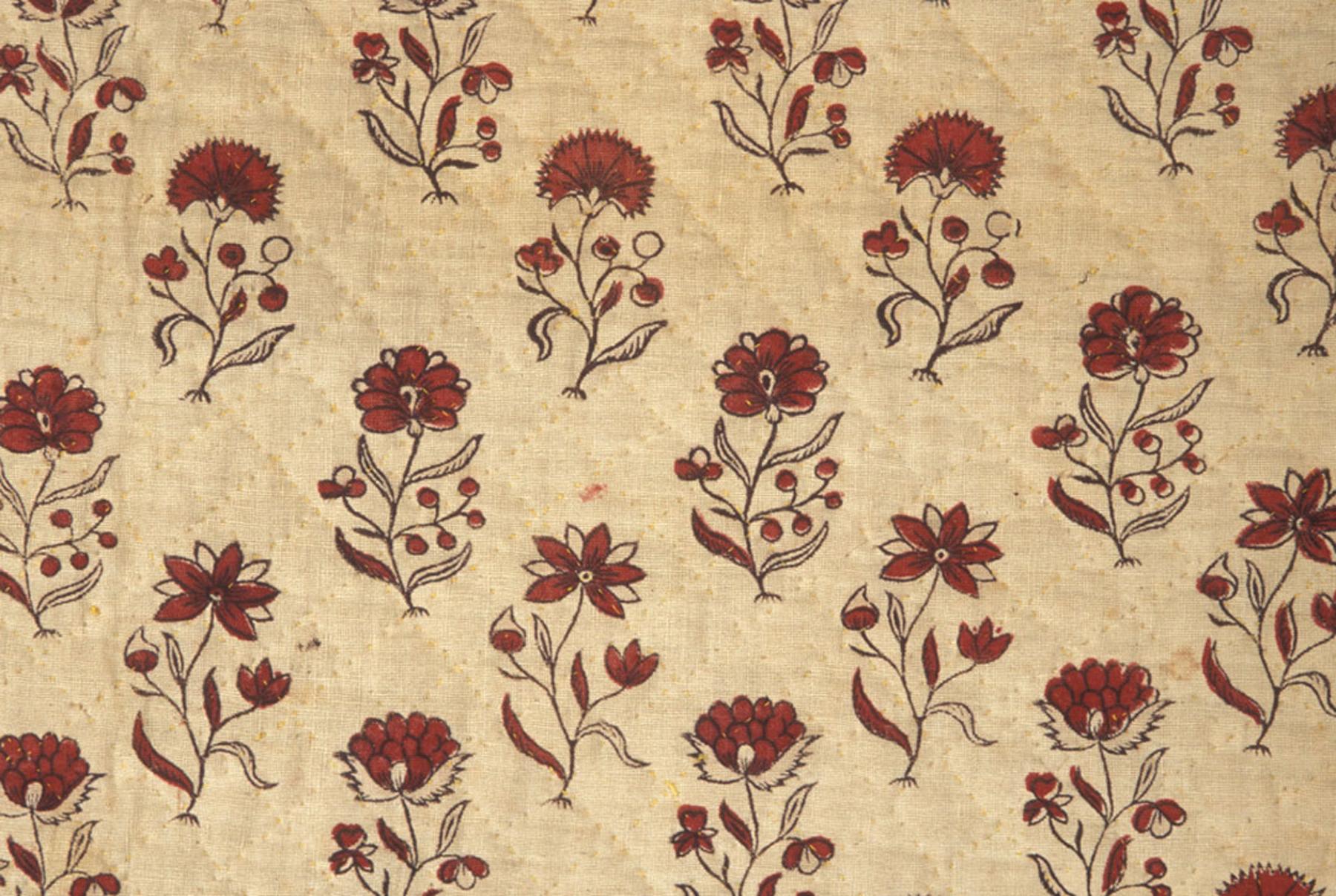
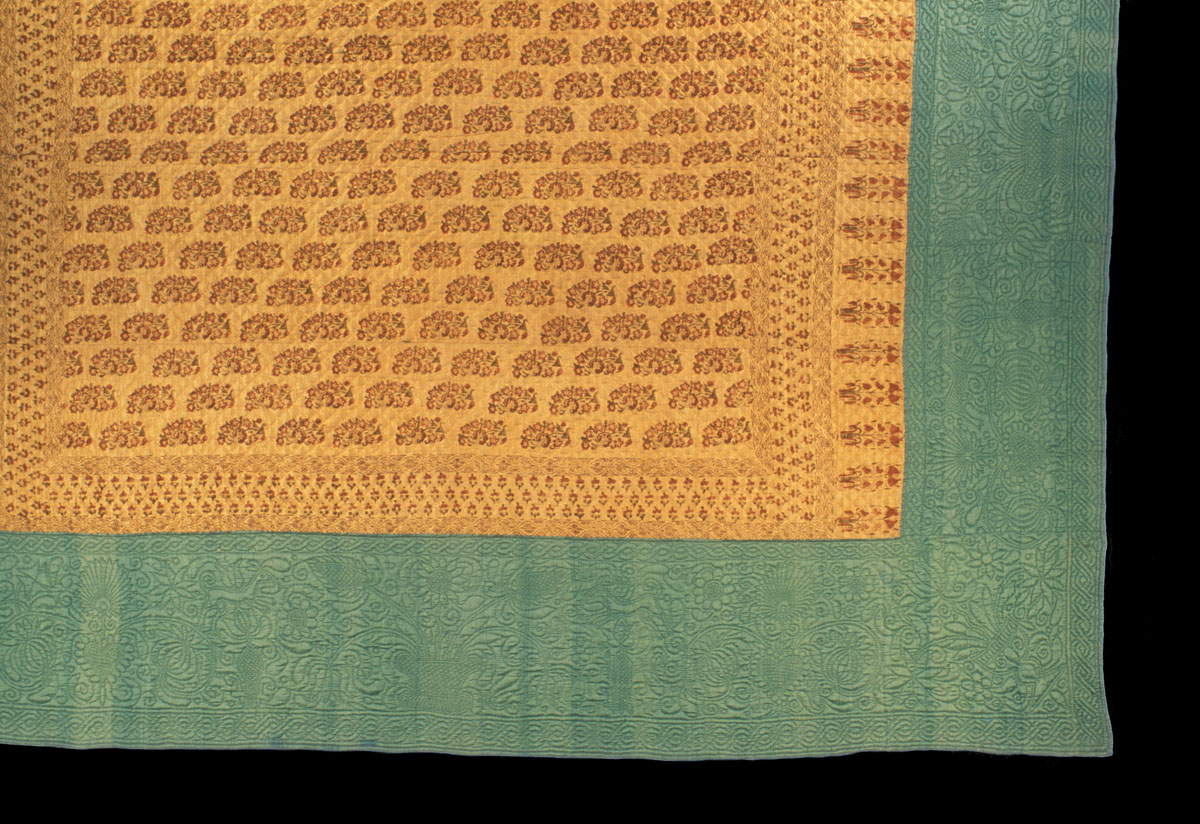
This wholecloth quilt features a center field thought to be mashru, a textile originating in sixteenth-century India under the Mughal Dynasty. From the Arabic word for "permitted," mashru's weave has a silk warp and a hidden cotton weft which gives the appearance of pure silk, allowing Muslim men to circumvent laws prohibiting dressing in entirely silk fabrics. The mashru on this quilt was likely imported from India to France, where the teal green border is thought to be made. The boarder contains many motifs that frequently appear on quilts from the Provence region, including sunflowers, marguerites, feathered hearts, and pomegranates. The left, right, and bottom borders all feature roughly identical symmetrical designs, with the center as a sunflower and other long-stemmed flowers emerging from a basket designed with cross-hatch or diamond lattice quilting. A quilted animal faces each of these central baskets on both sides, possibly meant to evoke the fantastical coquecigrue, a nonsensical hybrid animal from French folklore and literature sometimes depicted on quilts from the Provençal region. The quilt back is made from an early English block print, suggesting that the top and back may have been joined at a later date. More research is needed on the context of this unusual quilt's origin.
Category
Textiles (Furnishing)
Place of Origin
England; United Kingdom; Europe
Materials
- Silk
- Cotton
Museum Object Number
1969.0577
Credit Line/Donor
Bequest of Henry Francis du Pont
Share Object
Complete Details
Object Number
1969.0577
Object Name
Quilt (Wholecloth quilt with border)
Category
Textiles (Furnishing)
Place of Origin
England; United Kingdom; Europe
Origin Notes
Construction inidcates that this quilt was professionally made in England.
Secondary Place of Origin
India; Asia
Secondary Origin Notes
The fabric was probably printed in India.
Date
1750-1800
Subject(s)
- Flowers
Materials
- Silk
- Cotton
Techniques
- Pieced
- Quilted
- Printed
Construction Description
Hand-stitched
Dimensions (inches)
106.75 (W) x 113 (L)
Dimensions (centimeters)
271.15 (W) x 287.02 (L)