//
For internal use only
On Display: House - Counting Room
Whale tooth (Scrimshaw tooth)
1835-1865
Description
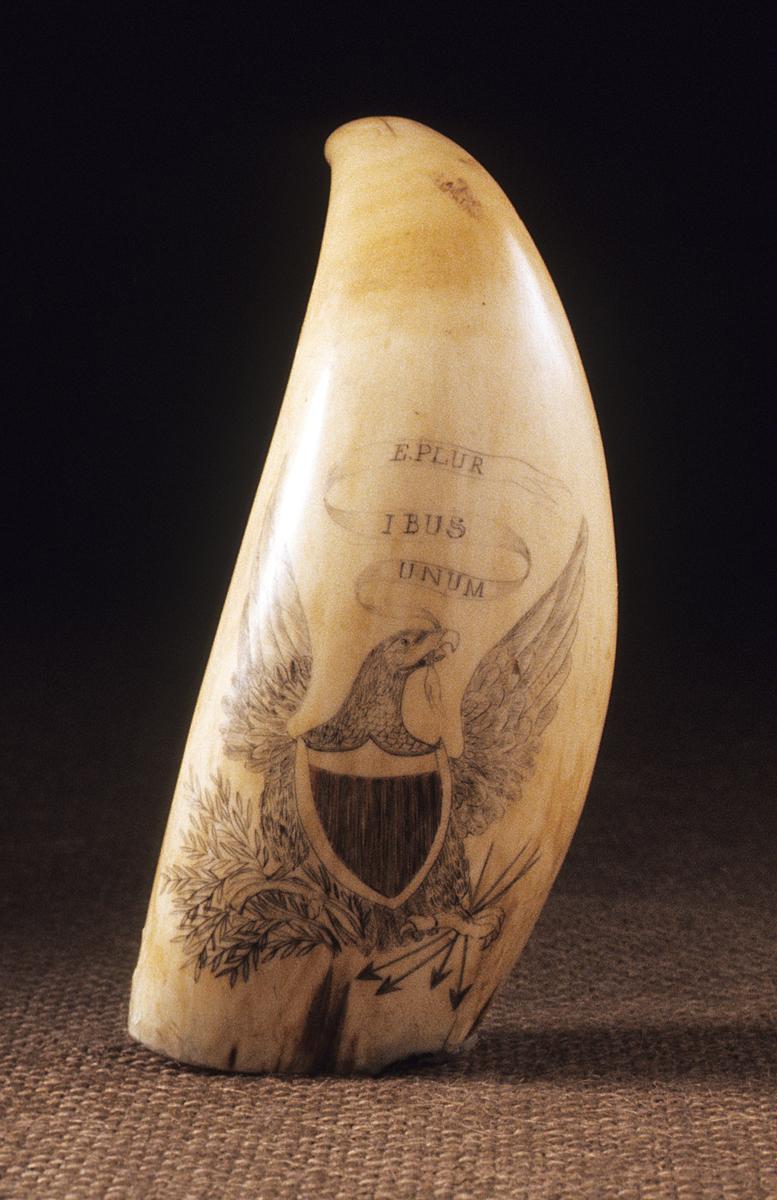
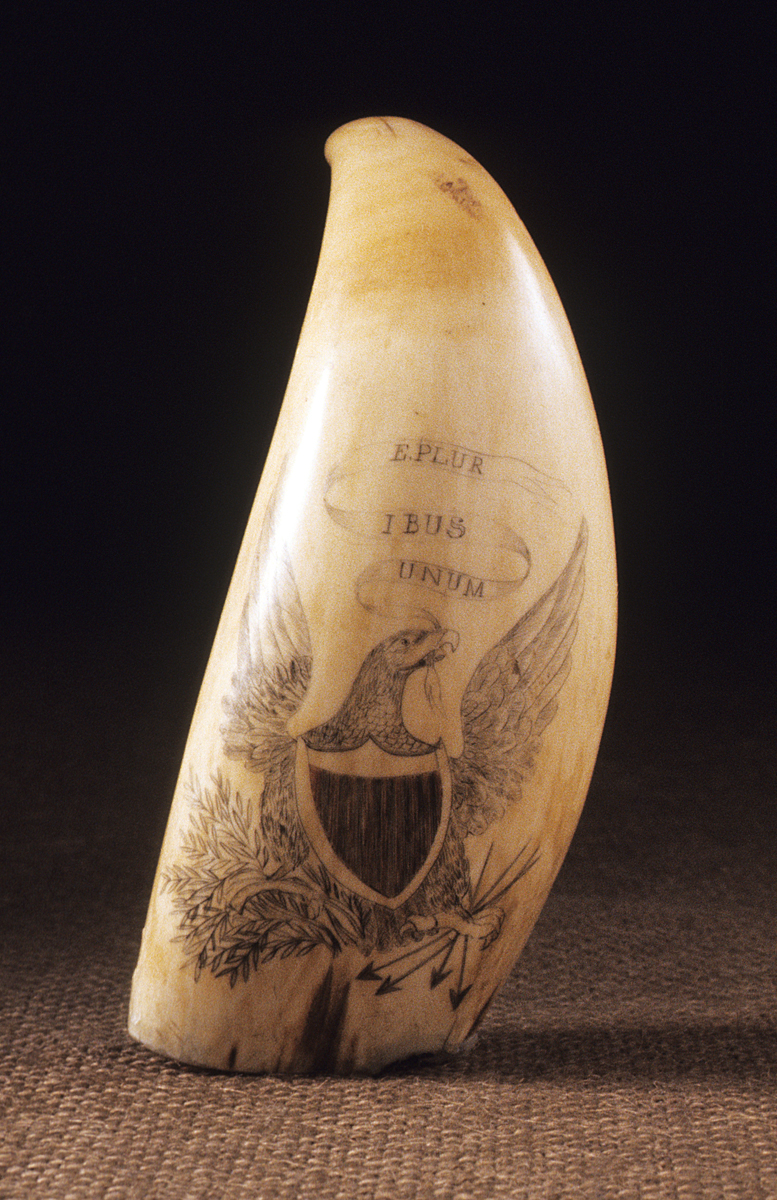
This engraved and inked sperm whale tooth is part of a historical genre of artmaking known as scrimshaw. Scrimshaw is broadly understood as the art and craft of decorative and practical objects, created by whalemen and sailors using the material byproducts of the whale hunt, including sperm whale teeth, walrus tusks, skeletal bone, and baleen. The obverse depicts an American bald eagle with outstretched wings, reminiscent of that on the Great Seal of the United States. The eagle holds in its beak a banner inscribed with the national motto of the United States, "E pluribus unum," meaning, "Out of many, one." It grasps an olive branch in its right talon and four arrows in its left talon. The eagle also supports a heraldic escutcheon with seventeen paleways, or vertical stripes, depicted in alternating bands of red and black ink. This eagle departs from the typical Federal-style eagle, both in the number of arrows (four, rather than the typical thirteen), number of paleways (seventeen, rather than the typical thirteen), and its head is turned to face the arrows, rather than toward the olive branch, a traditional symbol of peace. The reverse depicts a rectangular, full-length portrait of a young woman in a landscape. She wears a neoclassical-inspired empire waist gown with a shawl loosely draped over her right arm and around her waist. The engravings on both sides of the tooth have evidence of pinprick transfer, most readily visible in the small black dots along the woman's hair, face, shawl, and gown. The presence of these pockmarked and inked dots indicate this engraving was probably transferred from either an original drawing or a printed source. To transfer imagery from paper to tooth, paper illustrations were first cut out and lightly moistened to adhere them to the top of the tooth. A sharp implement was used to prick holes through the paper into the tooth, following the lines of the original image. When the paper was removed, a series of small holes remained, which provided an outline for the scrimshaw artist to follow with a blade. When the final engraving was inked, so too were these tiny pinpricks, which materialize the history of image transfer.
Category
Organic (ivory, horn, etc.)
Place of Origin
New England; United States; North America
Materials
- Ivory (sperm whale)
- Ink
Museum Object Number
1967.0868
Credit Line/Donor
Bequest of Henry Francis du Pont
Share Object
Complete Details
Object Number
1967.0868
Object Name
Whale tooth (Scrimshaw tooth)
Category
Organic (ivory, horn, etc.)
Place of Origin
New England; United States; North America
Date
1835-1865
Mark/Signature/Inscription/Label
Type: Inscription
Location: Obverse, banner held by eagle
Inscription: "E. PLUR / IBUS / UNUM"
Mark/Signature: No
Subject(s)
- Maritime
- Eagle
- American eagle
- Flowers
- Scrimshaw
Materials
- Ivory (sperm whale)
- Ink
Techniques
- Engraved
- Polished
- Pinpricking
Dimensions (inches)
5 (H) x 2 (W) x 1.5 (D)
Dimensions (centimeters)
12.7 (H) x 5.08 (W) x 3.81 (D)
Bibliography and Bibliographic Notes
Book: Frank, Stuart M. 2012 Ingenious Contrivances, Curiously Carved: Scrimshaw in the New Bedford Whaling Museum.
• Similar eagles illustrated fig. 3.1, p. 24; fig. 3.26a, p. 45. On pinprick transfer, see p. 153.Book: Malley, Richard C. 1983 Graven by the Fisherman Themselves: Scrimshaw in Mystic Seaport Museum.
• Eagle imagery: pp. 75-77, figs. 66-68.