//
For internal use only
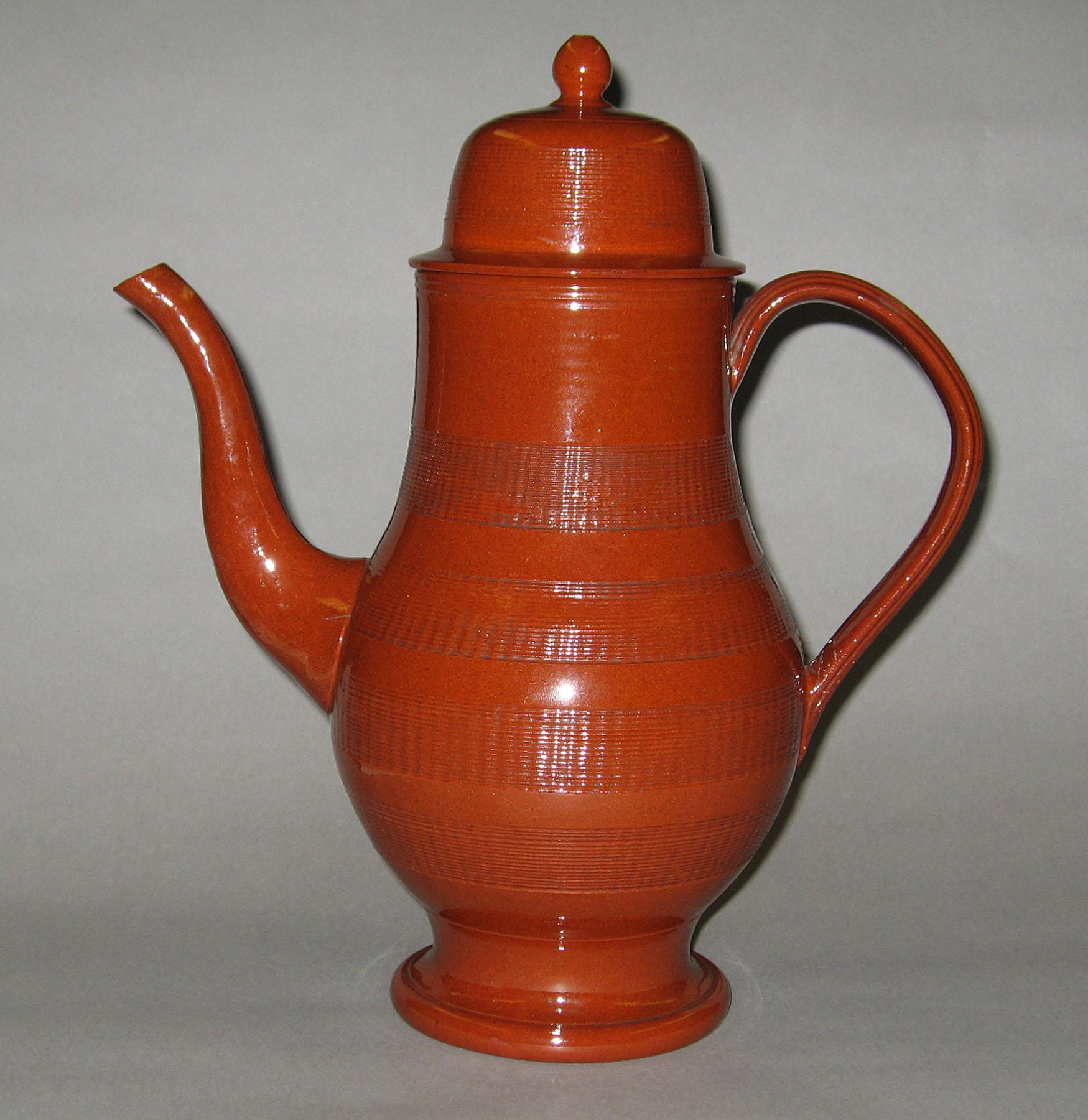
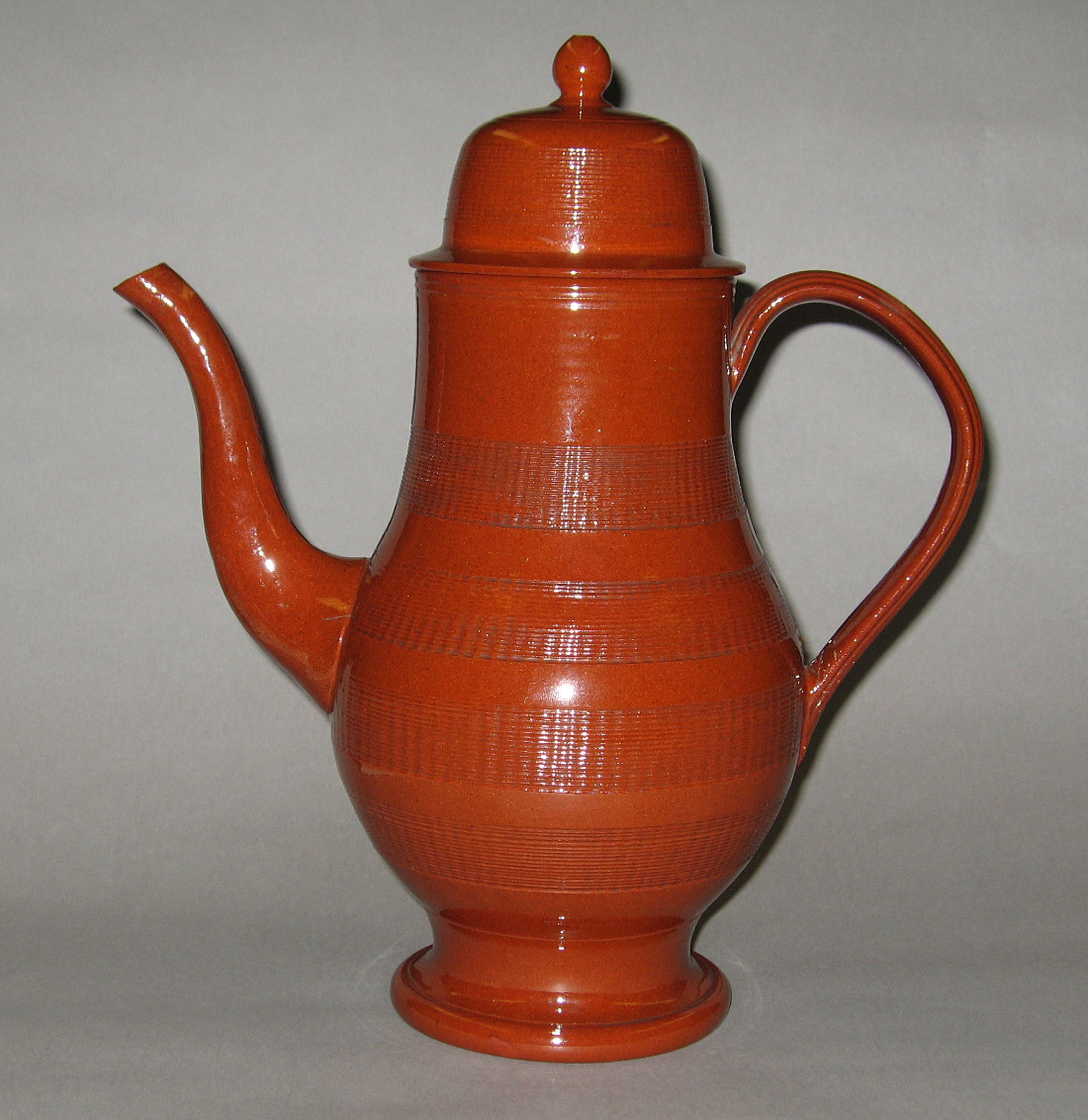
Not On Display
Coffee pot
1770-1780
Description
During the 1760s in England, Staffordshire potter Josiah Wedgwood was instrumental in introducing a new type of decorating tool into the ceramics industry. He modified the design of existing engine-turning (aka rose-and-crown) lathes, leading to an explosion of novel ceramic ornament featuring elegant wave patterns, geometricized motifs, ribbing, fluting, and more. Ultimately, the engine-turning lathe was used on a broad range of English ceramics, from earthenware to stoneware and porcelain. During the latter half of 1700s, engine-turned lead-glazed red earthenware and unglazed red stoneware, primarily from Staffordshire, was imported by American consumers on a fairly large scale. On both types of ware, turned patterns and shapes often resemble one another. Leslie Grigsby, discusses early documentary and archaeological evidence for engine-turned ware in “British Earthenware and Porcelain in Eighteenth Century America” (see References). She writes, “Fragments of engine-turned lead-glazed redware teapots were excavated at the Nims House in Deerfield, Massachusetts, at the Richard Shortridge House site in Portsmouth, New Hampshire and in Arlington, Virginia, at the McKnight's Tavern site. A rare documentary reference to this type of ornament is found in Alexander Bartram[‘s] April 1771 advertisement in the Pennsylvania Gazette, where he offers for sale 'Red Engine Lathe China' .” It is unclear if Bartram’s wares were in glazed earthenware or unglazed stoneware.
Category
Ceramics
Place of Origin
England or United States; Possibly United Kingdom; Europe or North America
Materials
- Earthenware (redware)
- Lead glaze
Museum Object Number
1957.0015.002 A, B
Credit Line/Donor
Gift of Charles F. Montgomery
Share Object
Complete Details
Object Number
1957.0015.002 A, B
Object Name
Coffee pot
Category
Ceramics
Place of Origin
England or United States; Possibly United Kingdom; Europe or North America
Date
1770-1780
Materials
- Earthenware (redware)
- Lead glaze
Techniques
- Thrown
- Engine-turned
- Extruded
Dimensions (inches)
10.8 (H) x 9.6 (L) x 5.3 (Diam)
Dimensions (centimeters)
27.5 (H) x 24.3 (L) x 13.5 (Diam)
Bibliography and Bibliographic Notes
Article: Rickard, Jonathan & Carpentier, Donald. 2004 "The Little Engine that Could: Adaptation of the Engine-Turning Lathe in the Pottery Industry". Ceramics in America. 78-99.
• Engine-turning, rouletting and history for dipped and other English ceramics: whole article.Book: Noel Hume, Ivor. 2001 If These Pots Could Talk: Collecting 200 Years of British Household Pottery.
• Engine-turned lead-glazed redware coffeepot with possible 18th-century ownership in St. Eustatius, in the Caribbean: p. 233, fig. X.19 b, found in use at home there in 1972Book: Beane, Candace & Donald, Ellen. 1994 Archaeology Sets the Tavern Table: Alexandria Tavern Ceramics 1760 to 1820.
• Engine-turned lead-glazed redware teapot excavated McKnight's Tavern, Alexandria, VA: fig. 28.Article: Grigsby, Leslie B. 2005 British Earthenware and Porcelain in Eighteenth Century America, in Gray, Jonathan. 2005. Welsh Ceramics in Context. 2. 71-91.
• Excavated and period references to lead-glazed redware bearing engine-turned ornament: p. 85, no. 4.19, noting teapots excavated at the Nims House (Deerfield, MA0, Richard Shortridge House (Portsmouth, NH), and McKnight's Tavern (Arlington, VA). Also notes Pennsylvania Gazette, Alexander Bartram April 1771 ad offering for sale "Red Engine Lathe China" (possibly unglazed stoneware).