//
For internal use only
On Display: House - Wentworth Room
Tobacco box
Gerrit V. Dyn
1670-1676
Description
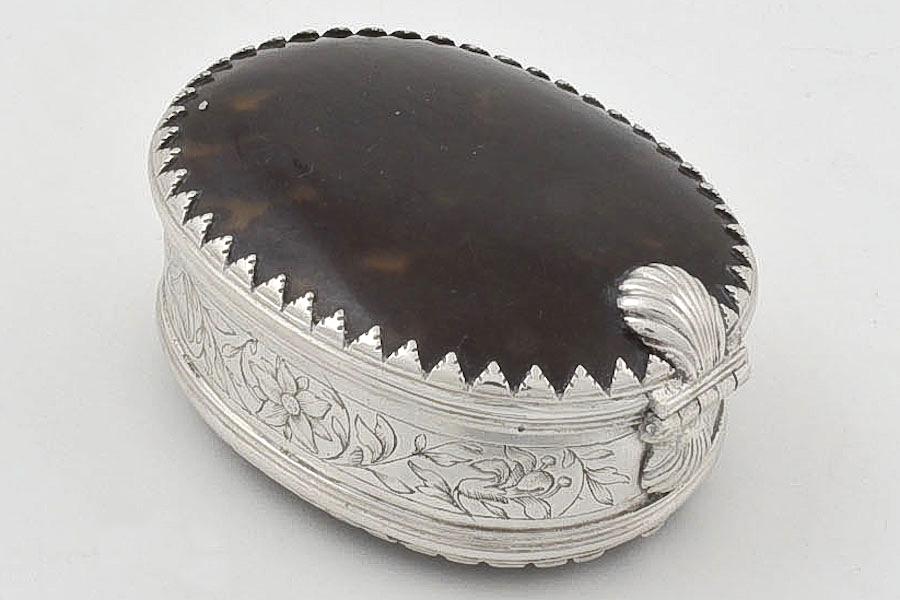
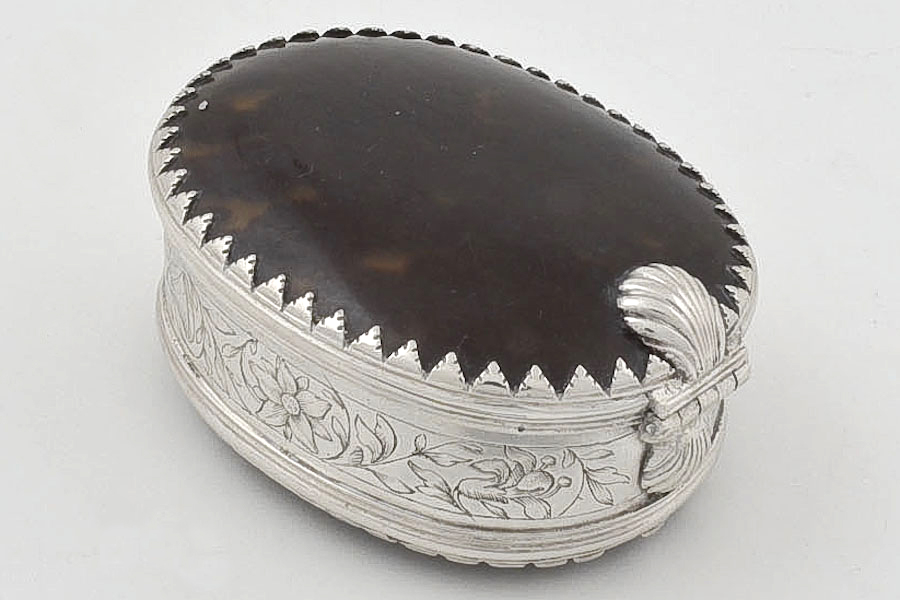
In decorative arts, the term "tortoise shell" is commonly used to describe scutes, or plates, of the shell from Hawksbill, Green, or Loggerhead marine turtles. Turtles once flourished in tropical waters in the Pacific and Atlantic oceans, with the Tortugas, the Cayman Islands, and the Mosquito Coast all having large populations before they were fished to near extinction. Early objects made from tortoise shell were an ultra-luxury for elite consumers in Europe and Asia. As a raw trade material, “shell” could be 8 to 10 times more costly than elephant tusk ivory during the 1700s. By the early 1800s, tortoise shell was in wide use for merchant-class fashion accessories such as tea caddies, magnifying lens cases, fans, boxes and vanity sets as well as handles on many elegant tools, but especially for lady’s hair combs. Tortoise shell as an artistic material transitioned from rare and exotic to widely-desirable and internationally-produced, and then back to scarcity within two centuries. Portable containers designed to keep tobacco or snuff (finely ground tobacco) dry were made in many different materials, some with tinned interiors. This rounded, oval shaped tobacco box is made of tortoise shell on the top and bottom mounted in decoratively engraved silver bands.
Category
Metals
Creator/Artist/Maker
Gerrit V. Dyn (Maker)
Place of Origin
Amsterdam; North Holland; Netherlands; Europe
Materials
- Silver
- Tortoise shell (marine turtle)
Museum Object Number
1965.1351
Credit Line/Donor
Gift of Henry Francis du Pont
Share Object
Complete Details
Object Number
1965.1351
Object Name
Tobacco box
Category
Metals
Creator (Role)
Gerrit V. Dyn (Maker)
Place of Origin
Amsterdam; North Holland; Netherlands; Europe
Date
1670-1676
Mark/Signature/Inscription/Label
Type: Mark
Location: Lid, rim, opposite handle
Inscription: "GD / {B or D]" stamped in shield with a semi-circle drop
Type: Mark
Location: Lid, rim, opposite handle
Inscription: "GD / {B or D]" stamped in shield with a semi-circle drop
Type: Inscription
Location: Exterior, side near opening
Inscription: "I * L * O" engraved
Mark/Signature: Yes
Materials
- Silver
- Tortoise shell (marine turtle)
Techniques
- Molded
- Engraved
Dimensions (inches)
1.575 (H) x 2.756 (W) x 3.622 (L)
Dimensions (centimeters)
4 (H) x 7 (W) x 9.2 (L)
Dimensions (oz)
4.2681