//
For internal use only
On Display: House - Bertrand Vestibule
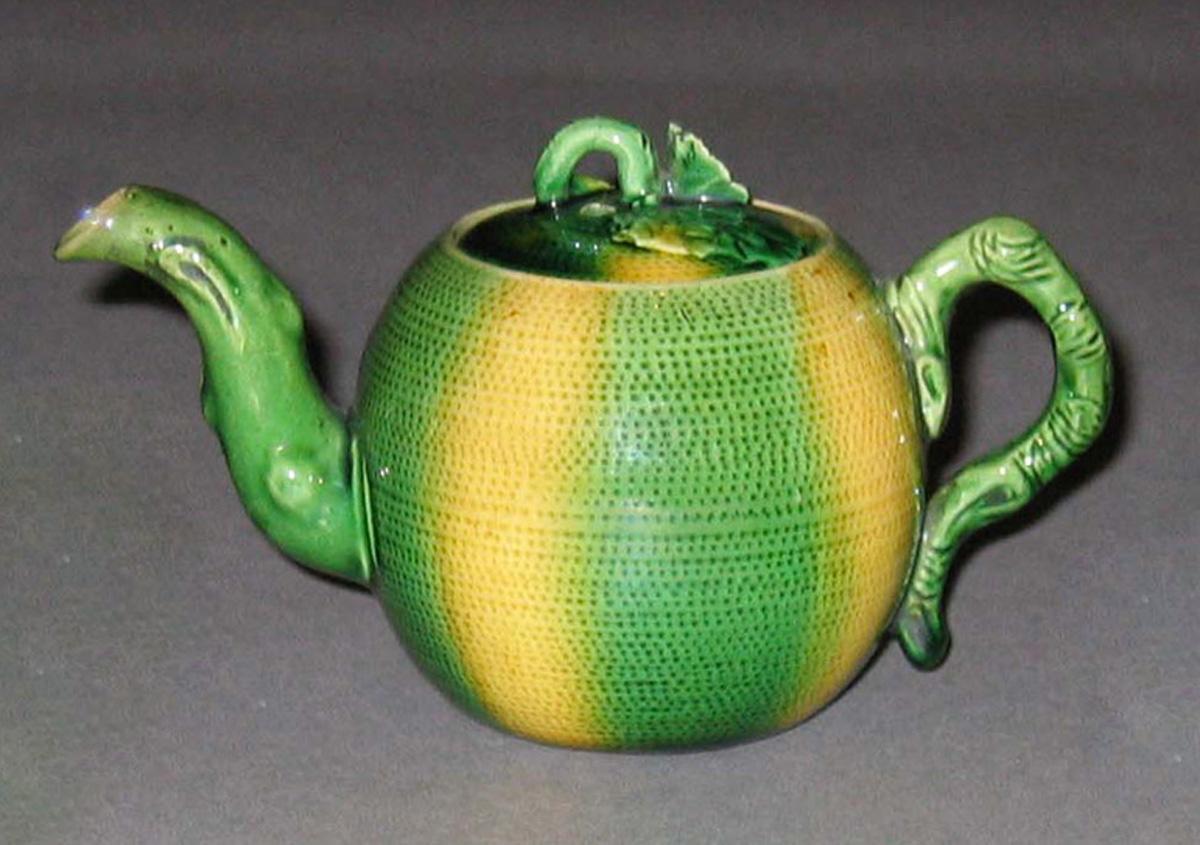
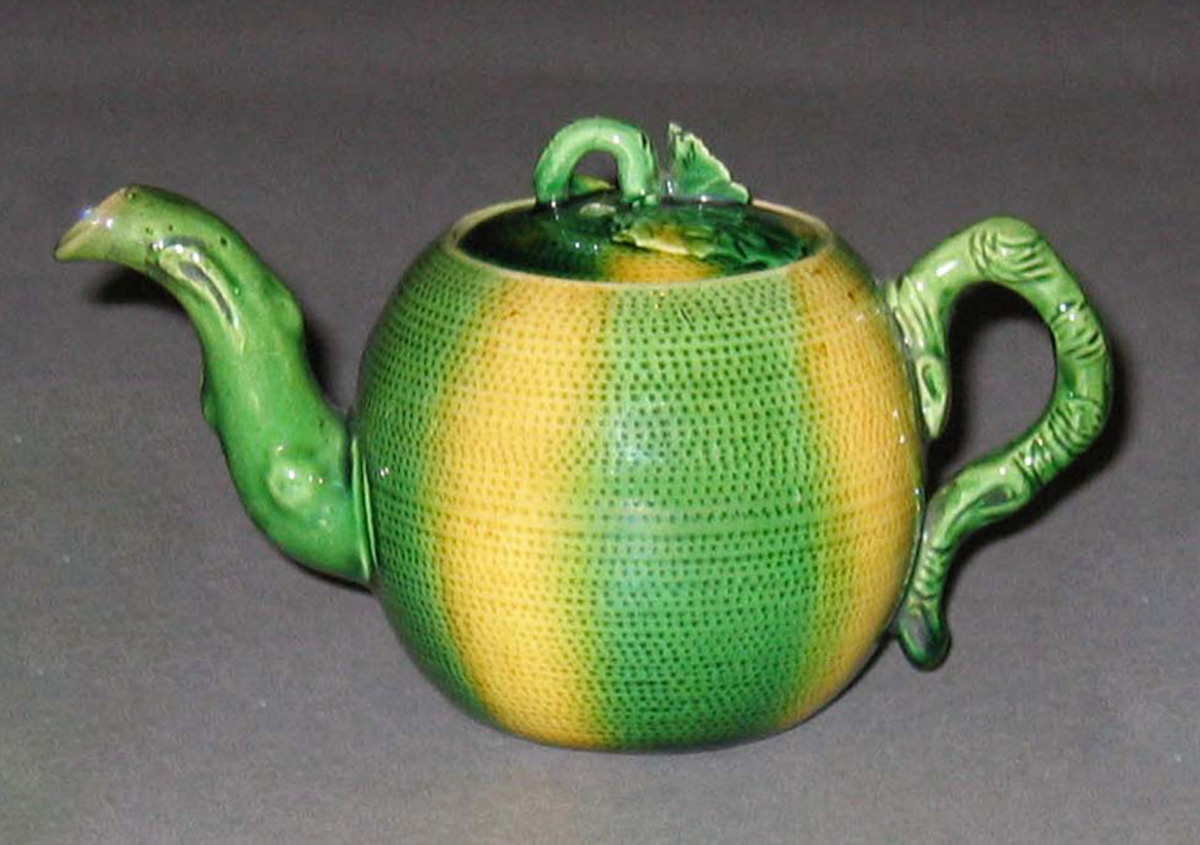
Teapot
1759-1765
Description
So-called melon ware, featuring a cream-colored earthenware body decorated in broad vertical stripes of alternating green and yellow, was a popular commodity among British and colonial consumers. The brilliant-colored glazes used to decorate such wares are associated with Staffordshire potter Josiah Wedgwood, who is said to have developed them in 1759 during his partnership with Thomas Whieldon. Such glazes became available at a time when ornament and shapes inspired by Nature were particularly popular. On creamware, this resulted not only in the production of melon ware but on cauliflower ware (such as the coffeepot 1993.0072), and tortoiseshell ware (such as the dish 1966.1503). Based on archaeological evidence, melon ware was produced in Staffordshire, England at many factories, including Thomas Whieldon’s Fenton Vivian works and the William Greatbatch factory at Lower Lane, Fenton. In New York, the orders and sales accounts of the successful merchant, Frederick Rhinelander, record purchases of melon teapots, cream-ewers, sugars and bowls, as well as cups and saucers. Such ware probably also is referred to in the 1774 estate inventory of widow Mary Westrand, of Providence, Rhode Island, who owned “1 Tea Pot green and yellow.” On October 23, 1773, Deerfield, Massachusetts, shopkeeper, John Williams ordered from the Boston merchant Ebenezer Bridgham, among other English earthenware, “1 Gro[ss of] Mellon Teas.” Further north, archaeological evidence found in Portsmouth, New Hampshire at the Richard Hart House and Deer Tavern sites includes fragments of melon teapot bases. Attempts at imitating such ware in America are evidenced by early 1770s biscuit fragments of melon ware excavated at the site of the works of potter John Bartlam of Charleston, South Carolina. For melon ware at Winterthur, see 1955.0136.012 (Teapot), 2006.0006.001 (Coffee cup), 2024.0014.028 (Tea bottle), and 2024.0014.029 (Teapot).
Category
Ceramics
Place of Origin
Staffordshire; England; United Kingdom; Europe
Materials
- Earthenware (creamware)
- Lead glaze
Museum Object Number
1955.0136.012 A, B
Credit Line/Donor
Museum purchase
Share Object
Complete Details
Object Number
1955.0136.012 A, B
Object Name
Teapot
Category
Ceramics
Place of Origin
Staffordshire; England; United Kingdom; Europe
Date
1759-1765
Materials
- Earthenware (creamware)
- Lead glaze
Techniques
- Thrown
- Rouletted
- Press-molded
- Painted
Dimensions (inches)
3 (H) x 5.25 (L) x 2.75 (Diam)
Dimensions (centimeters)
7.62 (H) x 13.335 (L) x 6.985 (Diam)
Measurement Notes
Length = diameter plus handle and spout.
Bibliography and Bibliographic Notes
Article: Grigsby, Leslie B. 2005 British Earthenware and Porcelain in Eighteenth Century America, in Gray, Jonathan. 2005. Welsh Ceramics in Context. 2. 71-91.
• Published: p. 76, pl. 4.7Article: Schwind, Arlene Palmer. 1984 The Ceramic Imports of Frederick Rhinelander, New York Loyalist Merchant. Winterthur Portfolio. 19: 21-36.
• Published: p. 30, Fig. 9Book: Barker, David. 1991 William Greatbatch: a Staffordshire Potter.
• Melon ware excavated at the Greatbatch factory waste site: pp. 254-55, pl. 182.Book: Volk, Joyce Geary. 2006 The Warner House: A Rich and Colorful History.
• Melon ware fragment excavated at Warner House, Portsmouth NH: pp. 78-79, fig. 7.7, unclear, but likely teaware form.Article: Grigsby, Leslie B. 2005 British Earthenware and Porcelain in Eighteenth Century America, in Gray, Jonathan. 2005. Welsh Ceramics in Context. 2. 71-91.
• Melonware among American period references and archaeology: pp. 76-77, fog. 4.7Book: Grigsby, Leslie B. 1990 The Henry H. Weldon Collection: English Pottery, Stoneware and Earthenware 1650-1800.
• Melonware water bottle, tea canister, and teapot, the last with applied large single leaf: pp. 186-87, no. 88, Staffordshire, c. 1765. Notes melon ware wasters found at Thomas Whieldon's Fenton Vivion factory site (1747-80) and at William Greatbatch's Lower Lane, Fenton waste site (1765-75 period). Other factories also produced such wares.Book: Halfpenny, Patricia A. & Williams, Peter. 2000 A Passion for Pottery: Further Selections from the Henry H. Weldon Collection.
• Melonware small jugs (3), one with a cover and two with single applied leaf sprigs: p. 139, no. 80, Staffordshire, c. 1765