//
For internal use only
On Display: House - Fraktur Room
Spectacles (Eyeglasses)
Benjamin Martin
1756-1800
Description
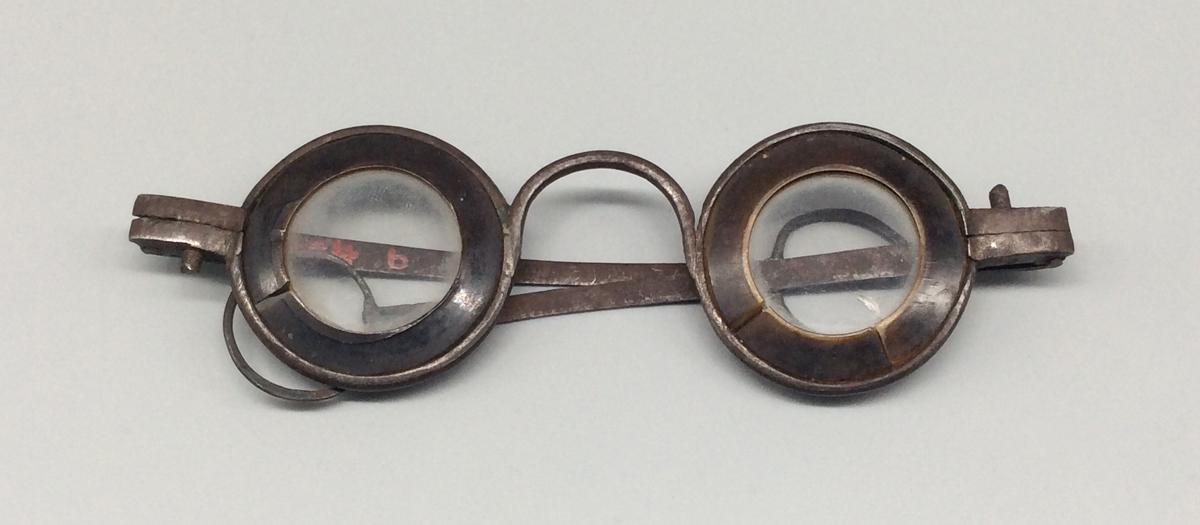
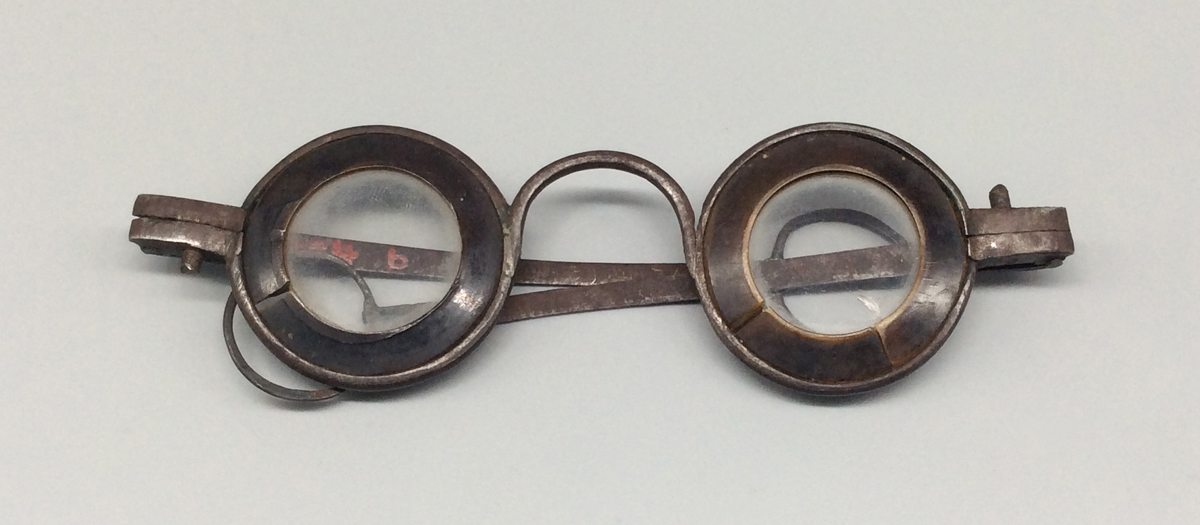
These spectacles, called “Visual Glasses,” have round iron eye rims with a C-shaped bridge. The straight temples are stamped with the number, “30,” indicating the focal length. The tips have circles so that a cord could be attached to allow the glasses to be hung around the neck. Within each eye rim is a quarter inch wide horn rim called a “Martin’s Margin” named after their inventor, Benjamin Martin, a scientific instrument maker from London, England. Martin created these glasses in response to his own need for reading glasses and published “An Essay on Visual Glasses” in 1756 describing how his invention was superior to common spectacles. The translucency of the horn was intended to protect the eyes from excessive light. Additionally, the glass lenses can be turned inward to allow the axis to point towards the viewer’s objective. The flip-top case with the spectacles has an elongated oval shape with four incised lines bordering the opening. Within this case resides a manuscript written by Samuel W. Pennypacker (1843-1916), a notable Philadelphia politician. Samuel traced the lineage of these spectacles back four generations to their original owner, John Pennebacker (1713-1784), son of Hendrick Pannebecker (1674-1754) who was a surveyor for William Penn.
Category
Metals
Creator/Artist/Maker
Benjamin Martin (Designer)
Place of Origin
London; London; England; United Kingdom; Europe
Materials
- Iron
- Glass
- Horn
Museum Object Number
1961.1174 B
Credit Line/Donor
Bequest of Henry Francis du Pont
Share Object
Complete Details
Object Number
1961.1174 B
Object Name
Spectacles (Eyeglasses)
Category
Metals
Creator (Role)
Benjamin Martin (Designer)
Place of Origin
London; London; England; United Kingdom; Europe
Origin Notes
Probably London, England (Fennimore, 2004, 342).
Date
1756-1800
Mark/Signature/Inscription/Label
Type: Mark
Location: Side of left bow
Inscription: "30" stamped incuse.
Mark/Signature: Yes
Materials
- Iron
- Glass
- Horn
Techniques
- Wrought
Dimensions (inches)
1.5 (H) x 4.055 (W) x 4.724 (L)
Dimensions (centimeters)
3.7 (H) x 10.3 (W) x 12 (L)
Bibliography and Bibliographic Notes
Book: Fennimore, Donald L. 2004 Iron at Winterthur.
• Published: pp. 342-345, cat. no. 171.Book: Rosenthal, J. William. 1996 Spectacles and Other Vision Aids A History and Guide to Collecting.
• Similar object: p. 108, fig. 198.Book: Davidson, Derek C. 1989 Spectacles, Lorgnettes and Monocles. 32.
• Similar object: p. 9.