//
For internal use only
On Display: House - Fraktur Room
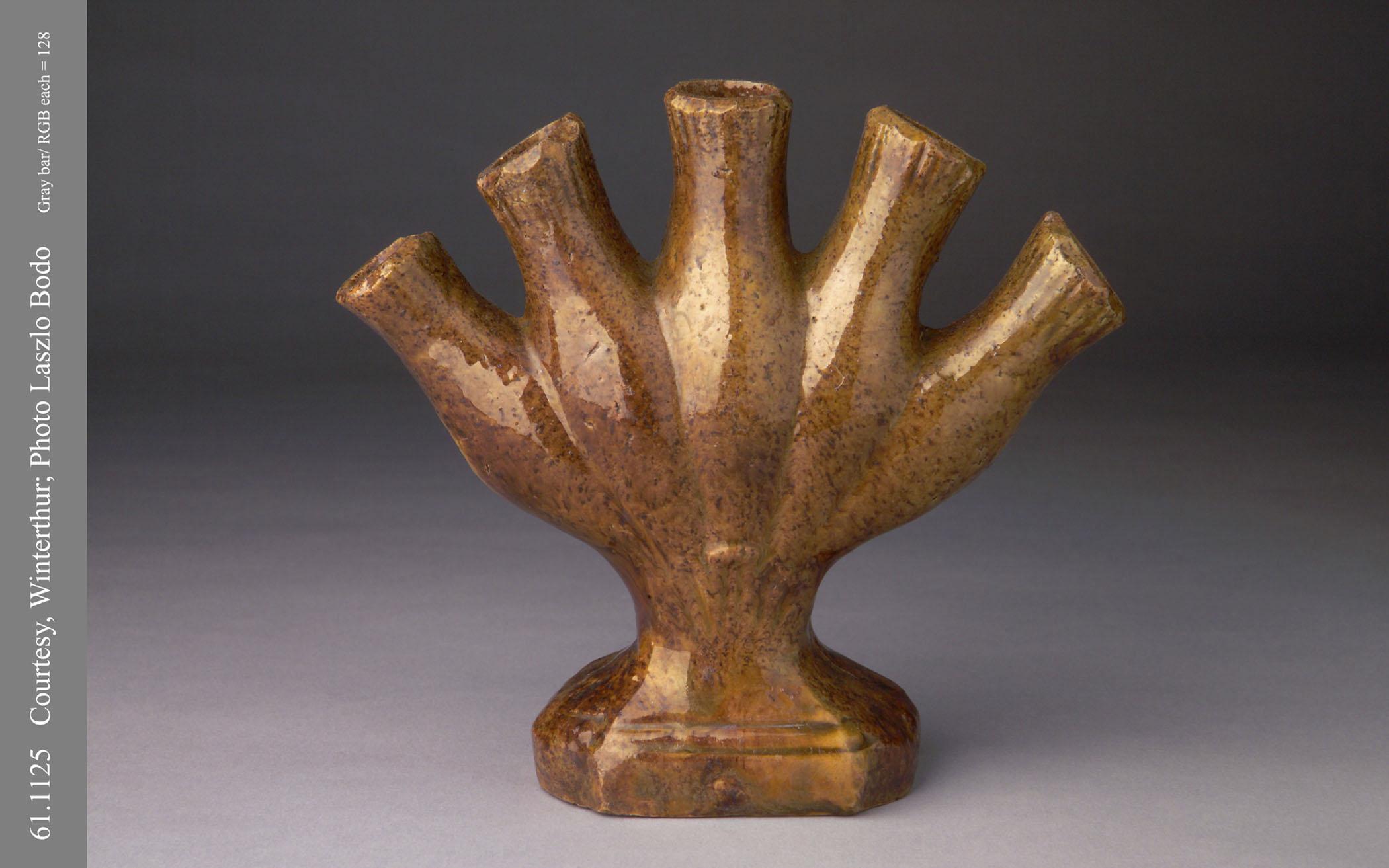
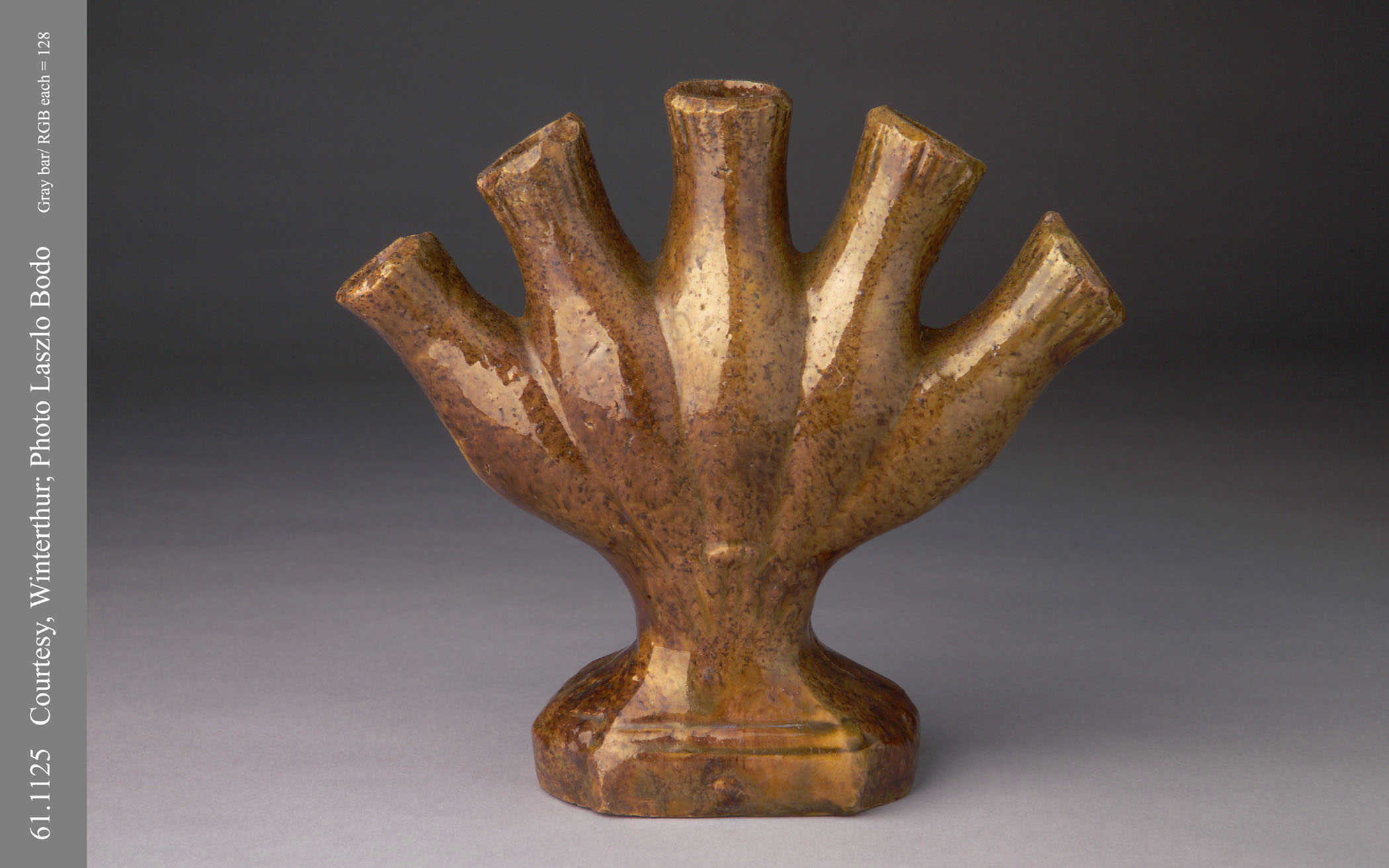
Flower container (Quintal flower horn or five-finger vase)
1800-1850
Description
Multi-nozzled, circular-section flower containers are known from the Near East as early as 2500 BC, but the flattened types referred to in England as “Quintals,” Quintal Flower Horns,” or “Five Fingered Flower Pots” derived from late 17th-century tin-glazed earthenware (Delftware) vases from the Netherlands. Fashionable Dutch examples from the Greek A factory were excavated at Queen Mary’s famous palace at Het Loo. The long-term, widespread popularity of quintals is hinted at in illustrated period catalogues from England. The 1798 catalogue of the James and Charles Whitehead factory of Hanley, Staffordshire, was published in English, German, Dutch and French and illustrates a vase of a generally similar shape to the example shown here. Well into the 1800s, quintals were made in English pearlware, lusterware and other ceramics for both domestic and foreign markets. Evidence for such vessels in America includes this somewhat crudely modeled earthenware example, possibly molded off of an English original.
Category
Ceramics
Place of Origin
United States; North America
Materials
- Earthenware (redware)
- Lead glaze
Museum Object Number
1961.1125
Credit Line/Donor
Bequest of Henry Francis du Pont
Share Object
Complete Details
Object Number
1961.1125
Object Name
Flower container (Quintal flower horn or five-finger vase)
Category
Ceramics
Place of Origin
United States; North America
Date
1800-1850
Materials
- Earthenware (redware)
- Lead glaze
Techniques
- Molded
Dimensions (inches)
6.969 (H) x 2.598 (W) x 7.598 (L)
Dimensions (centimeters)
17.7 (H) x 6.6 (W) x 19.3 (L)
Measurement Notes
OW at base.
Bibliography and Bibliographic Notes
Article: Grigsby, Leslie B. 05//2016 Flowery Thoughts: Ceramic Vases & Floral Ornament at Winterthur. Brandywine River Museum Antiques Show (catalogue). 6-12.
• Published: p. 10, pl. 11Book: Cooper, Wendy A. 2002 An American Vision: Henry Francis du Pont's Winterthur Museum.
• Published: pp. 134-5, in situ in Fraktur RoomCatalogue: Minardi, Lisa. 2015 A Colorful Folk: Pennsylvania Germans & the Art of Everyday Life.
• Published: fig. 44, p.35Book: Walton, Peter. 1976 Creamware and Other English Pottery at Temple Newsam House, Leeds.
• Staffordshire or Yorkshire creamware models and period names: pp. 138-39, nos. 550-52. No. 550 notes Leeds (c. 1814) and Castleford (1796) Pottery pattern books use "Quintal Flower Horn" for form; Whitehead Pattern book (1798) "Five Fingered Flower Pot"Book: van Aken-Fehmers, Marion S. 2007 Delfts aardewerk: Geschiedenis van een nationaal product. VI.
• Dutch delft much earlier quintals of somewhat similar form: p. 124, no. 2.01 and pp. 206-07, nos. 7.01-.02, blue and white, from Greek A factory, 1690-95Article: Austin, John C. 2006 J. Palin Thorley (1892-1987), Potter and Designer: Part 2, Williamsburg. Ceramics in America. 178-216.
• 18th century and modern (Palin Thorley, Williamsburg, VA) "posy holders" or quintals in creamware: pp. 192-193, figs. 37-43; p. 207, fig. 81; p. 209, fig. 86Book: Berrall, Julia S. 1968 A History of Flower Arrangement.
• Multi-nozzled, circular-section flower container from Egypt, 2500 BC: p. 11, fig. 1