//
For internal use only
Not On Display
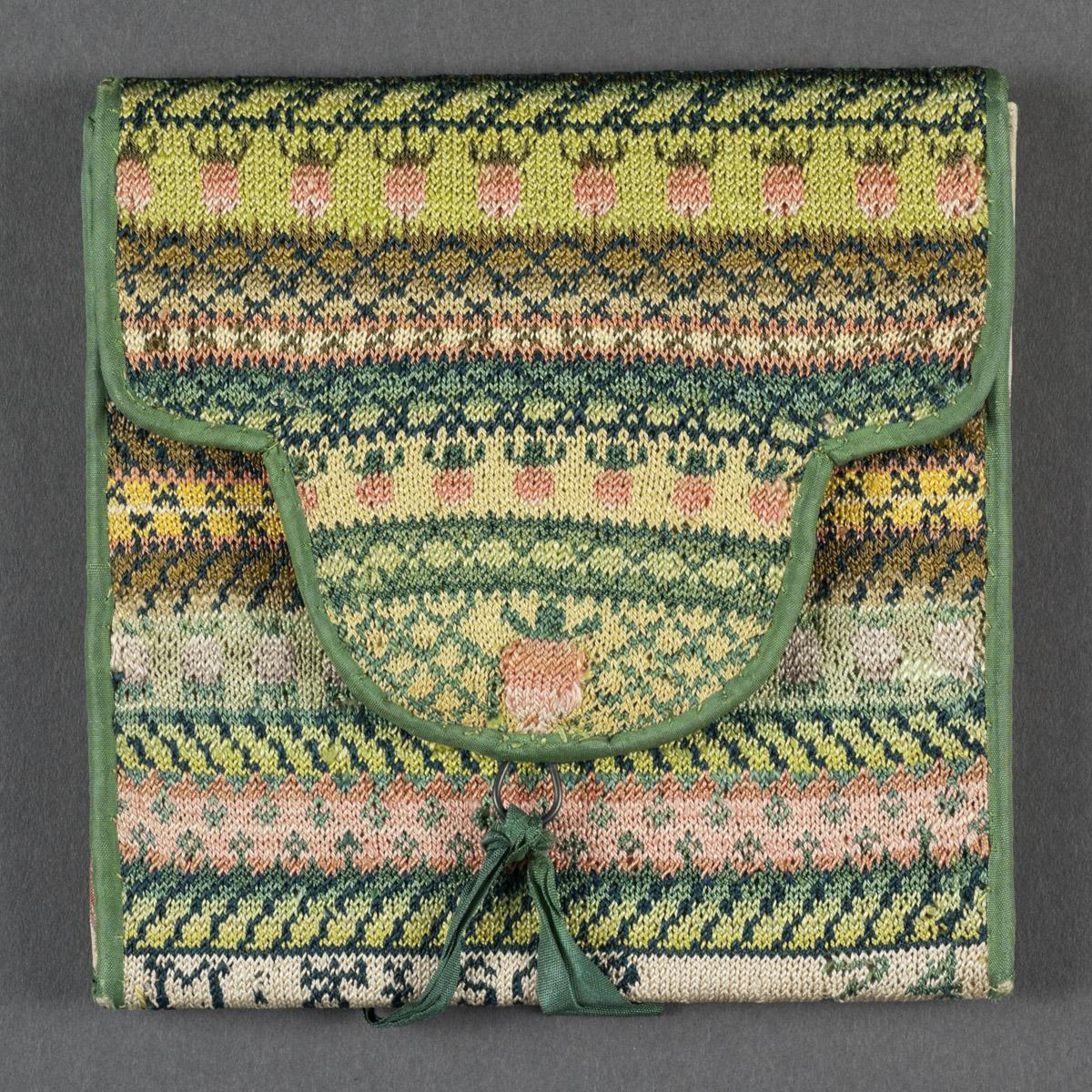
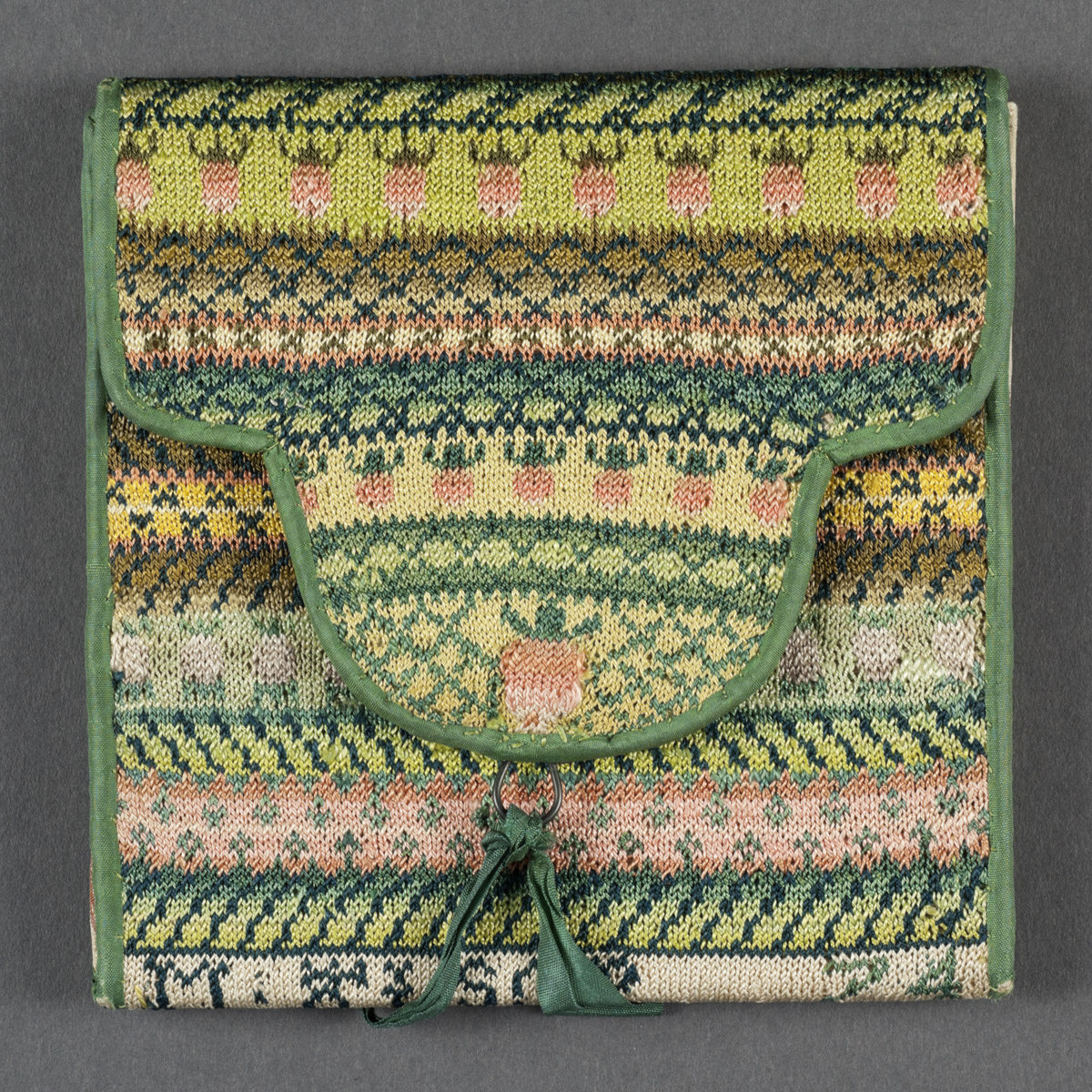
Pocketbook
Mary Wright Alsop
Description
Mary Alsop was left a wealthy widow with a large family when her husband died in 1776. As Dr. Marla Miller states in The Needle’s Eye: Women and Work in the Age of Revolution, “…steady production of sophisticated ornamental work is inseparable from the family’s access to slave labor. Before Richard’s death, the Alsop household included at least two enslaved men, Acra and Quash, and a woman, Catherine Barrett. By 1790, five slaves helped care for Mary’s large family. Catherine Barrett would be freed in 1794, while Mary’s 1795 will instructed her children to continue to provide for an ‘aged Negro’ named Jenny” (Miller 101). A skilled needlewoman, in later life Mary knit and embroidered pocketbooks and reticules (drawstring bags) as gifts for her children and grandchildren. On many she inscribed her name, her age at the time of making, and the name of the recipient. Clearly her grandchildren did not visit as often as she would have liked, as she wrote to one grandson: "I send you a Purse which I knit for you sometime ago, hoping to have the satisfaction of giving it to you myself. Receive it as a small testimony of my affection."
Category
Textiles (Needlework)
Creator/Artist/Maker
Mary Wright Alsop (Maker)
Place of Origin
Middletown; Connecticut; United States; North America
Materials
- Silk
- Linen
- Canvas
- Cardboard
Museum Object Number
1955.0003.003
Credit Line/Donor
Gift of Henry Francis du Pont
Share Object
Complete Details
Object Number
1955.0003.003
Object Name
Pocketbook
Category
Textiles (Needlework)
Creator (Role)
Mary Wright Alsop (Maker)
Place of Origin
Middletown; Connecticut; United States; North America
Mark/Signature/Inscription/Label
Type: Inscription
Location: in band
Inscription: "F: Alsop 1814" (embroidered)
Type: Signature
Location: at the fold
Inscription: "M. Alsop 74" (embroidered)
Type: Label
Location: on note in pocket
Inscription: "worked by my great grand / mother Mary Wright Alsop / for her daughter Fanny Alsop / in 1814. (M.W.A. aged 74 / Middletown Connecticut" (in graphite)
Mark/Signature: Yes
Materials
- Silk
- Linen
- Canvas
- Cardboard
Techniques
- Knit
- Woven (plain)
- Sewn
Construction Description
Hand-knit, Hand-embroidered
Dimensions (inches)
4.625 (H) x 4.625 (W)
Dimensions (centimeters)
11.748 (H) x 11.748 (W)
Measurement Notes
OH is closed
Bibliography and Bibliographic Notes
Electronic: Scott, Susan Holloway. 10/28/2024 The Pocketbooks and Purses of Mary Wright Alsop. Long Thread Media 03/10/2025 https://pieceworkmagazine.com/the-pocketbooks-and-purses-of-mary-wright-alsop/
• Published: in discussion of Mary Wright Alsop pocketbooks. (Note: hard copy of magazine published Summer 2024 issue.)Journal: Krueger, Glee. "A Middletown Cameo: Mary Wright Alsop and Her Needlework.". Connecticut Historical Society Museum & Library Vol. 52, No.3-4 Summer/Fall 1987
• Published: pp. 188-189, fig. 23; pp. 125-137, biography of MaryBook: Swan, Susan Burrows. 1977 Plain & Fancy: American Women and Their Needlework, 1700-1850.
• Published: p.116, pl. 20Book: Swan, Susan Burrows. 1995 Plain and Fancy: American Women and their Needlework, 1650-1850.
• Published: p. 148, pl. 22Book: Fennimore, Donald L., et al. 1994 Eye for Excellence: Masterworks from Winterthur.
• Published: pp. 98-99