//
For internal use only
On Display: House - Kershner Parlor
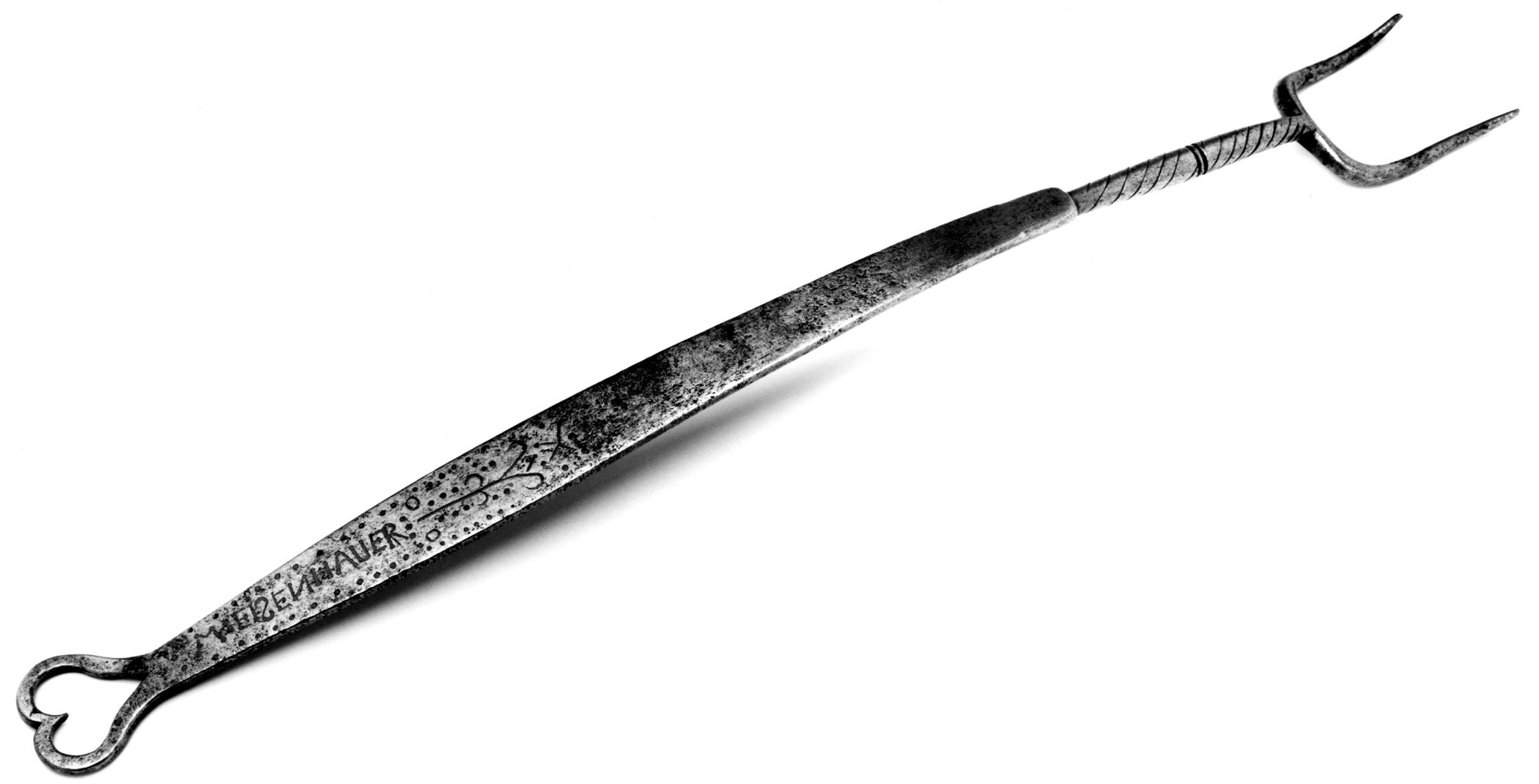
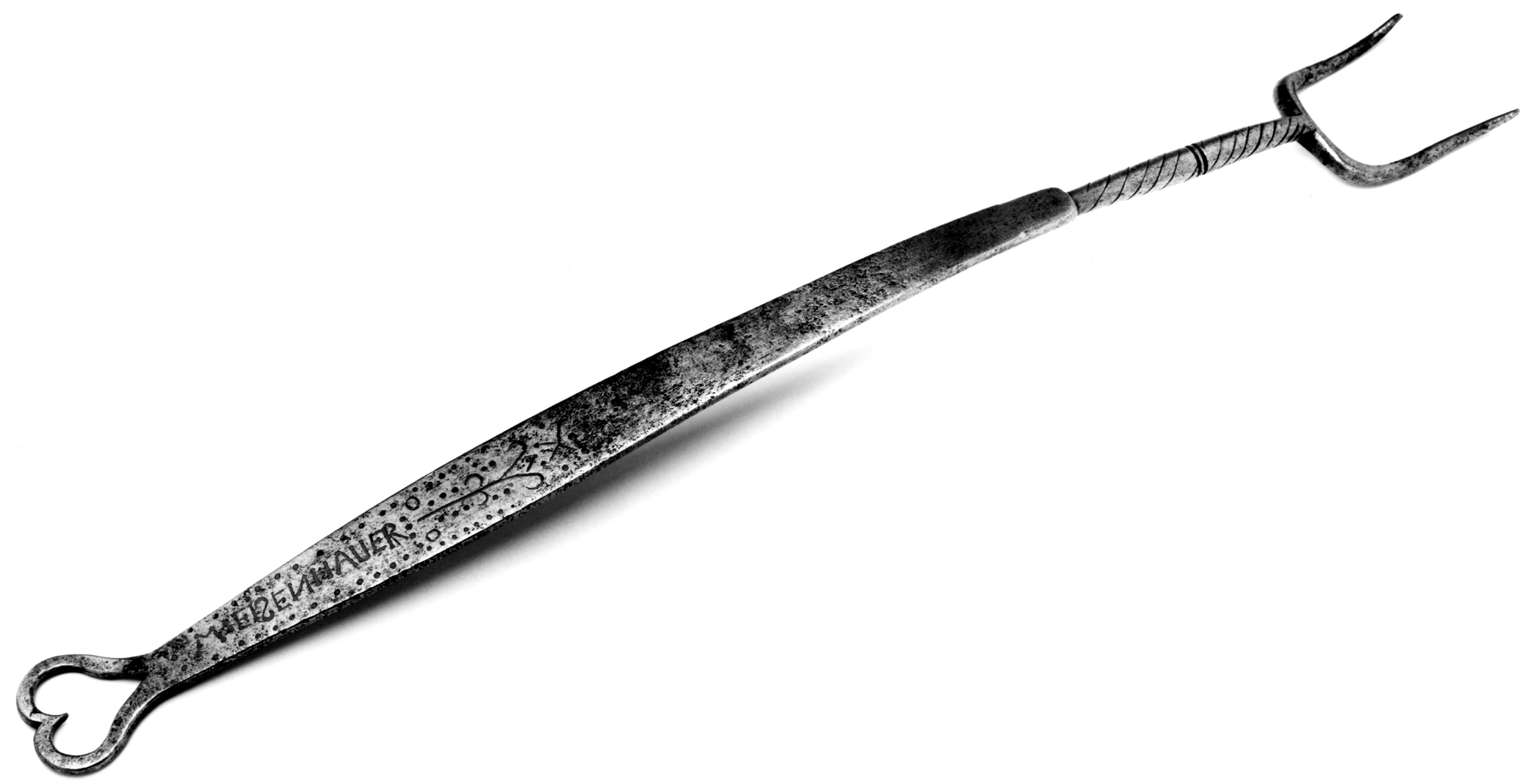
Fork (Cooking fork)
Martin Eisenhauer
1776
Description
A long-handled cooking fork, sometimes called a flesh fork because it was useful for meat dishes, was an indepsensible utensil for cooking at an open hearth or over coals. This example holds the surname of a German-immigrant blacksmithing family, Eisenhauer (translated, "Iron cutter"), who first settled in Tulpenhocken, Pennsylvania in the 1740s. The fork may have been made by an Eisenhauer family blacksmith (likely Martin) for another family member with a first name beginnign with "M" or it was the property of the smith himself. The maker further enlivened this refined handle's surface with a perimeter of dots and a central reflexive tree-like ornament all called out with golden color brass inlay. The same technique outlines the date "1776" on the underside.
Category
Metals
Creator/Artist/Maker
Martin Eisenhauer (Probable maker)
Place of Origin
Hereford Township; Pennsylvania; Berks; Mid-Atlantic; United States; North America
Materials
- Iron
- Brass
Museum Object Number
1960.0792
Credit Line/Donor
Bequest of Henry Francis du Pont
Share Object
Complete Details
Object Number
1960.0792
Object Name
Fork (Cooking fork)
Category
Metals
Creator (Role)
Martin Eisenhauer (Probable maker)
Place of Origin
Hereford Township; Pennsylvania; Berks; Mid-Atlantic; United States; North America
Date
1776
Mark/Signature/Inscription/Label
Type: Mark
Location: Handle, surface at center
Inscription: "M:EISENHAUER", stamped incuse with brass inlay.
Type: Mark
Location: Handle, underside at center
Inscription: "1776", stamped incuse with brass inlay.
Mark/Signature: Yes
Materials
- Iron
- Brass
Techniques
- Wrought
Dimensions (inches)
1.7 (W) x 15.2 (L)
Dimensions (centimeters)
4.4 (W) x 38.5 (L)
Bibliography and Bibliographic Notes
Book: Fennimore, Donald L. 2004 Iron at Winterthur.
• Published: pp. 264-265, cat. no. 129b.Book: Ames, Kenneth L. 1977 Beyond Necessity: Art in the Folk Tradition.
• Published on p. 78, fig.90; p.115, cat. no. 86.Book: Hutchins, Catherine E., et al. 1983 Arts of the Pennsylvania Germans.
• Published: fig. 204, p. 213.Book: Barons, Richard I. 1976 The American Hearth.
• Published: fig. 32.Article: Mangieri, Scott. 07//2008 "Decoration for the Everyday: Early American Iron Cooking Utensils,". Antiques and Fine Art. 138-139.
• Published: fig. 3, p. 139.