//
For internal use only
Not On Display
Plate
Thomas Carll Smith, Union Porcelain Works, Richard Briggs
1881-1893
Description
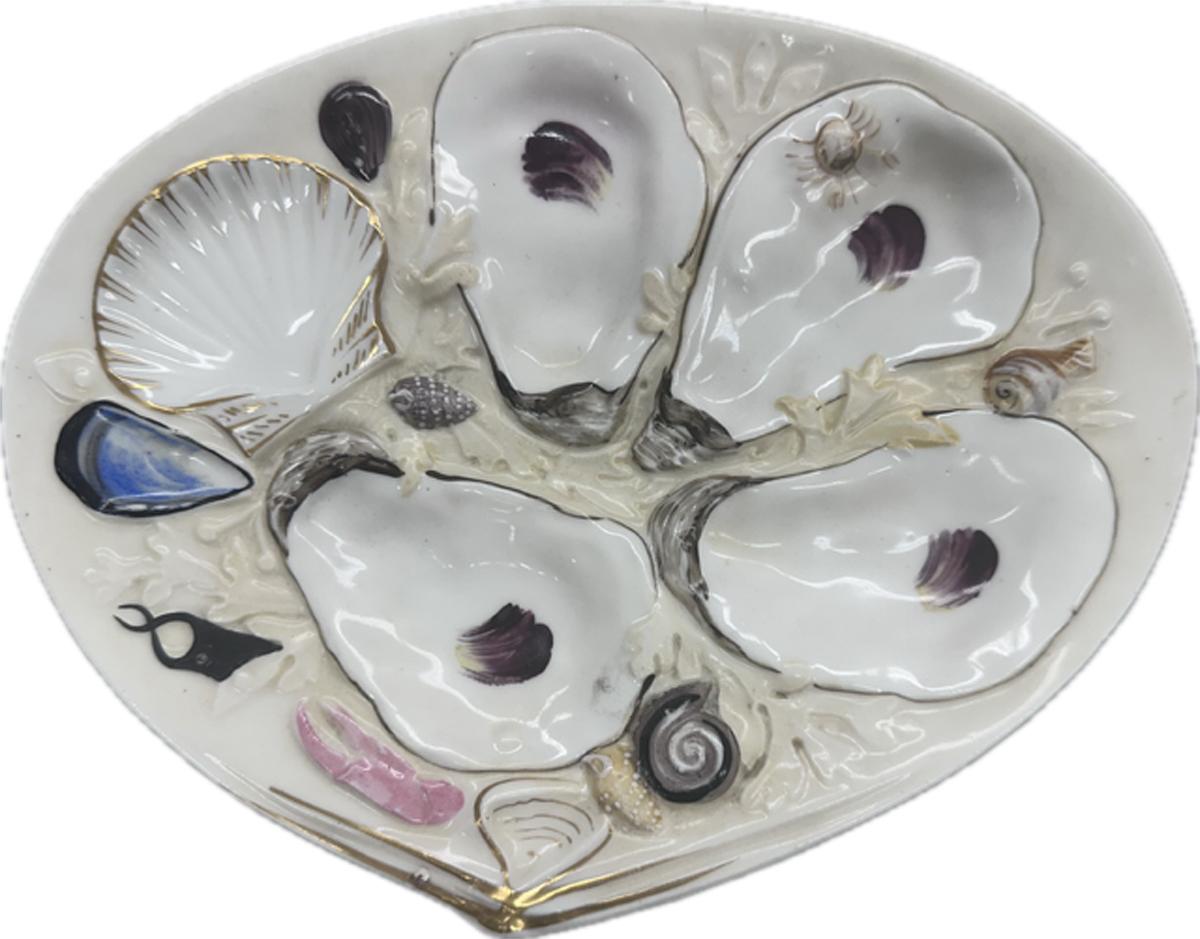
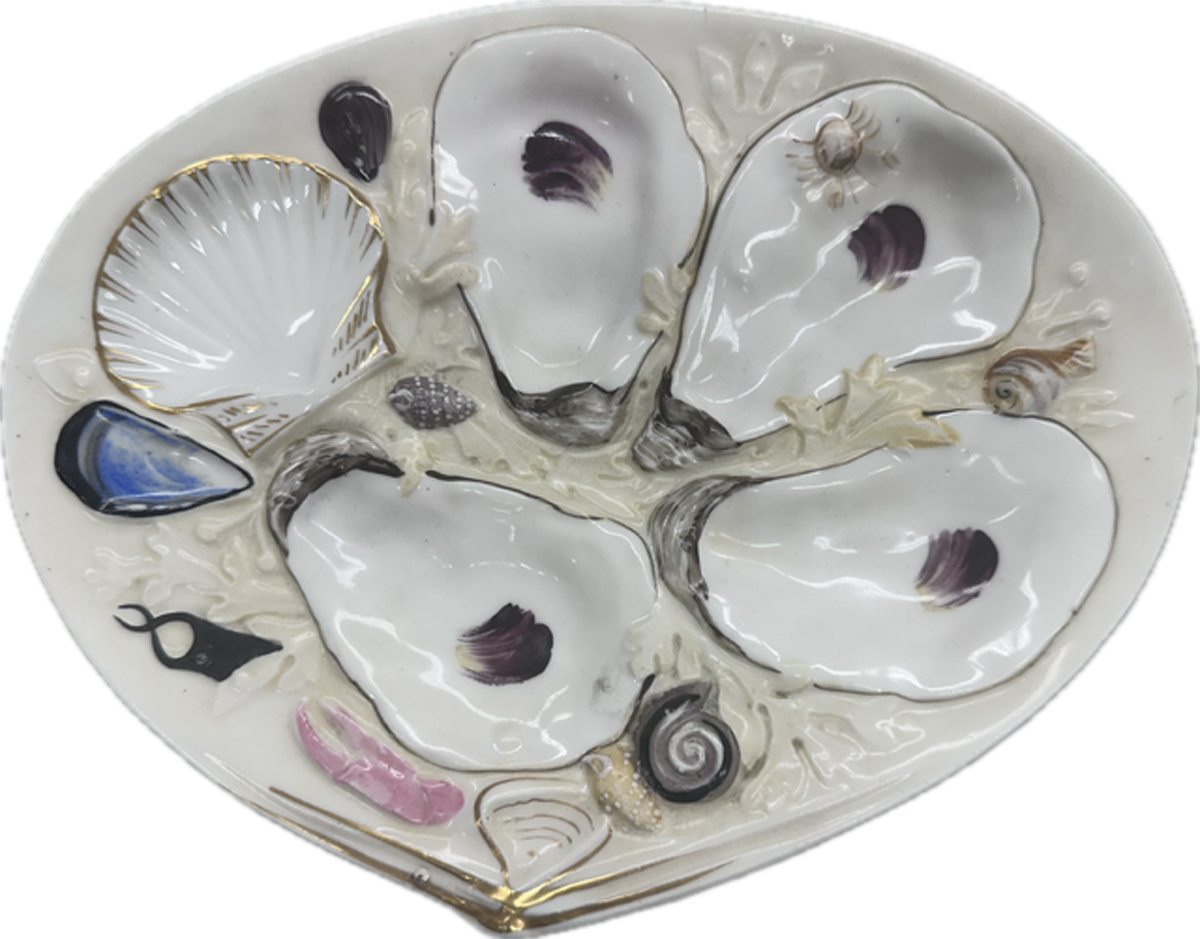
Oysters had their heyday in American cuisine in the second half of the 19th century. With the opening of the Erie Canal and the advent of the railroad, Americans inland had unprecedented access to fresh oyster shipped from coastal hubs as well as oysters preserved by pickling and canning. Also during this time period, Victorian dining grew more elaborate to include more and more courses, each with its own specialized dishes and utensils. Formal dinners often began with a raw oyster course, and hosts could impress their guests by serving the popular shellfish on small, special oyster plates with wells for each individual oyster and often a lemon half. This oyster plate by Union Porcelain Works features an overall sea-life theme with its clamshell shape, wells shaped like oyster shells, and filler ornament featuring seaweed, smaller seashells, and even a small oyster crab. Thomas C. Smith, director of Union Porcelain Works in Greenpoint (Brooklyn), New York, patented this design in 1881. In describing his design, he boasted in the realistic shell designs and overall nautical theme of his plate: “The difference between my invention and other similar designs now in use is, while others represent shells modeled in conventional form and attached together without meaning...my design represents truthfully modeled seaweed, oyster shells, shell-fish, and sea-shells placed upon the internal side of a half clam-shell” (U.S. Design Patent 12,105). Under Smith’s leadership, Union Porcelain Works became the first American manufacturer to successfully hard-paste porcelain, or “true porcelain,” on a commercial scale. The company is largely remembered for some of its most showy pieces such as the jug depicting “Truthful James and the Heathen Chinee” (2020.0008) or objects such as the “Liberty teacup” (2021.0009.001), which adorned the Union Porcelain Works display at the Philadelphia Centennial Exposition. However, the company’s main production was in more commonplace tablewares and architectural trimmings. As evidenced by the retailer’s mark on the plate’s underside, Union Porcelain Works made this oyster plate especially for Richard Briggs, a prominent crockery and glass dealer in Boston. While Briggs was by no means the only one to sell Union Porcelain Works oyster plates, he wanted his customers to know that the company made this specific batch of plates for especially for Briggs’s business. Richard Briggs sold a vast variety of ceramics and glass objects, the most famous of which was the Longfellow jug by Wedgwood (2021.0019.003). Briggs had his own staff of in-house decorators who could paint enamels onto premade objects to suit his customers’ different tastes and budgets, and it is likely that one of Briggs’s decorators added the colored decoration onto what arrived as a plain, cream-colored molded plate.
Category
Ceramics
Creator/Artist/Maker
Thomas Carll Smith (Designer)
Place of Origin
Greenpoint (Brooklyn); New York; United States; North America
Materials
- Porcelain (hard-paste)
- Enamel
- Gilding
Museum Object Number
2026.0005
Credit Line/Donor
Museum purchase with funds provided by the Winterthur Founder's Circle
Share Object
Complete Details
Object Number
2026.0005
Object Name
Plate
Category
Ceramics
Creator (Role)
Thomas Carll Smith (Designer); Union Porcelain Works (Manufacturer); Richard Briggs (Retailer)
Place of Origin
Greenpoint (Brooklyn); New York; United States; North America
Date
1881-1893
Mark/Signature/Inscription/Label
Type: Mark
Location: Bottom
Inscription: U.P.W./PAT. JAN. 4, 1881
Type: Mark
Location: Bottom, in banner
Inscription: RICHARD BRIGGS/ BOSTON/ MAss.
Materials
- Porcelain (hard-paste)
- Enamel
- Gilding
Dimensions (inches)
6.7 (H) x 8.7 (W) x 0.9 (D)
Dimensions (centimeters)
17.1 (H) x 22 (W) x 2.3 (D)