//
For internal use only
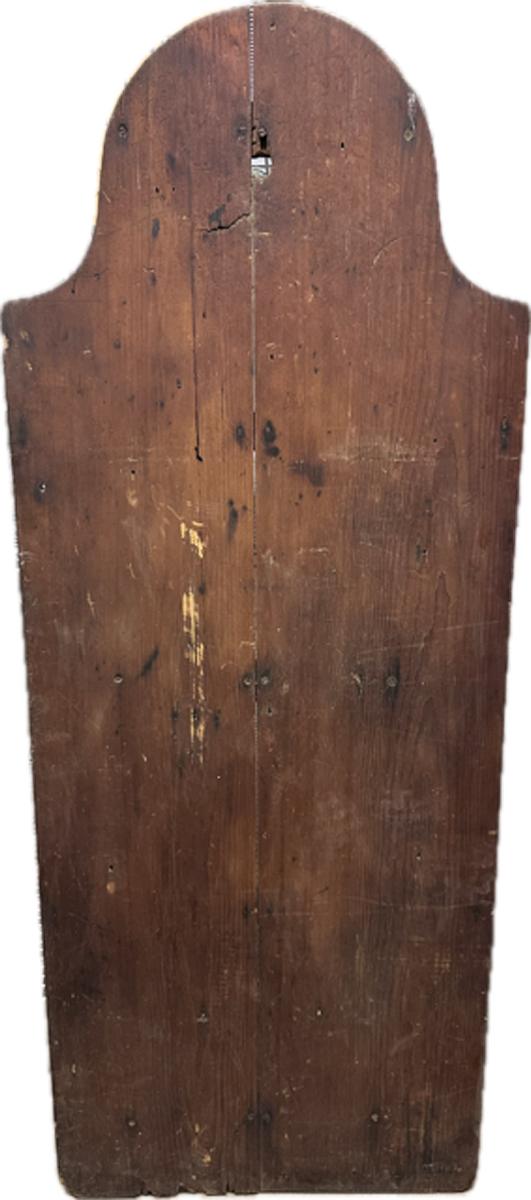
Not On Display
Tool (for textiles) (Ironing board)
1825-1875
Description
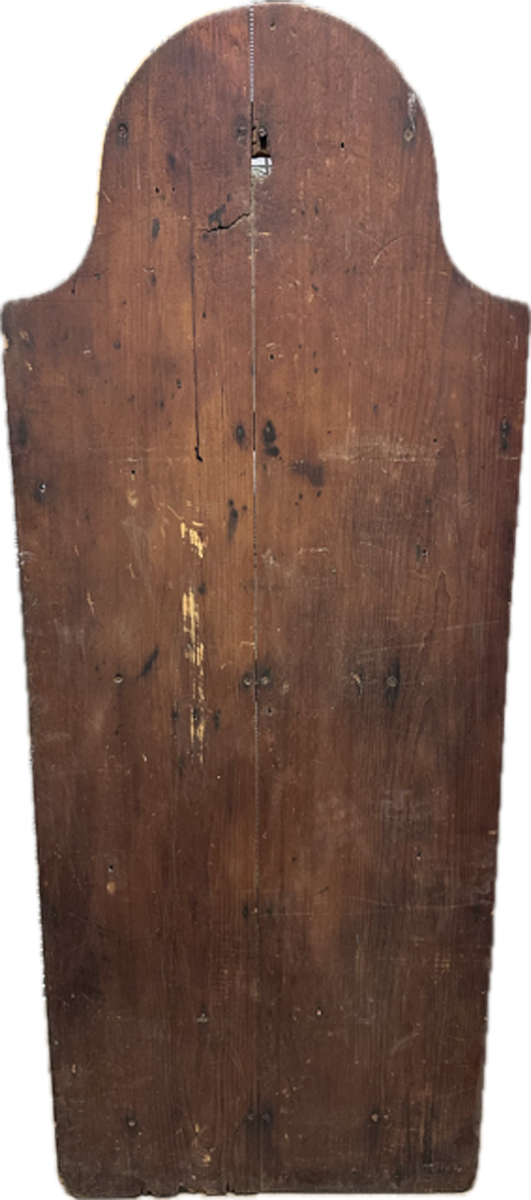
This ironing board comes from a farm owned by the Fales family in Foxborough, MA and was made and likely used in the first half of the 19th century. The board is made of two large planks of pine which connect to one another with five wooden braces set into crosscut rabbits and secured to the pine planks with four iron screws per brace. These braces not only held the ironing board together, but they also held the board in place during use. The user placed the board across the backs of two chairs close to a heat source for warming the irons. The top of the ironing board was shaped into a bell curve, possibly using a compass to design the curves. The board’s edges were rounded to allow textiles to more easily move across the board during ironing. There is a large hole in the top center of the board and wear patterns suggesting the board was hung on a wall when not in use. Laundry and ironing were activities 19th-century Americans would have encountered in different ways depending on who and where they were. Most rural Americans had to tend to their own laundry needs. Urban Americans had more access to large laundries. The board also helps tell the story of the people who did laundry including housewives, children, free and enslaved Black Americans, Irish and Chinese immigrant communities. The work of laundry was arduous, hot, heavy, and dangerous and just like today, unending.
Category
Furniture
Materials
- Yellow Pine
- Iron
Museum Object Number
2025.0023
Credit Line/Donor
Gift of Josh Lane
Share Object
Complete Details
Object Number
2025.0023
Object Name
Tool (for textiles) (Ironing board)
Category
Furniture
Origin Notes
Place of origin: Foxborough, Massachusetts
Date
1825-1875
Materials
- Yellow Pine
- Iron
Dimensions (inches)
59 (H) x 23.5 (W) x 0.75 (D)
Dimensions (centimeters)
149.86 (H) x 59.69 (W) x 1.905 (D)