//
For internal use only
Not On Display
Quilt (Pieced quilt)
1916
Description
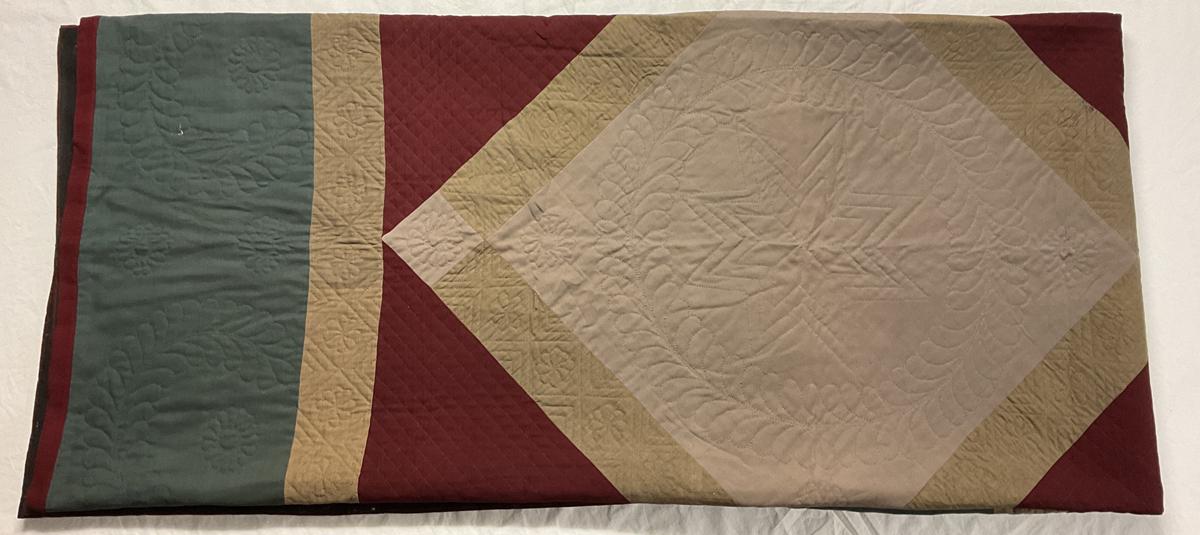
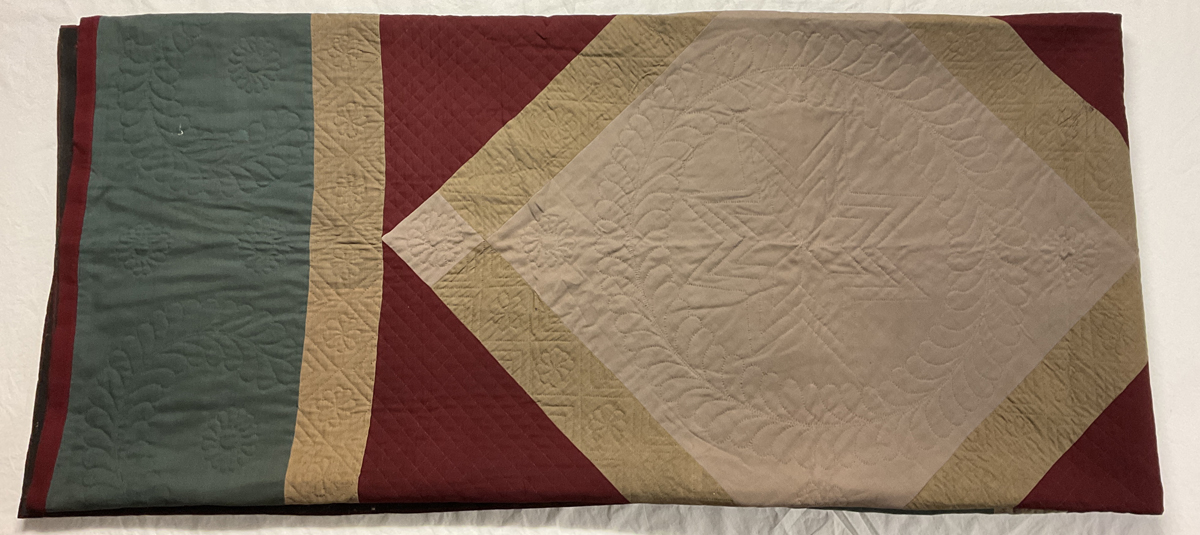
A female member or members of an Old Order Amish community in Lancaster County, Pennsylvania made this "Center Diamond" quilt in 1916. The Center Diamond pattern is the quintessential and most collectable of the Old Amish quilt patterns. The maker, or perhaps owner, marked on the back, lower right corner of the quilt with the initials "DE" and the date, "1916." The initials and date are embroidered to the quilt back with a black cotton thread. The black thread couches down what appears to be a core of natural brown wool yarn giving the initials and date a three-dimensionality. The quilt is made of a variety of woolen suiting fabrics commonly used to create these early Amish quilts (serge, gabardine, crepe, and Henrietta). These commercially manufactured fabrics were used as light weight suiting and dress fabrics and because of the wool and silk used to make them, they take dyes in an incredibly intense and saturated way. These early bold colored Amish quilts have been called “Old Dark Quilts,” further helping us date this quilt firmly in the nineteen teens. The maker pieced the quilt using a treadle sewing machine, but the quilting was all handwork done with tiny, very even running stitches. The exterior borders feature an undulating sine motif often called a "broken feather" pattern. This quilting pattern is thought to have come to the Amish from their Quaker neighbors. The broken feather border is flanked with alternating floral motifs and floral medallion corner blocks. The inner border, known as a "Zaun" or fence, features diapered (diamond) floral patterns, the centerfield design is composed of an eight-pointed star medallion surrounded by a laurel wreath/broken feather quilted patterns and flanked by quilted flowers at each corner of the central diamond. The quilt top is made of white, ecru, red, and blue woolen suiting and dress fabrics. The quilt back is made from a vibrant red plain-weave cotton fabric. The irregularity of the red dying suggests it may have been dyed at home or have come from different commercial dye lots. Amish quilts were made for children as wedding gifts, used as display objects, treasured as heirlooms, and more recently collected as vernacular and regional examples of American abstraction and Modern art.
Category
Textiles (Furnishing)
Place of Origin
Pennsylvania; Lancaster; Mid-Atlantic; United States; North America
Materials
- Wool
- Silk
- Cotton
Museum Object Number
2025.0008
Credit Line/Donor
Museum purchase with funds provided by the Winterthur Founder’s Circle
Share Object
Complete Details
Object Number
2025.0008
Object Name
Quilt (Pieced quilt)
Category
Textiles (Furnishing)
Place of Origin
Pennsylvania; Lancaster; Mid-Atlantic; United States; North America
Date
1916
Subject(s)
- Amish
Materials
- Wool
- Silk
- Cotton
Techniques
- Quilted
- Pieced
Construction Description
Machine piecing and hand quilting
Dimensions (inches)
76 (H) x 76 (W)
Dimensions (centimeters)
193.04 (H) x 193.04 (W)