//
For internal use only
Not On Display
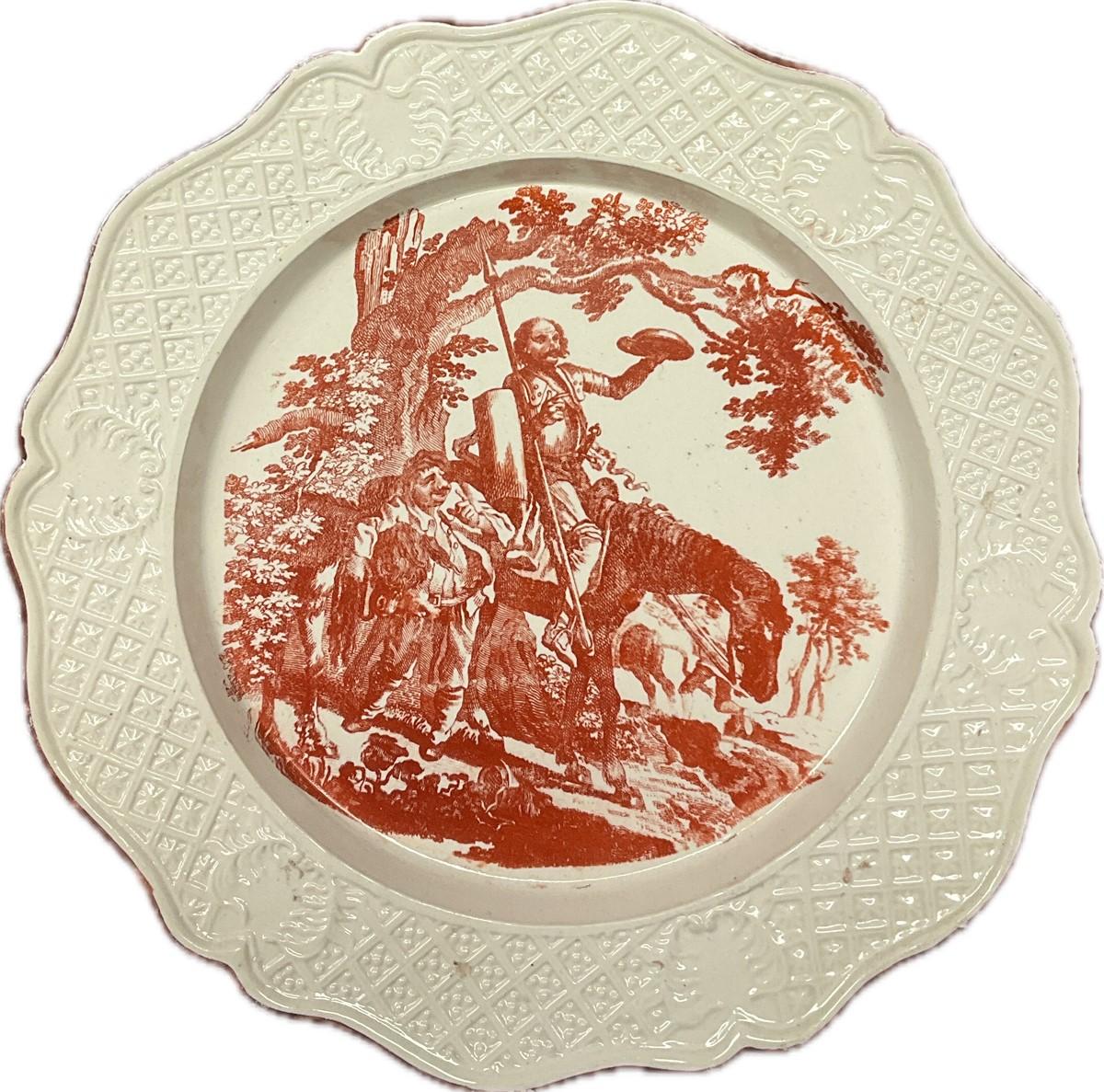
Plate (Dinner plate)
“The Shining Acquisition of Mambrino’s Helmet” from Don Quixote de La Mancha
Miguel de Cervantes, Francis Hayman, Simon Francois Ravenet, Stephen Theodore Janssen and John Brooks at York House
1753-1755
Description
This salt-glazed stoneware plate portrays “The Shining Acquisition of Mambrino’s Helmet,” a scene from the early 1600s Spanish novel “Don Quixote de La Mancha,” by Miguel de Cervantes (1547-1616). International fascination with this story continues to the modern day in print, film, and other media, including most famously on the stage as the musical “The Man of La Mancha.” Several Winterthur museum objects portray different Quixote scenes. These include a 1740s hand-painted Chinese export porcelain plate (2001.0020.003); a late 1700s French printed textile (1969.3273); an 1820s green-transfer-printed earthenware plate and dish (1969.1612, 1969.1633) from Staffordshire, England; and an 1880s American glass child’s alphabet plate (2023.0014.007). An 1800s print in the museum collection features a portrait of the author Cervantes (1966.0216.001), and numerous illustrated editions of Don Quixote, dating from the early 1700s onward, are included in the Winterthur Library collection. Transfer-printing on salt-glazed stoneware most commonly is associated with Liverpool printers John Sadler and Guy Green or with Staffordshire factories. Research suggests, however, that though this plate was made in Staffordshire, it received its red printed ornament from Stephen Theodore Janssen and John Brooks at York House, Battersea, England. Among other salt-glazed plates associated with Battersea is a Winterthur Aesop’s Fable plate portraying “The Ass and the Boar” (1975.0087) and a red-printed Aesop plate (“The Dog in the Manger”) that was excavated at the Ravenscroft site in Williamsburg, Virginia.
Category
Ceramics
Creator/Artist/Maker
Miguel de Cervantes (Design inspiration)
Place of Origin
Staffordshire; England; United Kingdom; Europe
Materials
- Stoneware
- Salt glaze
Museum Object Number
2025.0015
Credit Line/Donor
Museum purchase with funds provided by Ron and Debra Pook
Share Object
Complete Details
Object Number
2025.0015
Object Name
Plate (Dinner plate)
Title
“The Shining Acquisition of Mambrino’s Helmet” from Don Quixote de La Mancha
Category
Ceramics
Creator (Role)
Miguel de Cervantes (Design inspiration); Francis Hayman (Design source); Simon Francois Ravenet (Design source); Stephen Theodore Janssen and John Brooks at York House (Transfer printer)
Place of Origin
Staffordshire; England; United Kingdom; Europe
Origin Notes
Manufacture of plate.
Secondary Place of Origin
Probably Battersea; England; United Kingdom; Europe
Secondary Origin Notes
Battersea (now a part of London) is a possible place of transfer-printing and firing enamel decoration.
Date
1753-1755
Mark/Signature/Inscription/Label
Type: Label
Location: Underside
Inscription: Brown-printed circular sticker imitating Toft-style slipware dish (with standing woman at center), the cross-hatched border featuring two inscribed reserves: "HARRIET CARLTON GOLDWEITZ" and "Collection."
Type: Label
Location: Underside
Inscription: Black-printed circular sticker inscribed "CHRISTIE'S" over a horizontal line; in hand-written black pen are the inscriptions "3/6/81" over "51"
Mark/Signature: No
Subject(s)
- Don Quixote
- Literary scene
- Literature
Materials
- Stoneware
- Salt glaze
Techniques
- Press-molded
- Printed
- Painted
- Enameled
Bibliography and Bibliographic Notes
Book: Edwards, Diana & Hampson, Rodney. 2005 White Salt-glazed Stoneware of the British Isles.
• Published: p. 137, col. pl. 118, shown with design source (fig. 112), "Engraving by Hayman from Simon Francois Ravent...taken from T. Smollett's Don Quixote (1755)...Article: Goldweitz, Harriet Carlton. 1984 An American Collection of English Pottery: A Chronology 1635-1778. Transactions of the English Ceramic Circle. 12 (1)
• Published: pp. 17-18, pl. 241.Article: Tilley, Frank. 06//1963 Ravenet an Engraver for Battersea Transfers on Saltglaze Plates: The Final Link in the Chain of Evidence. The Antique Collector. XXXIV: 121-128.
• Published: p. 127, fig. 16.