//
For internal use only
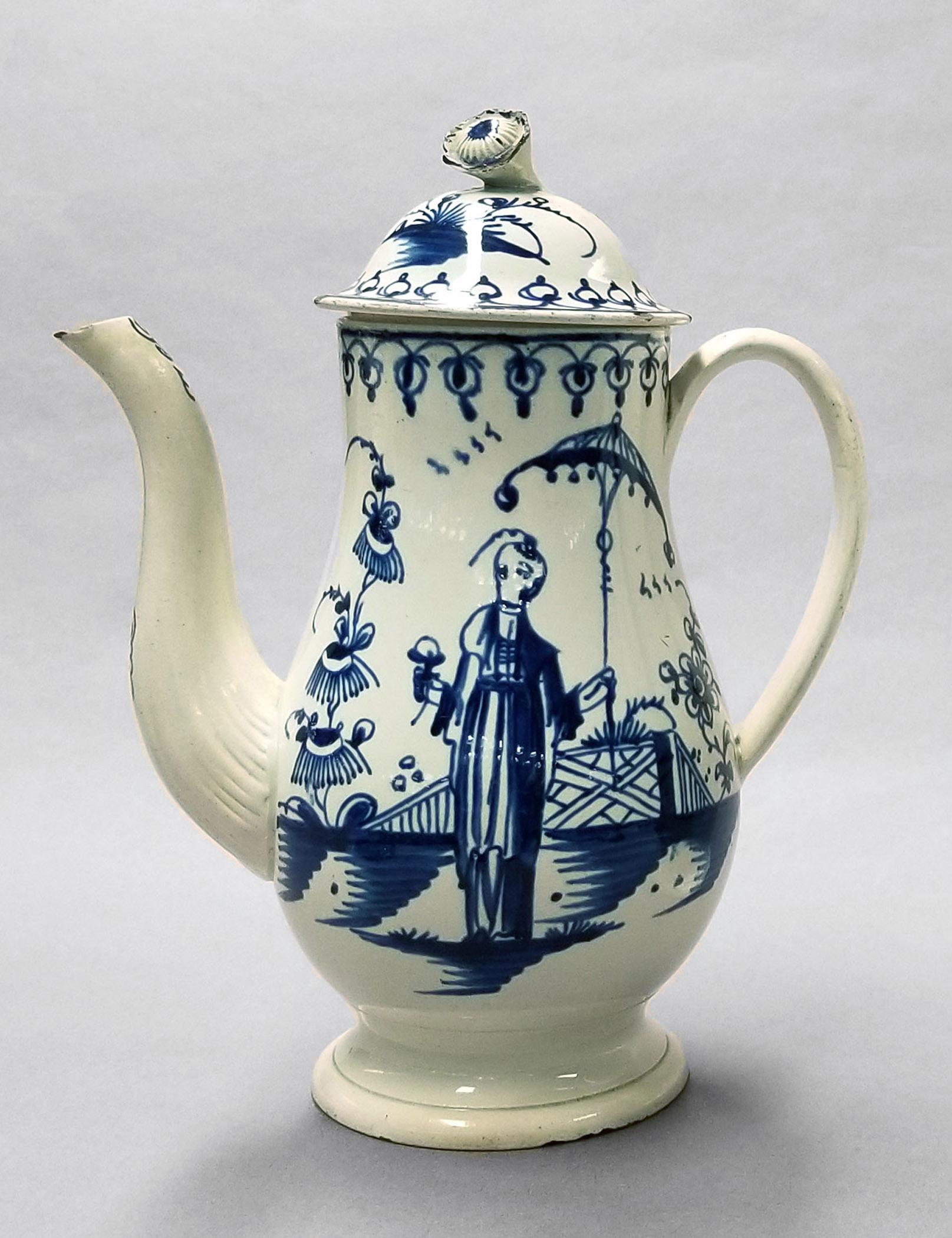
Not On Display
Coffee or chocolate pot
1770-1785
Description
In the vein of “imitation is the sincerest form of flattery,” many ceramics manufacturers over the centuries have attempted to imitate in less pricey ceramics more costly wares including porcelain. Among these imitations is a pale-bodied earthenware featuring a bluish lead glaze and commonly known as pearlware. The name derived from “pearl white” ware, a type of pottery from Josiah Wedgwood’s Staffordshire, England, factory. Though Wedgwood first brought pearl white ware to market in the late 1770s, other manufacturers appear to have been producing versions of it already, under the name “china glaze.” The term China, in the 1700s, commonly referred to much-prized Chinese export porcelain though as the century progressed European manufacturers also produced a broad range of fine wares. Porcelain from both continents would be imitated in pearlware made at numerous factories in Staffordshire and other English counties. On this coffee- or chocolate pot, underglaze blue-painted Chinese porcelain-inspired designs include on the primary side (with the handle positioned at the right) an elongated figure of a Chinese woman with a parasol, standing in a garden with a fence. On the opposite side is a pavilion (or pagoda), fences and willows. Similar patterns are found on pearlware beverage- and dinnerware excavated at numerous archaeological sites associated with Colonial America.
Category
Ceramics
Place of Origin
Staffordshire; England; United Kingdom; Europe
Materials
- Earthenware (pearlware)
- Lead glaze
Museum Object Number
2024.0014.050 A, B
Credit Line/Donor
Bequest of John A. and Judith C. Herdeg
Share Object
Complete Details
Object Number
2024.0014.050 A, B
Object Name
Coffee or chocolate pot
Category
Ceramics
Place of Origin
Staffordshire; England; United Kingdom; Europe
Date
1770-1785
Mark/Signature/Inscription/Label
Type: Inscription
Location: Underside
Inscription: Inscribed in black permanent(?) marker: underside of body "G562a"; lid "G562b" (both overstruck)
Type: Label
Location: Underside
Inscription: (On lid) Rectangular sticker with canted corner and red border, inscribed in black pen "Coolidge"
Mark/Signature: No
Materials
- Earthenware (pearlware)
- Lead glaze
Techniques
- Thrown
- Molded
- Painted
Dimensions (inches)
8.15 (H) x 6.46 (L) x 3.9 (Diam)
Dimensions (centimeters)
20.7 (H) x 16.4 (L) x 9.9 (Diam)
Bibliography and Bibliographic Notes
Article: Grigsby, Leslie B. 2005 British Earthenware and Porcelain in Eighteenth Century America, in Gray, Jonathan. 2005. Welsh Ceramics in Context. 2. 71-91.
• Discussion of blue and white pearlware in early America: p. 82, no. 4.14.