//
For internal use only
On Display: House - Connecticut Valley House Side
Dish (Basket)
Description
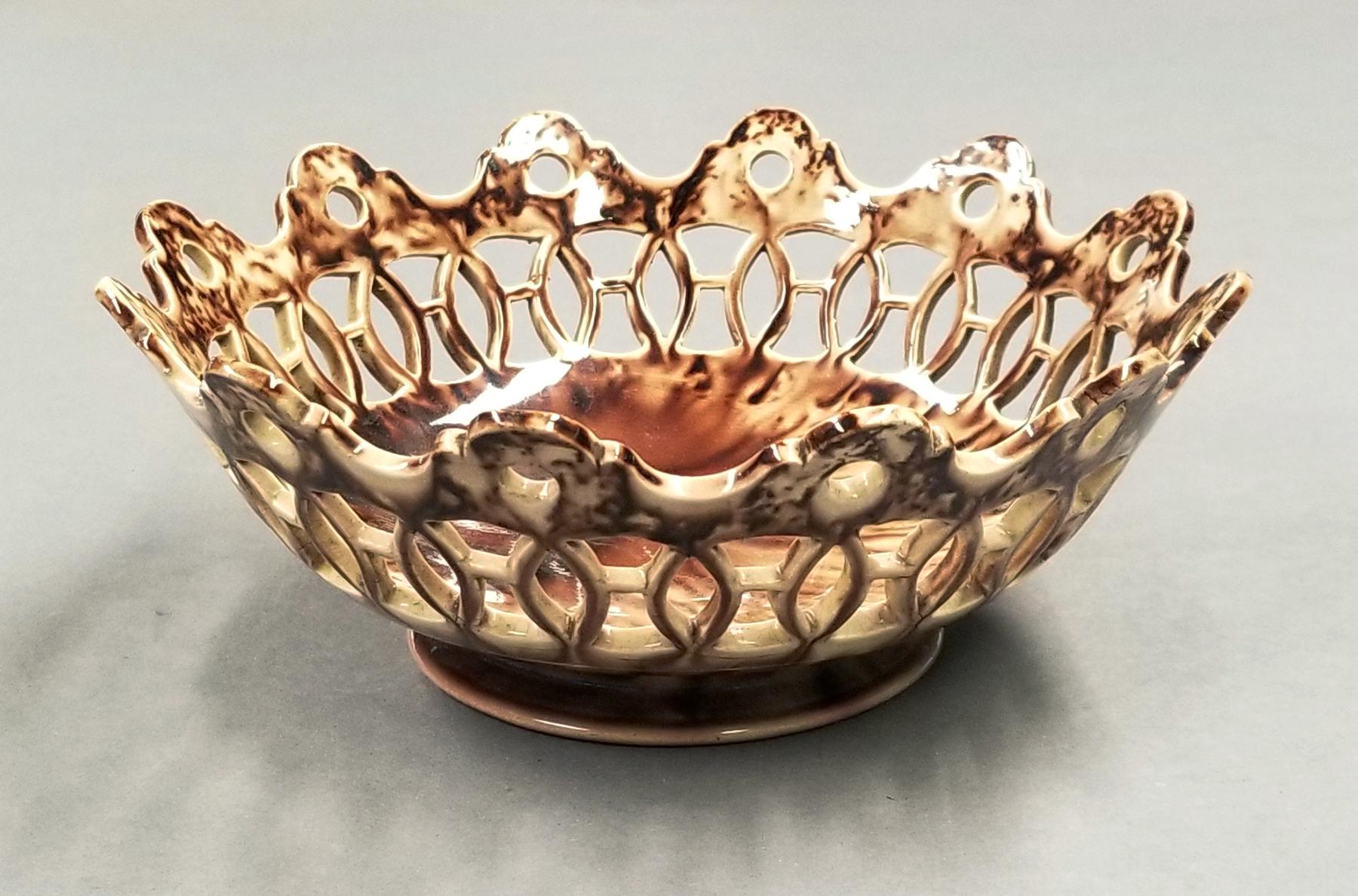
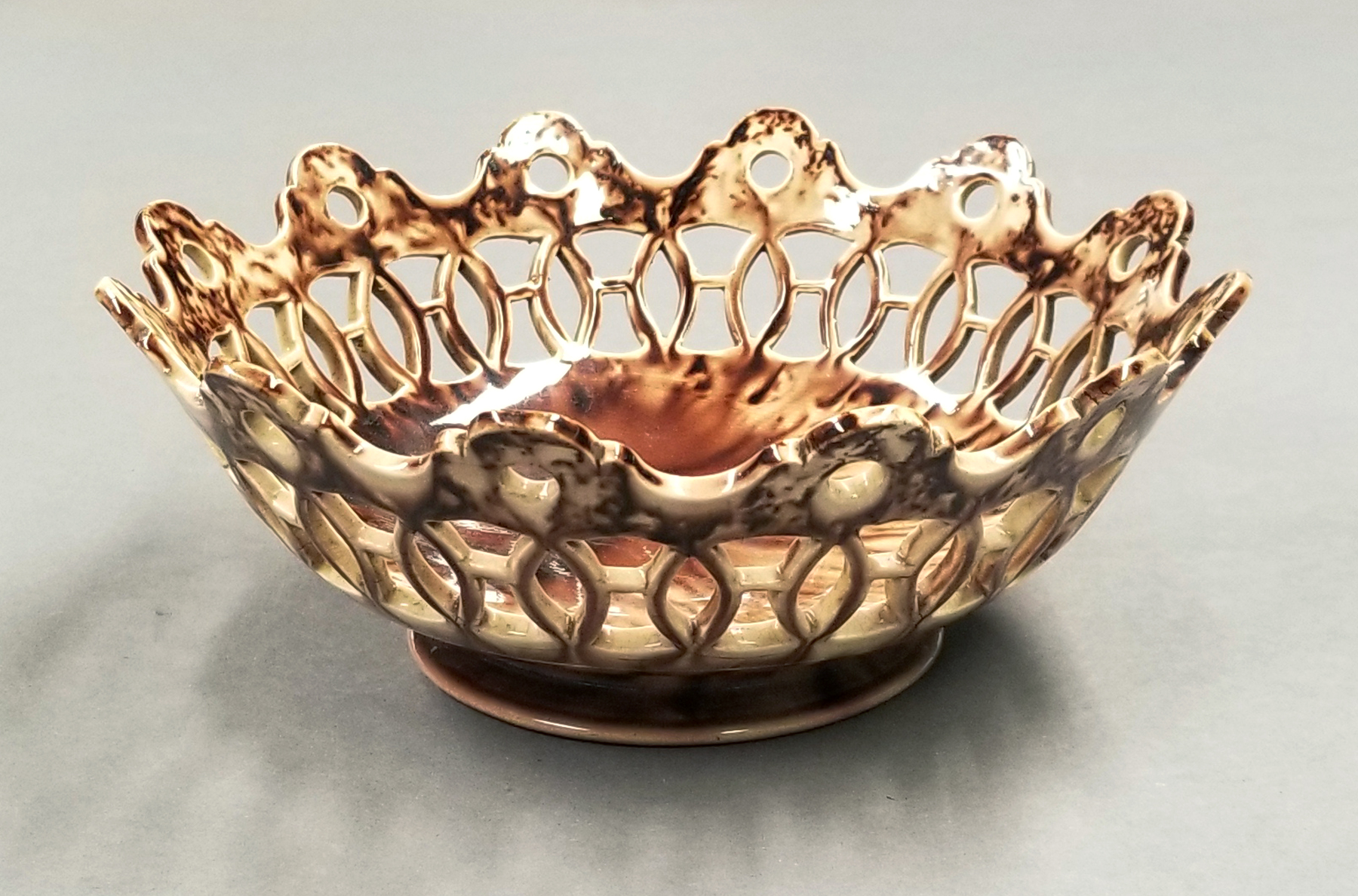
During the mid to late 1700s an increased interest in designs after Nature inspired a new range of ceramics to be produced in England, especially Staffordshire. So-called tortoiseshell, “tortoise” or “turtle” ware attempted to copy the appearance of shells of increasingly endangered marine turtles (rather than actual tortoises). The lead-glazed pale-bodied earthenware (creamware) featured sponged-on colors that more or less realistically resembled natural marine turtle shell patterns. Though differing somewhat in details, baskets of the same general form shown here not only were made in a range of Staffordshire, England's earthenware and stoneware but also in English, Chinese export and American porcelain. Such objects were appropriate for serving fresh fruit and presumably certain other non-liquid foods and, in some cases, imitated vessels woven in natural materials such as cane. Border fragments of tortoiseshell creamware baskets of this type were excavated at the site of Thomas Whieldon's Fenton Vivian factory (active 1747-80). Some feature delicate outlines that helped craftsmen know where to cut the overlapping circle elements. For a salt-glazed white stoneware version of this vessel form that bears brilliant turquoise and purple enamel decoration, see 1958.0956. The museum collection also includes somewhat similarly pierced porcelain baskets by England's Bow factory (1978.0073) and, especially rare, one by Philadelphia's Bonnin and Morris factory (1959.0057).
Category
Ceramics
Place of Origin
Staffordshire; England; United Kingdom; Europe
Materials
- Earthenware (creamware)
- Lead glaze
Museum Object Number
2024.0014.048
Credit Line/Donor
Bequest of John A. and Judith C. Herdeg
Share Object
Complete Details
Object Number
2024.0014.048
Object Name
Dish (Basket)
Category
Ceramics
Place of Origin
Staffordshire; England; United Kingdom; Europe
Materials
- Earthenware (creamware)
- Lead glaze
Techniques
- Thrown
- Pierced
- Sponged
Dimensions (inches)
2.83 (H) x 7.28 (Diam)
Dimensions (centimeters)
7.2 (H) x 18.5 (Diam)
Bibliography and Bibliographic Notes
Article: Grigsby, Leslie B. 2005 British Earthenware and Porcelain in Eighteenth Century America, in Gray, Jonathan. 2005. Welsh Ceramics in Context. 2. 71-91.
• Discussion of tortoiseshell ware in early America: p. 73-74, no. 4.2.Book: Grigsby, Leslie B. 1990 The Henry H. Weldon Collection: English Pottery, Stoneware and Earthenware 1650-1800.
• Very similar form tortoiseshell fruit dish or basket: pp. 236-37, no. 127, Staffordshire, c. 1755. Wasters of borders from similar tortoiseshell creamware baskets were excavated at the Thomas Whieldon, Fenton Vivian factory site (1747-80)Book: Grigsby, Leslie B. 1990 The Henry H. Weldon Collection: English Pottery, Stoneware and Earthenware 1650-1800.
• Somewhat similar form salt-glazed stoneware fruit dish or basket: pp. 134-35, no. 54 and pp. 236-37, no. 127, Staffordshire, c. 1755Book: Halfpenny, Patricia A. & Williams, Peter. 2000 A Passion for Pottery: Further Selections from the Henry H. Weldon Collection.
• Littler's blue-type pierced stoneware bowl of a different form: p. 106, no. 56, c. 1755-60Book: Halfpenny, Patricia A. & Williams, Peter. 2000 A Passion for Pottery: Further Selections from the Henry H. Weldon Collection.
• Polychrome enameled stoneware baskets (3): pp. 114-15, no. 63, c. 1765, all with floral decorationBook: Halfpenny, Patricia A. & Williams, Peter. 2000 A Passion for Pottery: Further Selections from the Henry H. Weldon Collection.
• Very similar form tortoiseshell baskets (2): pp. 196, no. 126, Staffordshire, c. 1755.