//
For internal use only
Not On Display
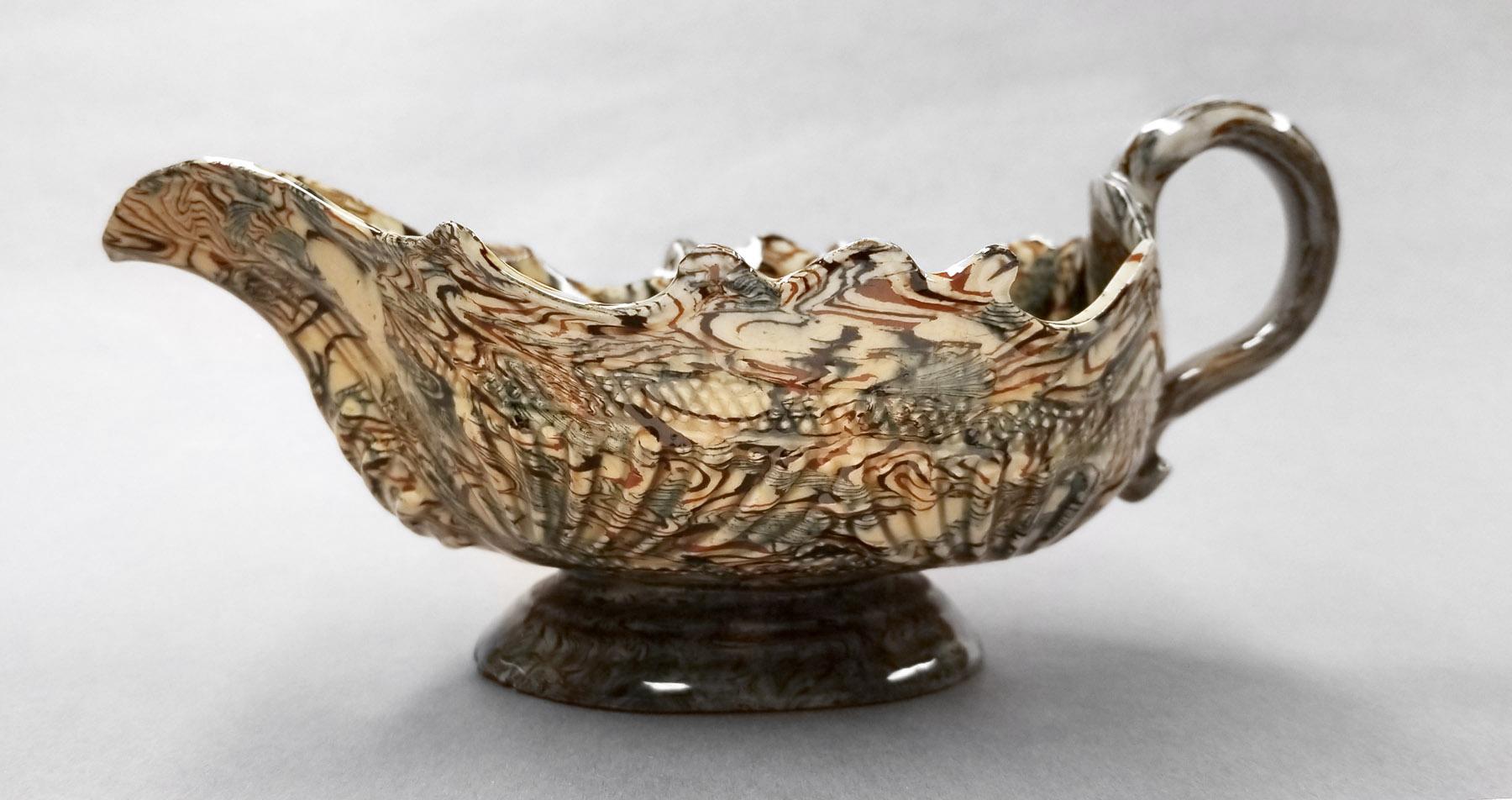
Sauceboat
1750-1780
Description
During the mid to late 1700s the fashion for neoclassical design as well as an increased interest in natural history drove the creation of many seashell-themed designs. This sauceboat features shell-like gadrooning at the base of the body. In many ways, the overall form imitates costly silver of the period. This earthenware type is known as agateware and was intended to imitate patterns found in natural stone. Such stone, during the 1700s, was fashionable for use as inlays on objects, such as boxes, or in architectural settings. Ceramic agateware was produced in Staffordshire, England in lead-glazed earthenware (as shown here) and salt-glazed stoneware. Labor-intensive to produce, some agateware required kneading different colors of clay together before rolling it out and pressing it into molds. Careful cleaning of the surface exposed crisply defined colors. Archaeological evidence from American sites, as well as documentary evidence, prove that agateware was fashionable here during the colonial period. Period terms for agateware include "agate" and "marbled" typically followed by the object type (as in teapot).
Category
Ceramics
Place of Origin
Staffordshire; England; United Kingdom; Europe
Materials
- Earthenware (agateware)
- Lead glaze
Museum Object Number
2024.0014.018
Credit Line/Donor
Bequest of John A. and Judith C. Herdeg
Share Object
Complete Details
Object Number
2024.0014.018
Object Name
Sauceboat
Category
Ceramics
Place of Origin
Staffordshire; England; United Kingdom; Europe
Date
1750-1780
Materials
- Earthenware (agateware)
- Lead glaze
Techniques
- Molded
- Rolled
Dimensions (inches)
3.23 (H) x 4.21 (W) x 6.77 (L)
Dimensions (centimeters)
8.2 (H) x 10.7 (W) x 17.2 (L)
Bibliography and Bibliographic Notes
Article: Grigsby, Leslie B. 2005 British Earthenware and Porcelain in Eighteenth Century America, in Gray, Jonathan. 2005. Welsh Ceramics in Context. 2. 71-91.
• Discussion of English agateware in early America: pp. 84-85. Includes early documentary references.Book: Mountford, Arnold R. 1971 The Illustrated Guide to Staffordshire Salt-Glazed Stoneware.
• Salt-glazed white stoneware example of somewhat similar form and relief decoration: no. 128, c. 1750. For variations in same material see nos. 128-29.Book: Edwards, Diana & Hampson, Rodney. 2005 White Salt-glazed Stoneware of the British Isles.
• Salt-glazed white stoneware example of somewhat similar form and relief decoration: p. 90, fig. 79 and p. 92, fig. 85, c. 1750-65