//
For internal use only
On Display: House - End Shop
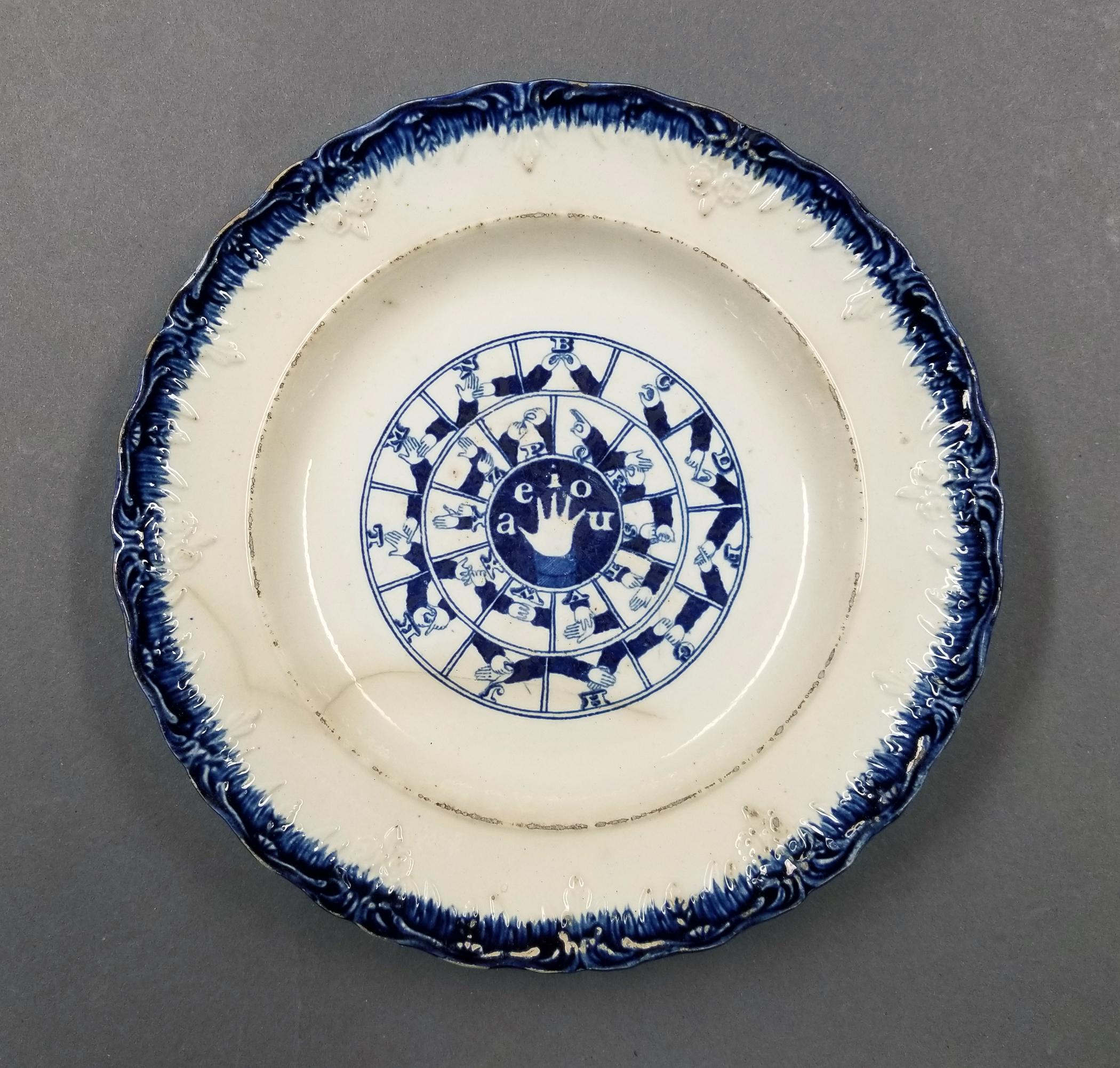
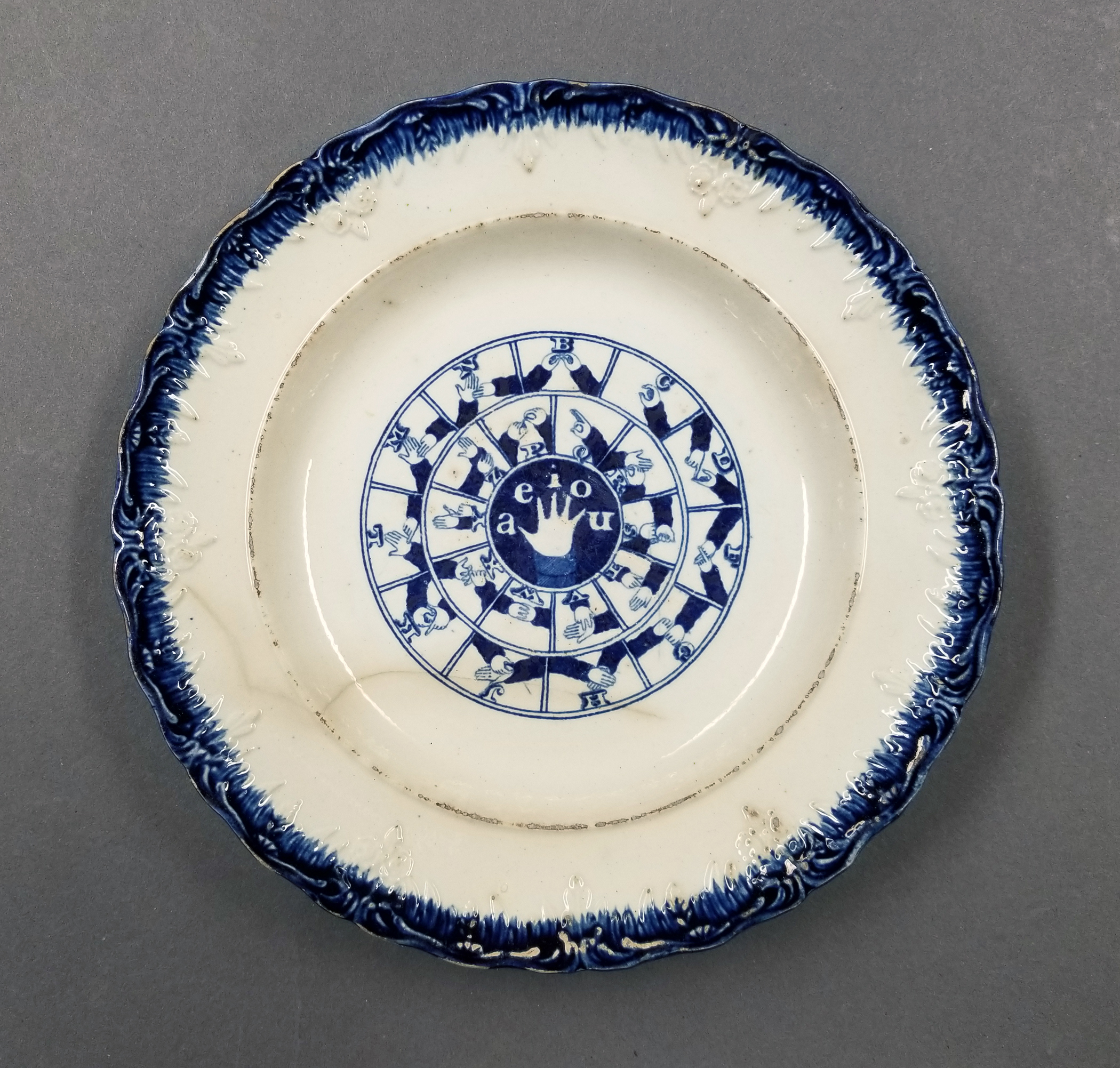
Plate (Child's sign language or alphabet plate)
Goodwins & Harris
1815-1825
Description
This fascinating white earthenware (pearlware) “child’s plate” dates to around 1820 and was made in Staffordshire, England. The central reserve displays a blue transfer-printed chart illustrating a British Sign Language (BSL) alphabet with adjacent letters. Small plates like these, whether displaying the BSL chart or other designs, seem most commonly to have been presented as gifts to children, sometimes as a reward for success during their studies. Alternatively, they may have been produced as gifts to philanthropists who supported aid for those with disabilities. Although rare, children’s plates displaying sign-language motifs were produced by more than one English factory and in different colors. On this example, the consonant letters form concentric rings around a central circular panel showing the vowels (A, E, I, O, U). The British Sign Language alphabet, then as now, differs markedly from American signing alphabets. Also, the origins of British sign-language may date as early as the sixteenth-century, while American alphabets are said to have their origins in the early 1800s. The British alphabet on the plate forms an interesting comparison to a printed-on-paper chart regarding American Sign Language (ASL) in the Winterthur collection [1967.0224]. The paper print, also dating to the 1800s, is titled “MANUAL ALPHABET USED IN THE PENNSYLVANIA INSTITUTION FOR THE DEAF AND DUMB” and illustrates quite different signing positions for the different letters. Although this version of American sign language appears to have been fairly popular, it was not the only one available. For exampled, a more detailed publication regarding signing, titled Language Addressed to the Different Senses, was published in 1865 in Hartford, Connecticut. (A copy resides in the Winterthur Library.) Understanding of sign language also has been encouraged by organizations including The Girl Scouts of America, who traditionally awarded a badge for accomplishments in signing. Sign language has evolved over time and varied depending on one’s location and access to resources. Because of segregation, for example, a Black American Sign Language (Black ASL) was developed. For more on that subject, see "The Hidden Treasure of Black ASL: Its History and Structure" by Carolyn McCaskill and others (Gallaudet University Press, 2020). For a child's mug in Staffordshire pearlware, bearing a blue transfer-printed version of the same alphabet, see 2020.0013.
Category
Ceramics
Creator/Artist/Maker
Goodwins & Harris (Possible maker)
Place of Origin
Possibly Lane End; Probably Staffordshire; England; United Kingdom; Europe
Materials
- Earthenware (pearlware)
- Lead glaze
Museum Object Number
2023.0014.001
Credit Line/Donor
Gift of Irving and Davida Shipkowitz Family Trust
Share Object
Complete Details
Object Number
2023.0014.001
Object Name
Plate (Child's sign language or alphabet plate)
Category
Ceramics - Shipkowitz Collection
Creator (Role)
Goodwins & Harris (Possible maker)
Place of Origin
Possibly Lane End; Probably Staffordshire; England; United Kingdom; Europe
Date
1815-1825
Mark/Signature/Inscription/Label
Type: Inscription
Location: Underside
Inscription: Blue printed alphabet (upper case consonants; lower case vowels) with hand signs.
Mark/Signature: No
Subject(s)
- Disability
- Sign language
- Education
Materials
- Earthenware (pearlware)
- Lead glaze
Techniques
- Molded
- Printed
- Painted
Dimensions (inches)
1 (H) x 7.5 (Diam)
Dimensions (centimeters)
2 (H) x 19 (Diam)
Measurement Notes
Measurement taken from Shipkowitz book "The ABC's of ABC Ware" 7.5"
Bibliography and Bibliographic Notes
Book: Shipkowitz, Davida & Shipkowitz, Irving. 2002 The ABC’s of ABC Ware.
• Published: p. 192, fig. E150, "Manual Alphabet in a Circle," pearlware, possibly Leeds Pottery, Yorkshire.Article: Sousa, Daniel. 09//2021 Hartford's Asylum for the Deaf. Historic Deerfield. 19: 31-35.
• Discussion of Hartford Asylum and objects relating to deafness: see pp. 31 & 34 for blue-printed transferware portraying Hartford asylum; see p. 34 for brown-printed English child's mug with hand sign language. Well researched article with further illustrations. Objects in Deerfield collectionBook: Halliday, Rosemary & Halliday, Richard. 2012 Extraordinary British Transferware: 1780-1840.
• Child's mug with blue-printed, differently formated version of same sign language: p. 176, c. 1820.Electronic: Transferware Collectors Club. Transferware Collectors Club Database of Patterns & Sources. Transferware Collectors Club 03/13/2024 https://www.transferwarecollectorsclub.org/members/database
• Same pattern in red and in black on floral-relief bordered child's plates: pattern title listed as "Sign Language Alphabet," pattern no. 10532, with mark of Goodwins & Harris (1831-38), Lane End, StaffordshireElectronic: Transferware Collectors Club. Transferware Collectors Club Database of Patterns & Sources. Transferware Collectors Club 03/13/2024 https://www.transferwarecollectorsclub.org/members/database
• Same pattern in brown, horizontally oriented on child's mug: pattern title listed as "Sign Language," pattern no. 12847, unknown maker.