//
For internal use only
Not On Display
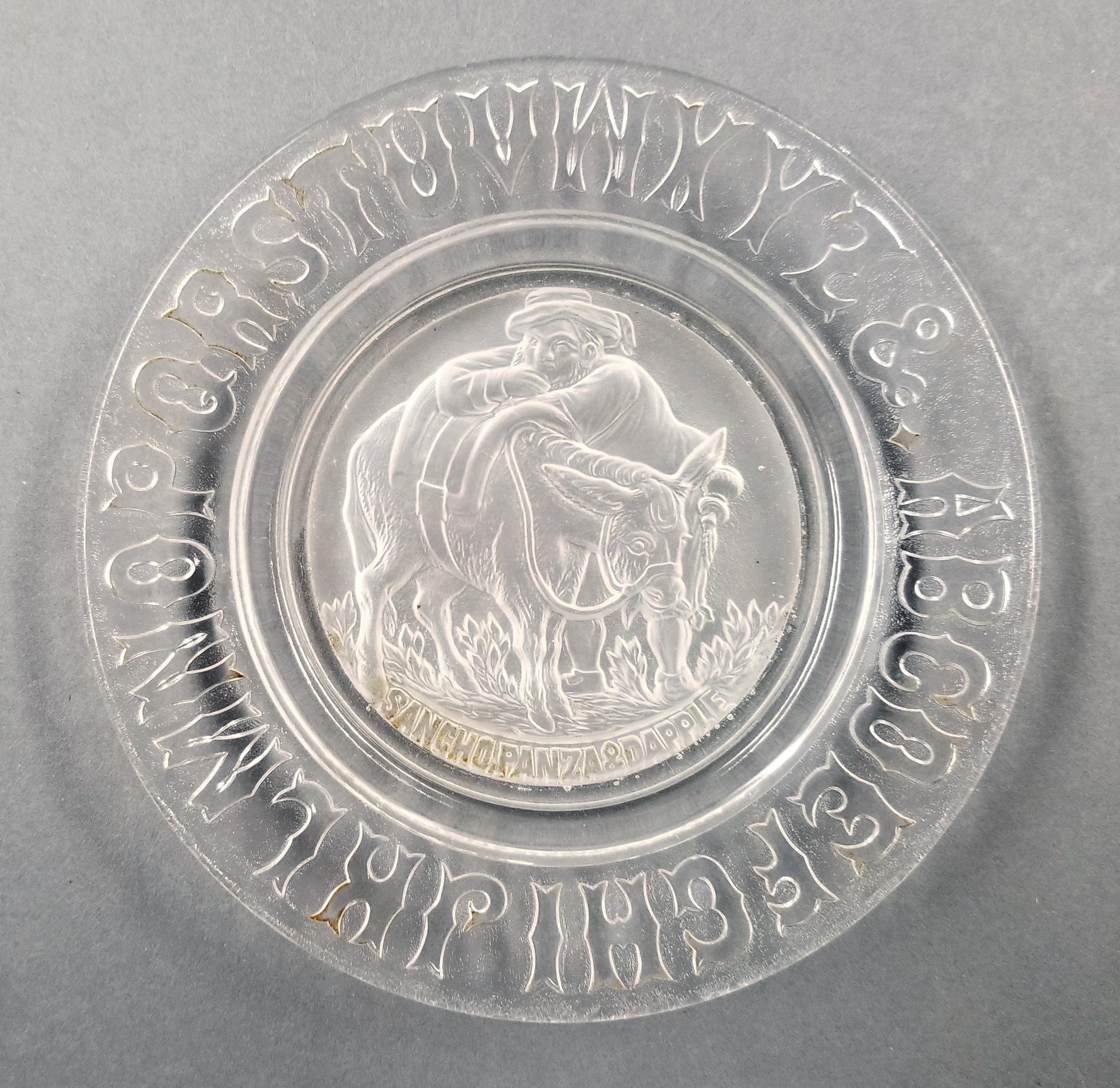
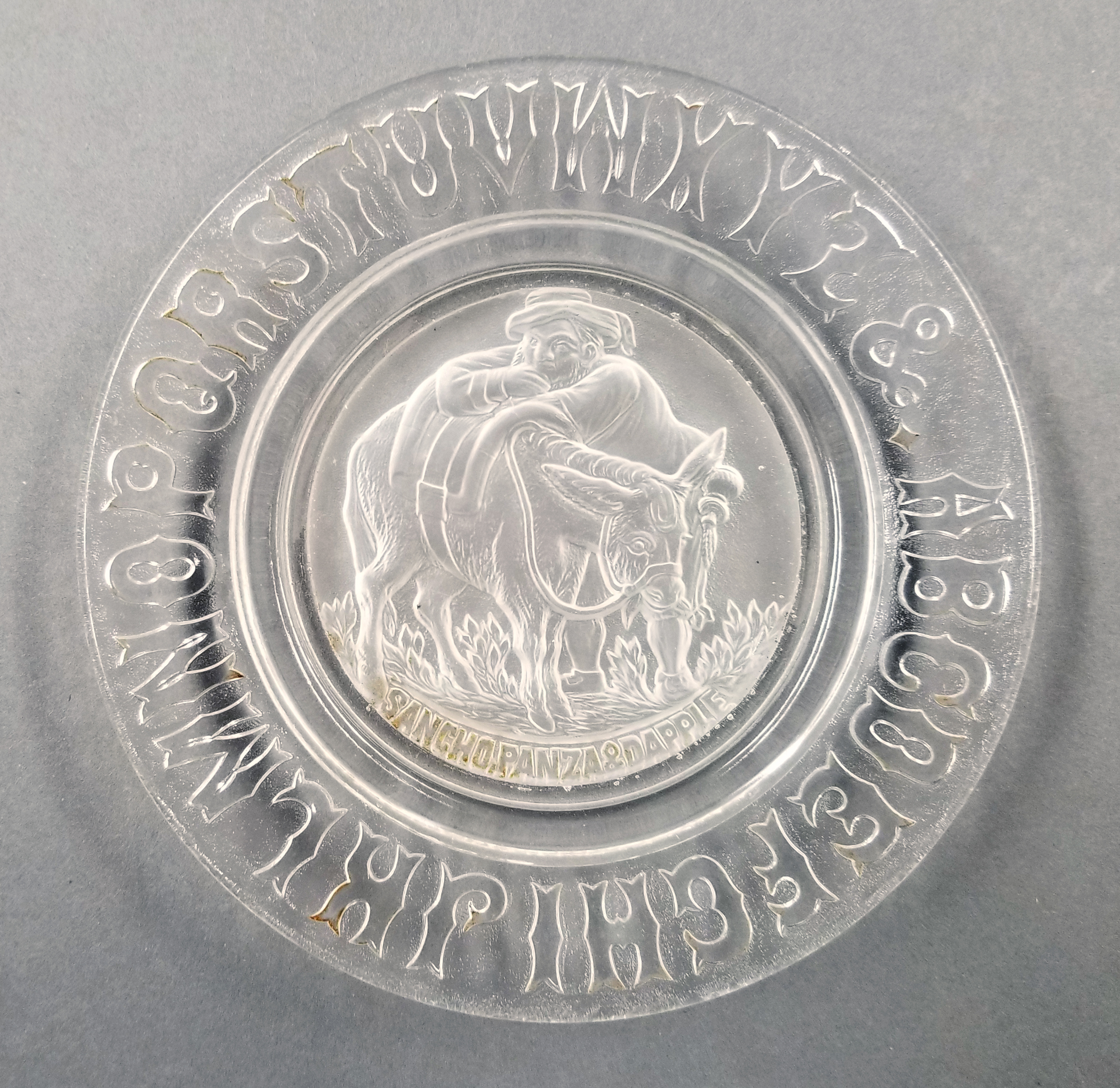
Plate (Child's or alphabet plate)
Sancho Panza & Dapple (from Don Quixote)
Gillinder and Sons, Inc., Miguel de Cervantes
1880-1890
Description
Miguel de Cervantes’s famous tale of “Don Quixote (Quijote) de la Mancha,” first published in Spain in two parts (1605 and 1615), has been the inspiration of myriad designs, whether portrayed on paper, textiles, ceramics, or as is the case here, glass. The center of this “child’s plate” portrays Quixote’s faithful assistant, Sancho Panza, with his donkey Dapple. It is unclear if the scene directly copied an illustration in an 1852 London edition of Quixote or an earlier version published in France (Paris, 1836-37). Whichever is the case, the object shown here was produced in the 1880s by Pennsylvania’s Gillinder & Sons factory as one of a three models of six-inch alphabet plates. The other two portray, respectively, a deer or flowers. This molded colorless glass plate is of circular form with a wide nearly flat rim and a shallow central well. The underside is relief-decorated, the pattern showing through to the front in correct orientation. The design is composed of a central scene in frosted-glass, portraying a portly standing man in a hat, resting his arms across the saddle of a donkey. The bottom of the scene displays the title “SANCHO PANZA & DAPPLE,” from Cervantes’s Don Quixote (Quijote) de la Mancha. The border of the dish features the English alphabet in uppercase letters, with the Z followed by “&” and a period. Winterthur Library has in its holdings several editions of Don Quixote, including a Spanish-language edition that was published in Bostin in 1832. The museum collection includes a printed portrait of Cervantes (1966.0216.001), and scenes from Don Quixote ornament ceramics (2001.0020.003; 1969.1612; 1969.1633) and textiles (1969.3273).
Category
Glass
Creator/Artist/Maker
Gillinder and Sons, Inc. (Maker)
Place of Origin
Philadelphia or Greensburg; Pennsylvania; United States; North America
Materials
- Glass (nonlead or lowlead)
Museum Object Number
2023.0014.007
Credit Line/Donor
Gift of Irving and Davida Shipkowitz Family Trust
Share Object
Complete Details
Object Number
2023.0014.007
Object Name
Plate (Child's or alphabet plate)
Title
Sancho Panza & Dapple (from Don Quixote)
Category
Glass - Shipkowitz Collection
Creator (Role)
Gillinder and Sons, Inc. (Maker); Miguel de Cervantes (Design inspiration)
Place of Origin
Philadelphia or Greensburg; Pennsylvania; United States; North America
Date
1880-1890
Mark/Signature/Inscription/Label
Type: Inscription
Location: Reverse
Inscription: Inscribed in molded raised letters "SANCHO AND DAPPLE" with upper case alphabet, "&" and "."
Mark/Signature: No
Subject(s)
- Literary scene
- Literature
- Cervantes
- Education
- Don Quixote
Materials
- Glass (nonlead or lowlead)
Techniques
- Molded
Dimensions (inches)
0.87 (H) x 5.98 (Diam)
Dimensions (centimeters)
2.2 (H) x 15.2 (Diam)
Measurement Notes
Measurement taken from Shipkowitz book "The ABC's of ABC Ware" 6"
Bibliography and Bibliographic Notes
Book: Shipkowitz, Davida & Shipkowitz, Irving. 2002 The ABC’s of ABC Ware.
• Published: p. 200, fig. G9, Gilander and Sons Glass, Greensburg, PA. Factory date: 1867-c. 1900; production date c. 1885.Electronic: 1852 London Willoughby (Sancho Panza and Dapple inspiration). Cervantes Project 03/28/2024 http://cervantes.dh.tamu.edu/dqiDisplayInterface/displayMidImage.jsp?edition=534&image=1852-London-Willoughby-01-034.jpg
• Illustrates likely design source: "Sancho Panza and Dapple," in "Adventures of Don Quixote de la Mancha..." published by Willoughby in London 1852. The illustration a reprint of Tony Johannot illustration for Paris 1836-37 edition by Dubochet.Electronic: ABC Plate (Sancho Panza and Dapple) by Gillinder. Early America Pattern Glass Society 03/28/2024 https://www.eapgs.net/pattern-details.php?idx=15
• View from Gillinder catalogue illustrating (engravings) three "6 in A.B.C. Plates," including the Sancho Panza type, another with a bouquet, and one with a deer. Pattern introduced in 1880s.