//
For internal use only
On Display: House - Counting Room
Hourglass
1700-1780
Description
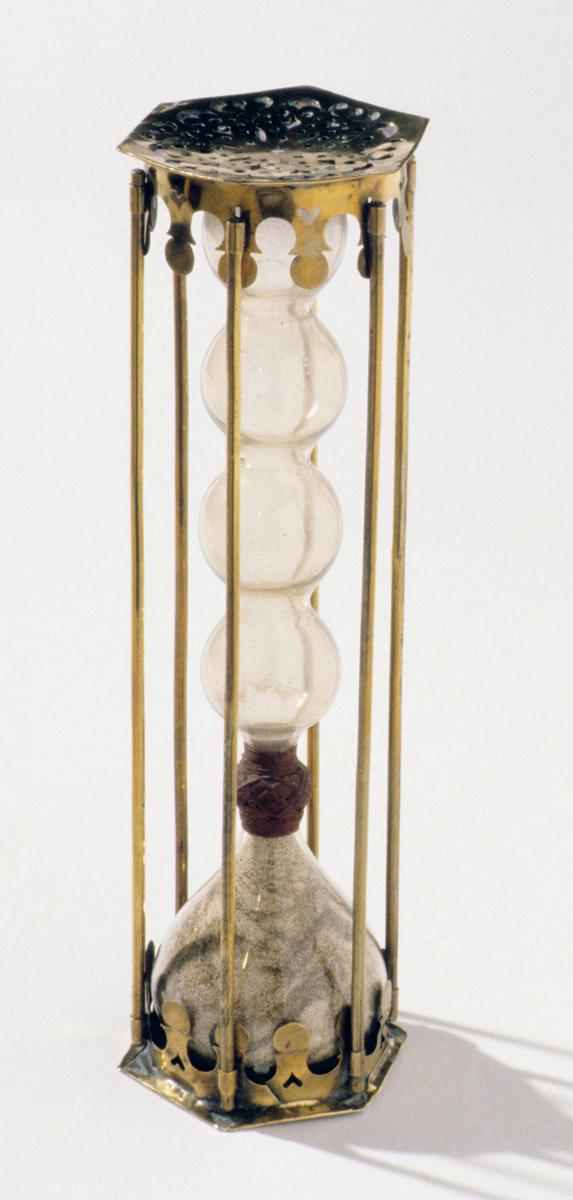
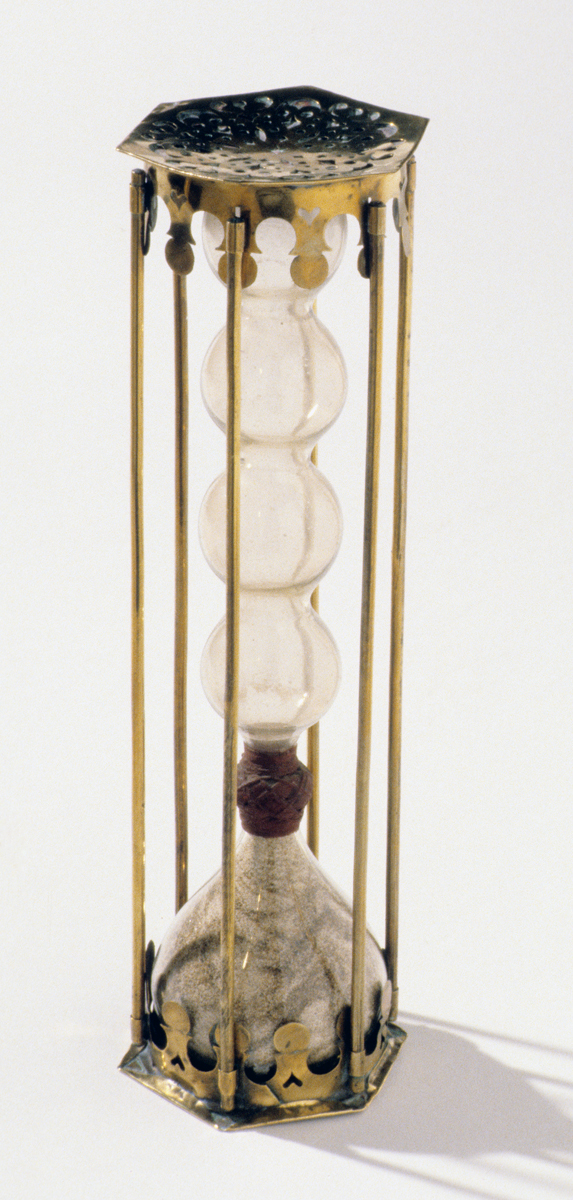
In the eighteenth century, scientific instruments were created in different categories of optical, mathematical, and philosophical instruments although they shared similar materials and crossed craft practices. This brass hourglass, with four distinct knops used to measure time in 15, 30, 45, and 60-minute intervals, was probably sold by a maker of mathematical instruments alongside objects like sundials and quadrants. The technology to blow the glass body of an hourglass as a single piece emerged in the 1760s, eliminating the need for the join that is covered with a red cloth and thread in this example. The horizontal brass plates attached to the six vertical rods are pierced decoratively and layered over red silk. A glass blower, brass worker, and a silk weaver would not all have worked under the same roof. However, an instrument maker made arrangements with such specialists to supply parts for his finished product. This hourglass reveals how collaboration among crafts created beautiful and functional instruments. The hourglass may have been used in a home laboratory, a classroom, or in a church to time sermons. Several hourglasses from the National Maritime Museum in Greenwich feature brass frames with similar pierced elements or frets revealing a red silk inner layer; this also appears on eighteenth-century English and Dutch clocks.
Category
Clocks, Watches, and Scientific Instruments
Place of Origin
England; United Kingdom; Europe
Materials
- Brass
- Glass
- Sand
- String
- Silk
Museum Object Number
1959.2744
Credit Line/Donor
Bequest of Henry Francis du Pont
Share Object
Complete Details
Object Number
1959.2744
Object Name
Hourglass
Category
Clocks, Watches, and Scientific Instruments
Place of Origin
England; United Kingdom; Europe
Origin Notes
The creation place was identified as England by a previous cataloguer [Lorena Baines 2007].
Date
1700-1780
Materials
- Brass
- Glass
- Sand
- String
- Silk
Dimensions (inches)
10 (H) x 3.15 (W) x 2.752 (D)
Dimensions (centimeters)
25.4 (H) x 8 (W) x 6.99 (D)