//
For internal use only
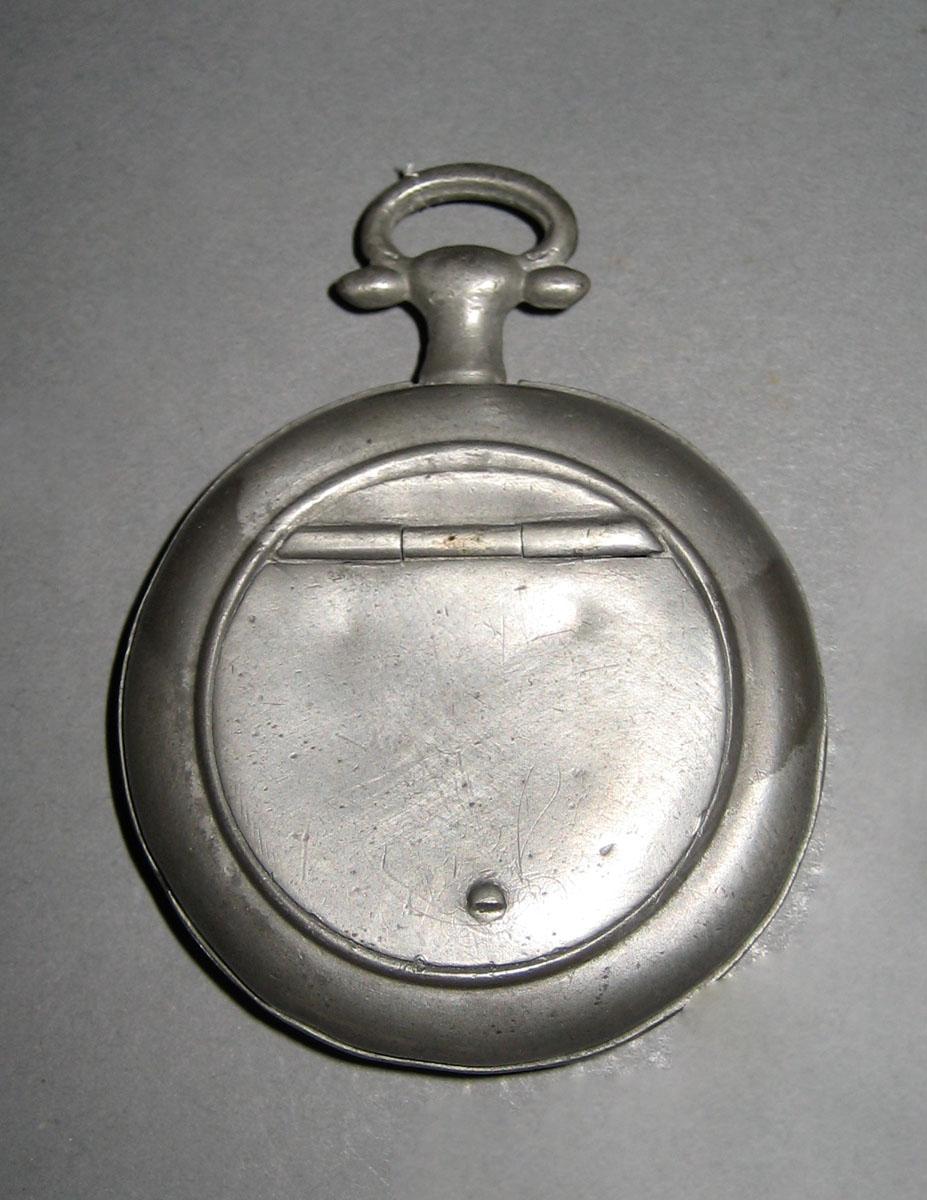
On Display: House - Counting Room
Box (False watch case or Snuff box)
1790-1840
Description
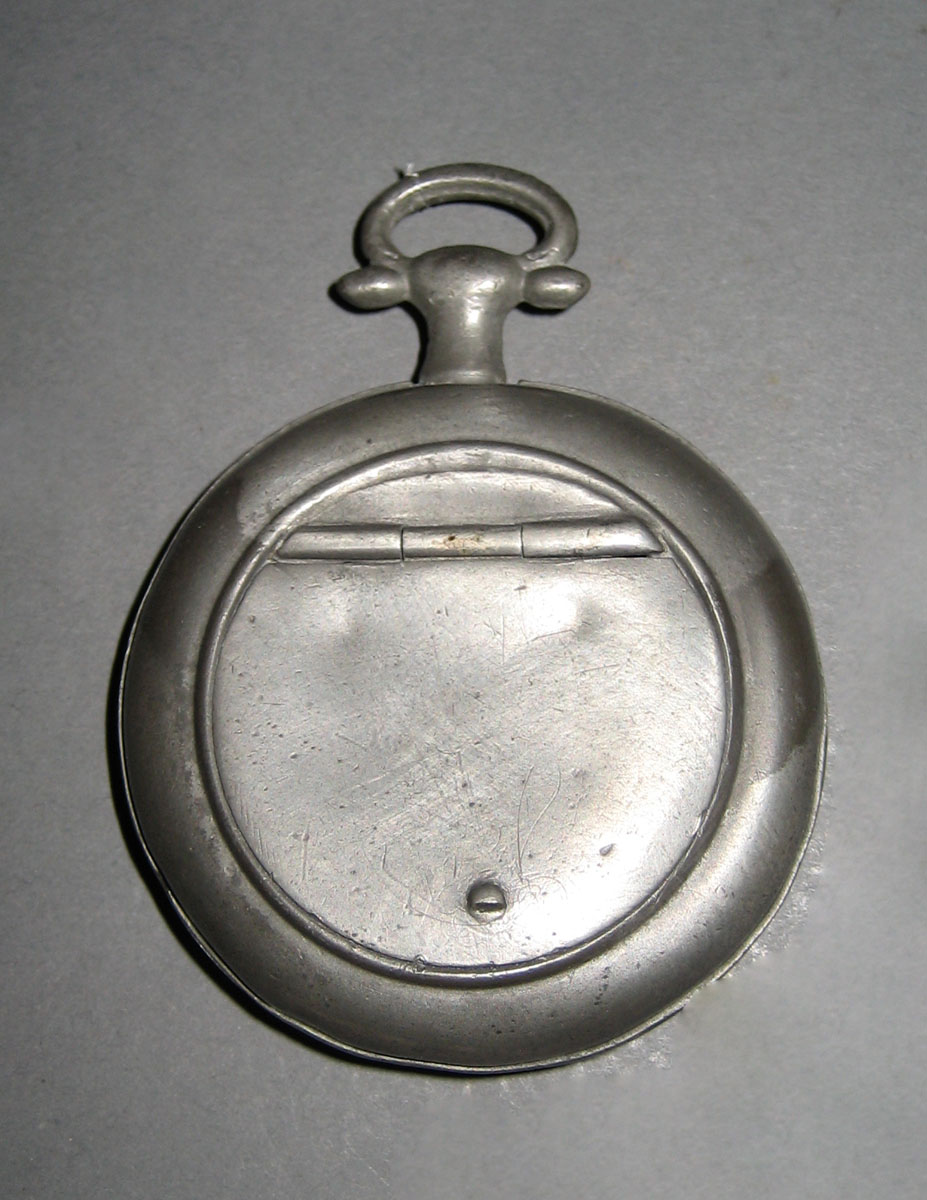
This circular Britannia metal snuff or tobacco box is in the form of a false pocket watch case with a flat hinged lid that opens in the center of one side and a horizontal D-shape suspension loop on a cylindrical stem soldered to the top of the case. The case is made from two halves of stamped sheet metal joined along the perimeter with a slightly molded edge. Unlike a pocket watch case, the flat, thin sheet metal lid has a hinge partly inside the case and is meant to be opened by lifting up a small rounded knob soldered along the edge of the lid. The exterior of the case is smooth and unornamented. There are no apparent stamped marks or inscriptions. False pocket watches, in French "fausse montre," were produced in the late 1700s until the mid-1800s. This example was designed to be a useful container. Although the original contents are often unknown, testing in Winterthur's Analytical Laboratory revealed nicotine residue (from tobacco or snuff) as well as evidence of lipids found in oils, resins (pine), varnishes, and waxes.
Category
Metals
Place of Origin
England or United States; United Kingdom or United States; Europe or North America
Materials
- Britannia metal
Museum Object Number
1959.2741
Credit Line/Donor
Bequest of Henry Francis du Pont
Share Object
Complete Details
Object Number
1959.2741
Object Name
Box (False watch case or Snuff box)
Category
Metals
Place of Origin
England or United States; United Kingdom or United States; Europe or North America
Date
1790-1840
Materials
- Britannia metal
Techniques
- Stamped
- Cast
Dimensions (inches)
0.709 (W) x 3 (L) x 2.205 (Diam)
Dimensions (centimeters)
1.8 (W) x 7.62 (L) x 5.6 (Diam)