//
For internal use only
Not On Display
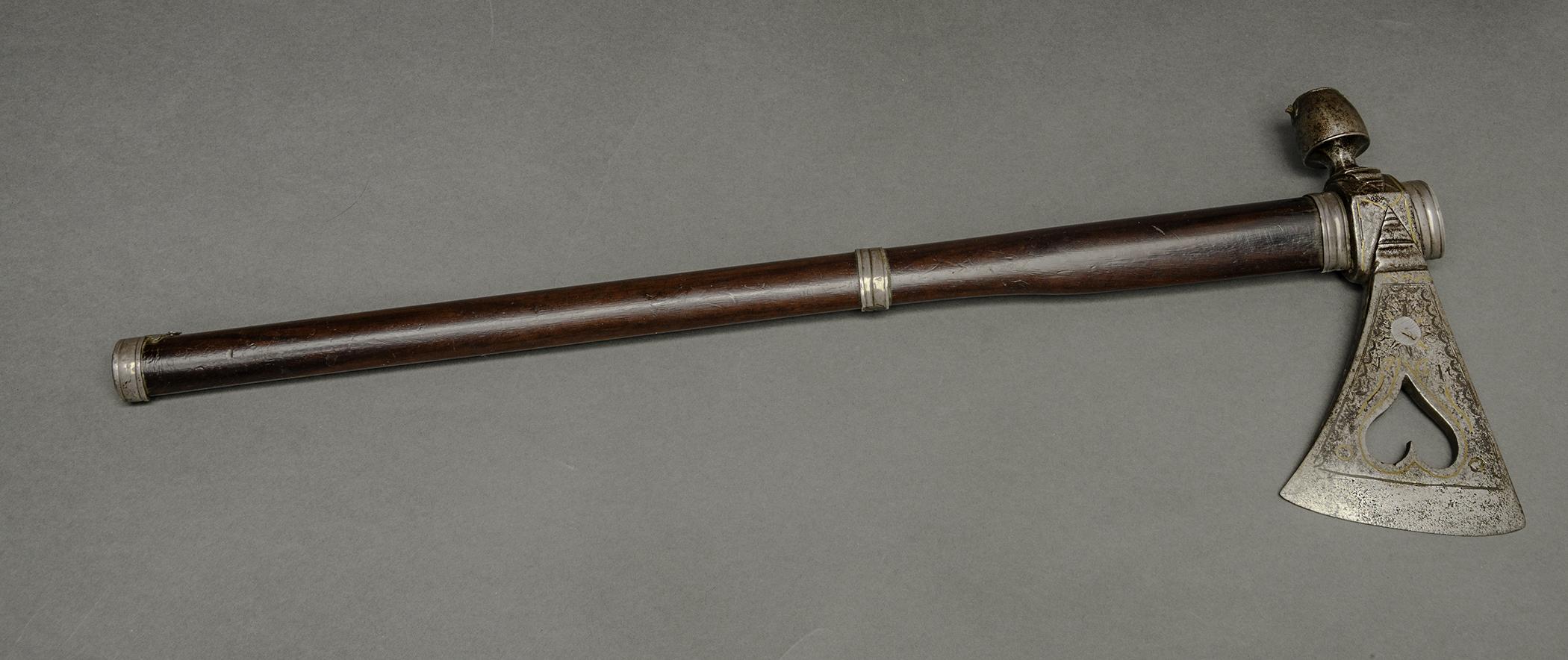
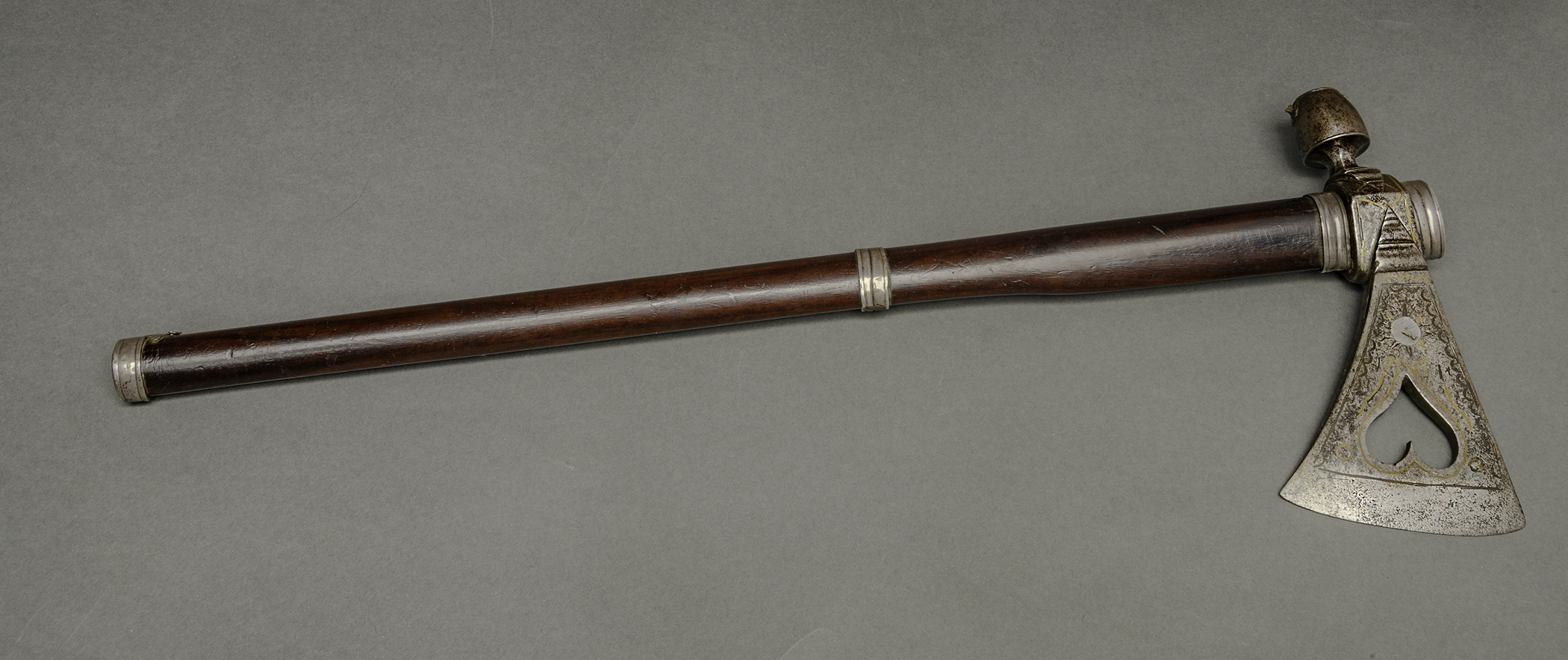
Tomahawk (Pipe tomahawk or trade axe)
1761
Description
Native American and European cultures visibly merge in this pipe tomahawk. During the colonial era, Native Americans introduced Europeans to smoking tobacco and were in turn, introduced to iron axes. Pipes and axes were first combined into pipe tomahawks in the early 1700s, usually forged by Europeans. They were gifted or traded to Native American leaders and also became popular among European military officers. This example, inscribed with the date “1761” was likely created by a French axe maker or a French Canadian armorer/gunsmith. Additional inscriptions inlaid in gold, silver, and brass include the names “A LEPOIVRES” and “FP LECOMTE” as well as images of the sun and moon. Silver bands encircle the wooden handle which is drilled as a pipe and is missing the mouthpiece that would have been inserted into the tip. The pipe tomahawk, while symbolic, was also a functional smoking pipe, a weapon, and a tool for trade and diplomacy. This overal form borrows from the basic design of a French trade hand axe or casse-tete. It is also called a pipe axe.
Category
Weapons, Hunting, and Fishing
Place of Origin
France or Canada; Europe or North America
Materials
- Iron
- Wood
- Silver
- Brass
- Gold
Museum Object Number
2019.0042.002
Credit Line/Donor
Gift of Rocky Hill Collection
Share Object
Complete Details
Object Number
2019.0042.002
Object Name
Tomahawk (Pipe tomahawk or trade axe)
Category
Weapons, Hunting, and Fishing
Place of Origin
France or Canada; Europe or North America
Origin Notes
Possibly made by a blacksmith in Paris or Quebec.
Date
1761
Mark/Signature/Inscription/Label
Type: Inscription
Location: Axe head, top
Inscription: "FP LECOMTE" inlay in brass
Type: Inscription
Location: Axe head, proper left
Inscription: "A. LEPOIV[inverted]VRES" inlay in brass
Type: Inscription
Location: Axe head, proper right
Inscription: "1761" inlay in brass and possibly niello
Mark/Signature: Yes
Subject(s)
- French and Indian War
- Native American
- Indigenous peoples
Materials
- Iron
- Wood
- Silver
- Brass
- Gold
Techniques
- Engraved
- Hammered
- Turned
Dimensions (inches)
7.5 (W) x 19.75 (L)
Dimensions (centimeters)
19.05 (W) x 50.165 (L)
Measurement Notes
Silver bands on shaft H: 1.1 - 1.3 cm
Bibliography and Bibliographic Notes
Book: Stephenson, R. Scott. 2005 Clash of Empires The British, French & Indian War 1754-1763.
• Published: p. 12.Article: Gladysz, Kevin & Hamilton, Ken. 12/01/2012 Axes in New France: Part III Casse-tetes (French Tomahawks). Journal of the Early Americas. II (VI): 6-19.
• Illustrated: Image I-4, p. 16.Article: Stolle, Nikolaus. 2010 Of French Origin? Eight "French Pipe Axes". European Review of Native American Studies. 21 (2): 43-47.
• Brass head trade axesBook: Hartzler, Daniel & Knowles, James. 1995 Indian Tomahawks and Frontiersmen Belt Axes.
• Published p. 124 (first edition)Other: Pedigo, Kelly. "That Wild Pipe of His": Deconstructing Narratives Around the Pipe Tomahawk.
• In object file 2019.0042.002