//
For internal use only
On Display: Galleries
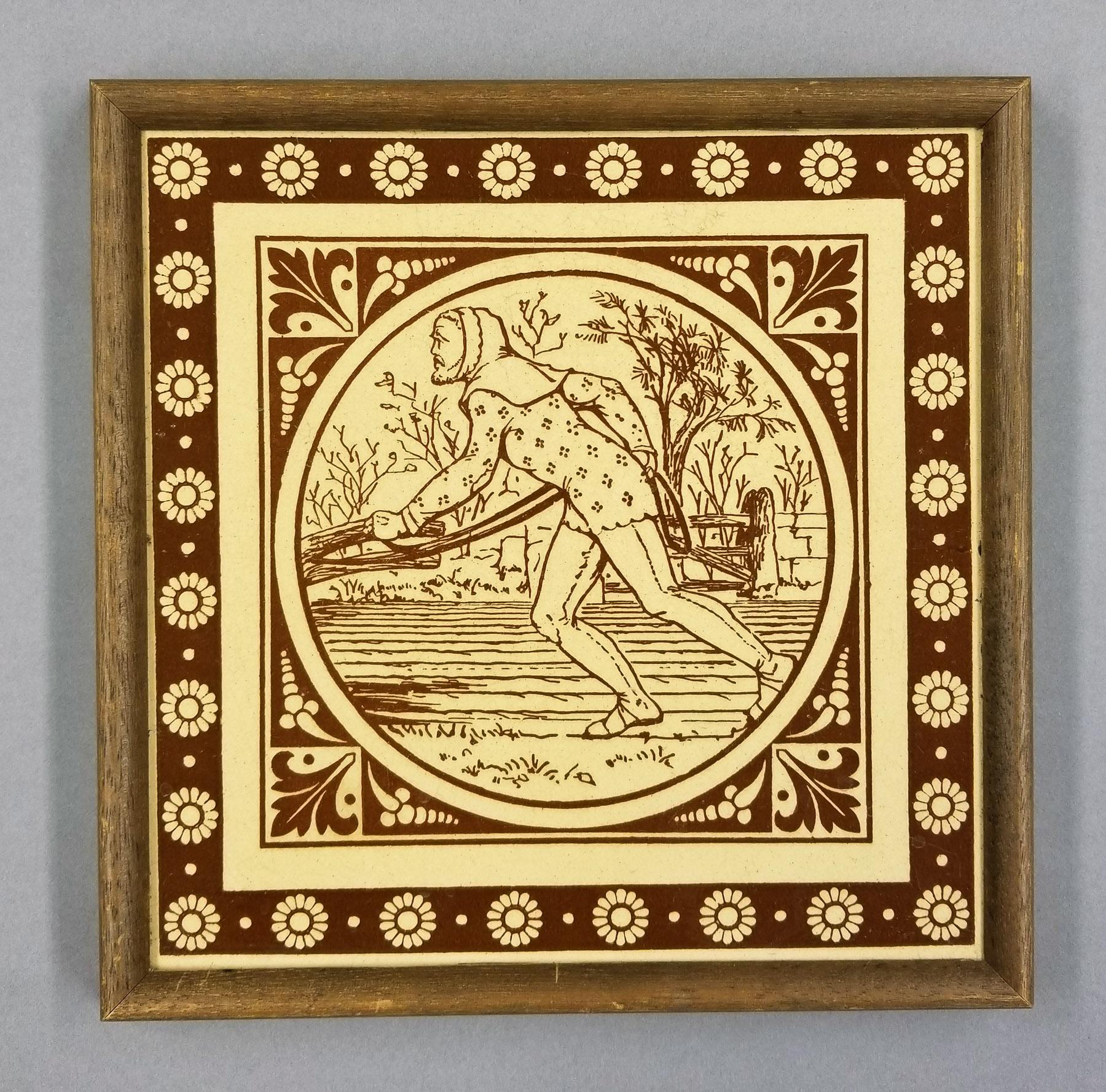
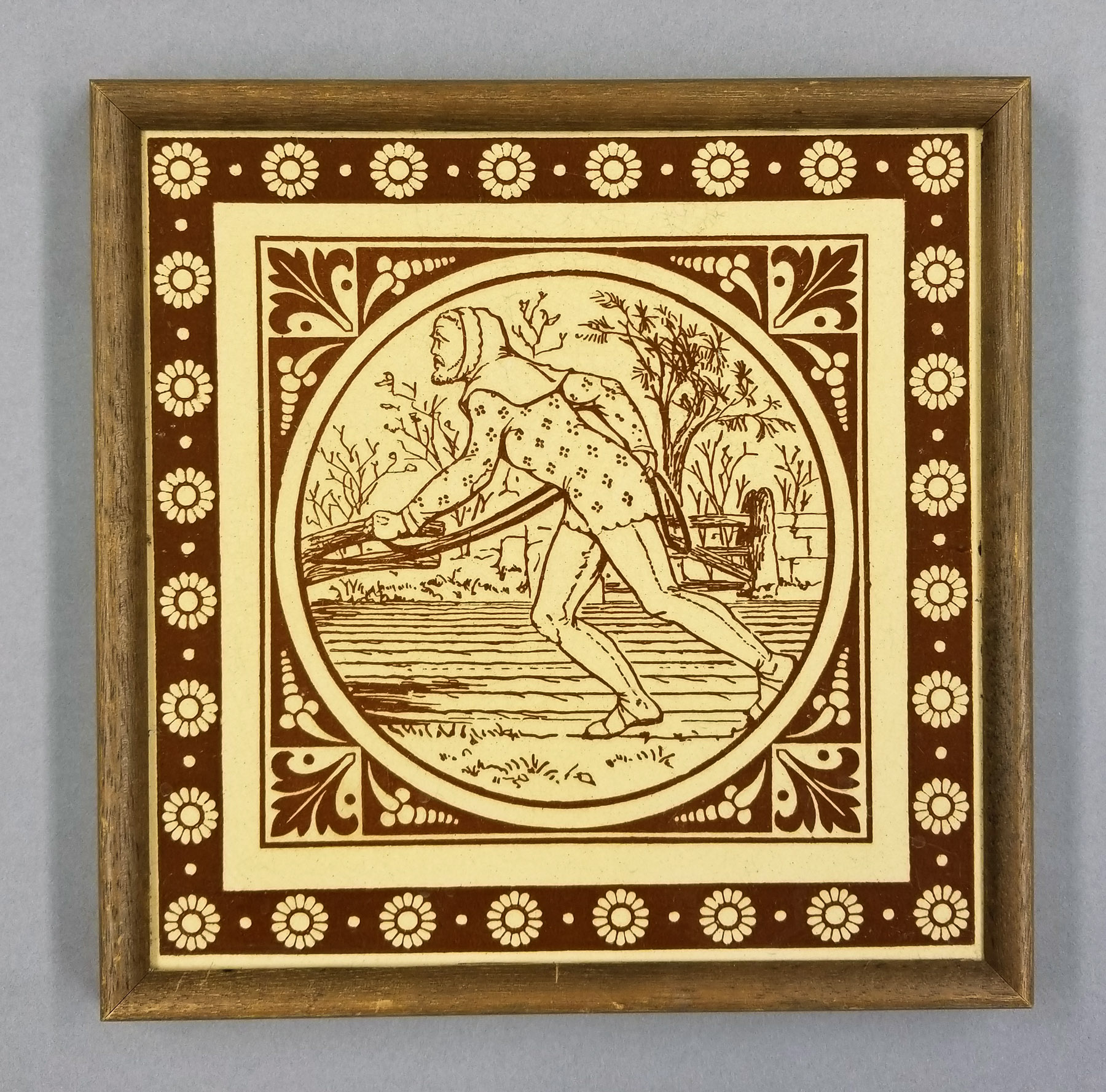
Tile (Fireplace or wall tile)
Ploughing
Minton factory, John Moyr Smith
1874-1876
Description
The body of this transfer-printed tile was created via a process known as dust-pressing, that was first patented by Richard Prosser in 1840 and was used by the Minton factory in Staffordshire. The tile's ornament reflects the then-popular fascination with the Medieval period and was created by the prominent designer John Moyr Smith. It is from his series of twelve tile designs featuring figures inspired by ornament on ceramics in London's South Kensington Museum (now the Victoria and Albert Museum). Moyer Smith included these designs in his "Album of Decorative Figures," noting that the series is "illustrating fieldwork for the twelve months of the year." The full series of tiles portray these themes: Digging, Reaping, Mowing, Fruit Gathering, Woodcutting, Sowing, Pruning, Grape Picking, Grafting, Espalier, Threshing, and Ploughing. Although the central reserves in the series remain the same, such tiles were available in a range of colorways and with different border details. As well as being used in fireplace surrounds and walls, these and other tiles formed decorative elements on furniture. (Winterthur is grateful to The Transferware Collectors Club for research support provided by the Paul and Gladys Richards Research Grant Program for Studies in British Transferware.)
Category
Ceramics
Creator/Artist/Maker
Minton factory (Maker)
Place of Origin
Stoke-On-Trent; Staffordshire; England; United Kingdom; Europe
Materials
- Earthenware
Museum Object Number
2021.0019.007
Credit Line/Donor
Gift of Hyman Myers & Sandra Kittner Myers
Share Object
Complete Details
Object Number
2021.0019.007
Object Name
Tile (Fireplace or wall tile)
Title
Ploughing
Category
Ceramics
Creator (Role)
Minton factory (Maker); John Moyr Smith (Designer)
Place of Origin
Stoke-On-Trent; Staffordshire; England; United Kingdom; Europe
Date
1874-1876
Mark/Signature/Inscription/Label
Type: Mark
Location: Underside
Inscription: Raised letters "MINTONS / CHINA WORKS / STOKE ON TRENT" and "L[?]"
Mark/Signature: Yes
Subject(s)
- Months
Materials
- Earthenware
Techniques
- Printed
- Molded
- Dust-pressed
Dimensions (inches)
1.063 (H) x 9.17 (W) x 9.17 (L)
Dimensions (centimeters)
2.7 (H) x 23.3 (W) x 23.3 (L)
Measurement Notes
Measurements (above) are for frame. Tile probably 8" x 8".
Bibliography and Bibliographic Notes
Electronic: Transferware Collectors Club. Transferware Collectors Club Database of Patterns & Sources. Transferware Collectors Club 03/13/2024 https://www.transferwarecollectorsclub.org/members/database
• Printed tile portraying same scene within different border: Identified as "Ploughing" (Alternate Name: Husbandry, Pattern No. 1727), pattern no. 17553. "...one of 12 designs in the Husbandry series of designs by John Moyr Smith c. 1874-76."Electronic: Transferware Collectors Club. Transferware Collectors Club Database of Patterns & Sources. Transferware Collectors Club 03/13/2024 https://www.transferwarecollectorsclub.org/members/database
• Printed tile portraying scene from same series within different border: Identified as "Sower" (Alternate Name: Husbandry), pattern no. 19034. "...one of 12 designs in the Husbandry series of designs by John Moyr Smith c. 1874-76." Lacks outer border shown on Winterthur tile.Electronic: Transferware Collectors Club. Transferware Collectors Club Database of Patterns & Sources. Transferware Collectors Club 03/13/2024 https://www.transferwarecollectorsclub.org/members/database
• Printed tile portraying scene from same series within different border: Identified as "Woodcutting" (Alternate Name: Husbandry, Pattern No. 1727), pattern no. 17554. "...one of 12 designs in the Husbandry series of designs by John Moyr Smith c. 1874-76." Lacks outer border shown on Winterthur tile.Book: Stapleton, Annamarie. 2020 John Moyr Smith 1839-1912: A Victorian Designer.
• Same central reserve theme on differently-bordered "Husbandry" tiles: pp. 64-65, the series with borders suiting them to "continuous horizontal or vertical borer[s] in buildings, fireplaces or furniture...the figures were taken from figures on early pottery in the South Kensington Museum (now the Victoria and Albert Museum, London)...In his 'Album of Decorative figures' Moyr Smith refers to this series as 'The Months...""Book: Stapleton, Annamarie. 2020 John Moyr Smith 1839-1912: A Victorian Designer.
• Book focused on John Moyr Smith designsBook: Stapleton, Annamarie. 2020 John Moyr Smith 1839-1912: A Victorian Designer.
• "Husbandry" tiles series by Moyr Smith: pp. 64-65, including "Ploughing" tile with same central reserve as Winterthur example but in blue with different border. Subject is one of 12 Husbandry themes, also refered to by Moyr Smith as The Months, 1874-76. Designs are after imagery on ceramics at Victoria & Albert Museum, London (formerly South Kensington Museum).Book: Stapleton, Annamarie. 2020 John Moyr Smith 1839-1912: A Victorian Designer.
• Hall chair including "Woodcutting" tile from Husbandry series by Moyr Smith: p. 64, left chair in lower right image.Electronic: van Lemmen, Hans. Minton's Prosser's Patent Tiles 1840-1854. Academia.edu (Journal of the Tiles & Architectural Ceramics Society) 06/23/2022 https://www.academia.edu/40425467/Mintons_Prossers_Patent_Tiles_1840_1854
• Article on dust-pressed tile process at Minton