//
For internal use only
Not On Display
Knotwork
Irene DeFoy Gregor
1970-1979
Description
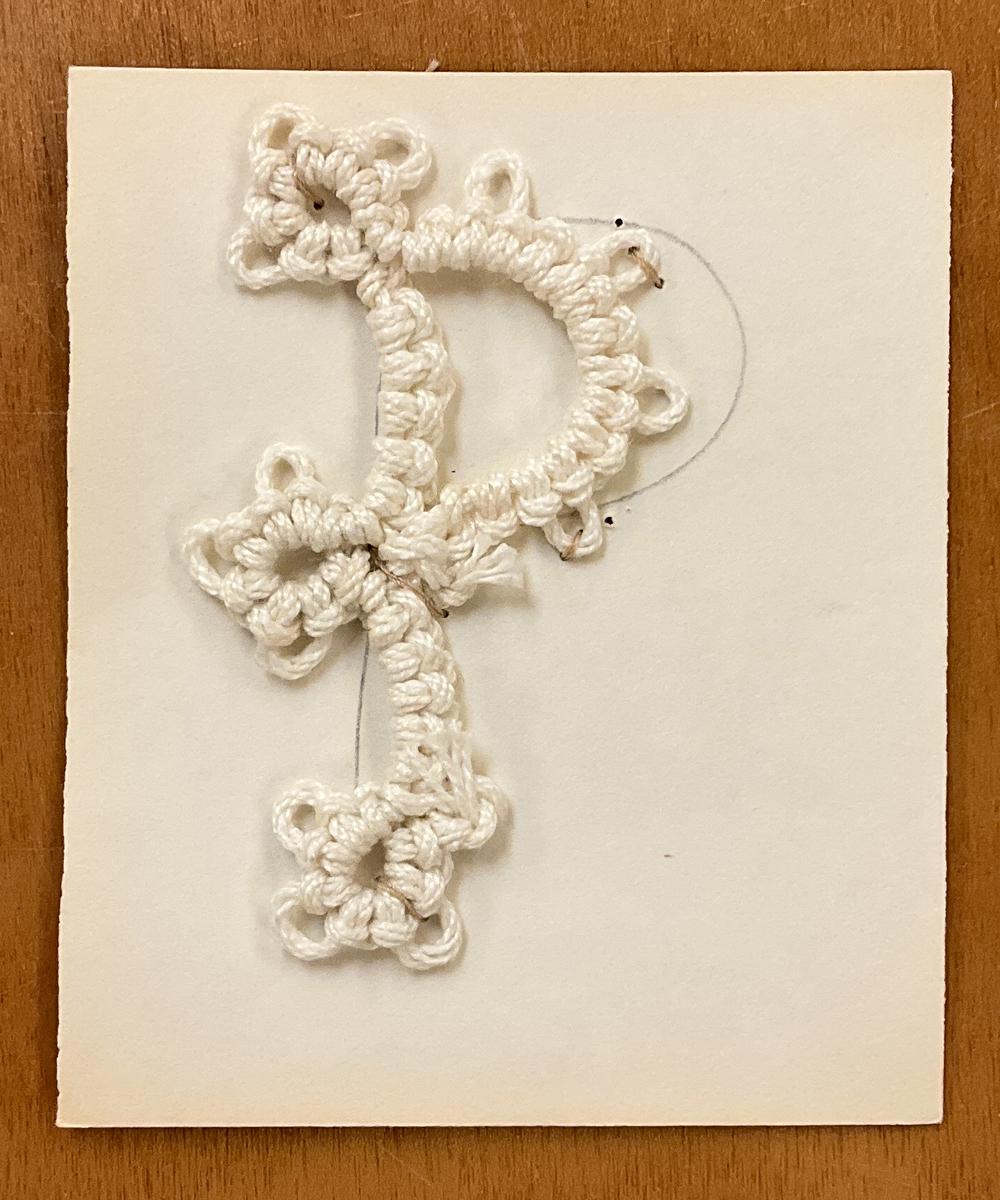
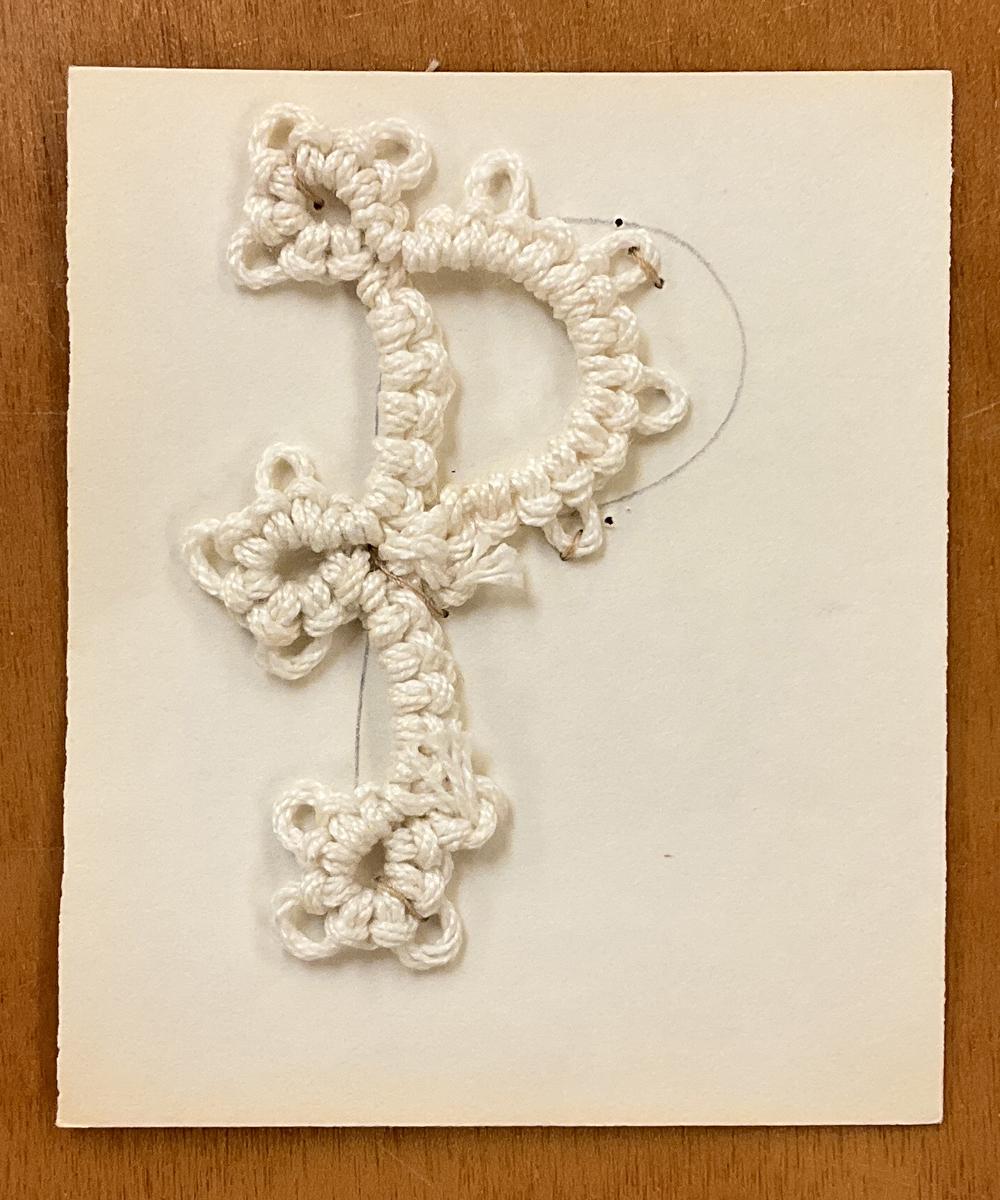
This knotwork letter “P” is made of heavyweight white cotton thread that has been tied into an intricate pattern of knots, which give it its structure. This manner of construction, done with a series of small knots, is known as tatting. Tatting is performed using a shuttle which holds thread wound around a bobbin in its center. The tatter holds a large loop of the thread in one hand and moves the shuttle back and forth through the loop with their other hand, making and tightening knots as they go. The two basic tatting structures are circles of knots, known as “rings,” and lines of knots, called “chains.” The tatter may also create small, loose loops called picots by leaving gaps in the thread as they form the knots. Picots can be decorative, but they can also be structural, used to join segments of tatting together to create a larger work. This object has decorative picots lining the rings and chains, and a structural picot joining the middle ring to the curved chain. This is one of a set (2017.0019.107.001-.023) of tatted letters done by New York-based artist Irene DeFoy Gregor during the 1970s. It was made following a pattern published in the December 1948 issue of Woman’s Day magazine. This object is one of a large group transferred to Winterthur from the American Textile History Museum when it closed in 2017.
Category
Textiles (Needlework)
Creator/Artist/Maker
Irene DeFoy Gregor (Maker)
Place of Origin
Massena; New York; St. Lawrence; Mid-Atlantic; United States; North America
Materials
- Cotton
Museum Object Number
2017.0019.107.015
Credit Line/Donor
American Textile History Museum Collection, gift of Nancy Ingham
Share Object
Complete Details
Object Number
2017.0019.107.015
Object Name
Knotwork
Category
Textiles (Needlework) - American Textile History Museum Collection
Creator (Role)
Irene DeFoy Gregor (Maker)
Place of Origin
Massena; New York; St. Lawrence; Mid-Atlantic; United States; North America
Date
1970-1979
Materials
- Cotton
Techniques
- Tatted
Dimensions (inches)
2.5 (W) x 3 (L)
Dimensions (centimeters)
6.35 (W) x 7.62 (L)