//
For internal use only
Not On Display
Handkerchief
1900-1915
Description
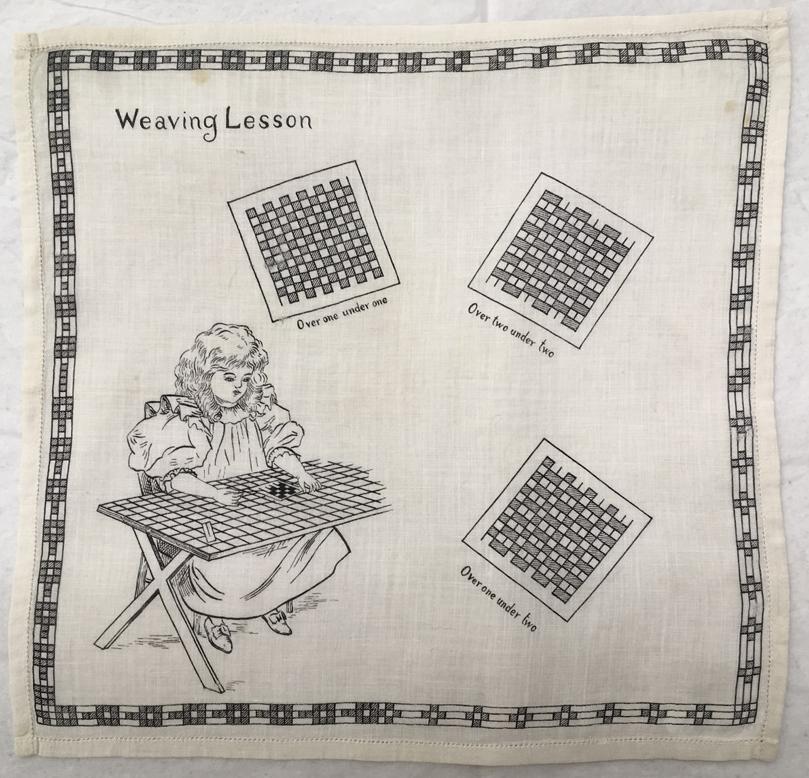
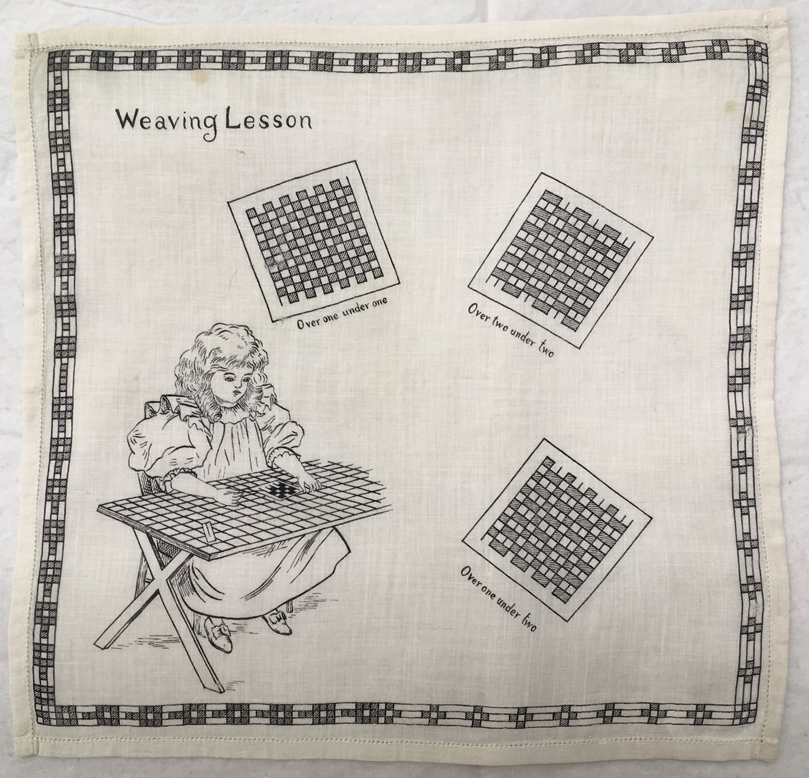
This cotton children's handkerchief, made in the United States during the early 20th century, is printed with an image of a weaving lesson. The image shows a young girl at a table using a needle to weave strips of paper together. Captioned patterns to the right of the girl illustrate three basic weaving structures: “Over one under one,” “Over two under two,” and “Over one under two.” The handkerchief’s border of alternating black and white blocks is designed to resemble a weaving pattern. This handkerchief is part of a set of instructional handkerchiefs made based on the work of Friedrich Froebel (b. 1782- d. 1852), the German educator who developed the idea of kindergarten. Froebel believed young children learned best through creative play, and designed a series of toys and activities to aid their intellectual development. The activities, which Froebel called “occupations,” included sewing, clay modeling, drawing, and – as shown on this handkerchief – weaving. Weaving was thought to help children develop skills such as manual dexterity, creativity, and mathematical thinking. Kate Douglas Wiggin and Nora Archibald Smith, American authors and promoters of Froebel, wrote in 1896 that “Mathematically considered, weaving seems one of the most perfect systems that could have been devised for teaching children to count and to calculate.” This object is one of a large group transferred to Winterthur from the American Textile History Museum when it closed in 2017.
Category
Textiles (Clothing)
Place of Origin
United States; North America
Materials
- Cotton
Museum Object Number
2017.0019.089
Credit Line/Donor
American Textile History Museum Collection
Share Object
Complete Details
Object Number
2017.0019.089
Object Name
Handkerchief
Category
Textiles (Clothing) - American Textile History Museum Collection
Place of Origin
United States; North America
Date
1900-1915
Mark/Signature/Inscription/Label
Type: Inscription
Location: upper left corner
Inscription: Weaving Lesson
Type: Inscription
Location: below each weaving card
Inscription: Over one under one / Over two under two / Over one under two
Mark/Signature: No
Materials
- Cotton
Techniques
- Woven (plain)
- Printed
Dimensions (inches)
11 (W) x 10.5 (L)
Dimensions (centimeters)
27.94 (W) x 26.67 (L)
Bibliography and Bibliographic Notes
Book: Murphy, J.J. 1998 Children's Handkerchiefs: A Two Hundred Year History. 160.
• For other handkerchiefs in this series, see page 75, plates 172-74Book: Wiggin, Kate Douglas & Smith, Nora Archibald. 1896 Froebel's Occupations. 313.
• See "Weaving" chapter, pages 166 to 191