//
For internal use only
Not On Display
Textile, woven
William Charles Ross
1851
Description
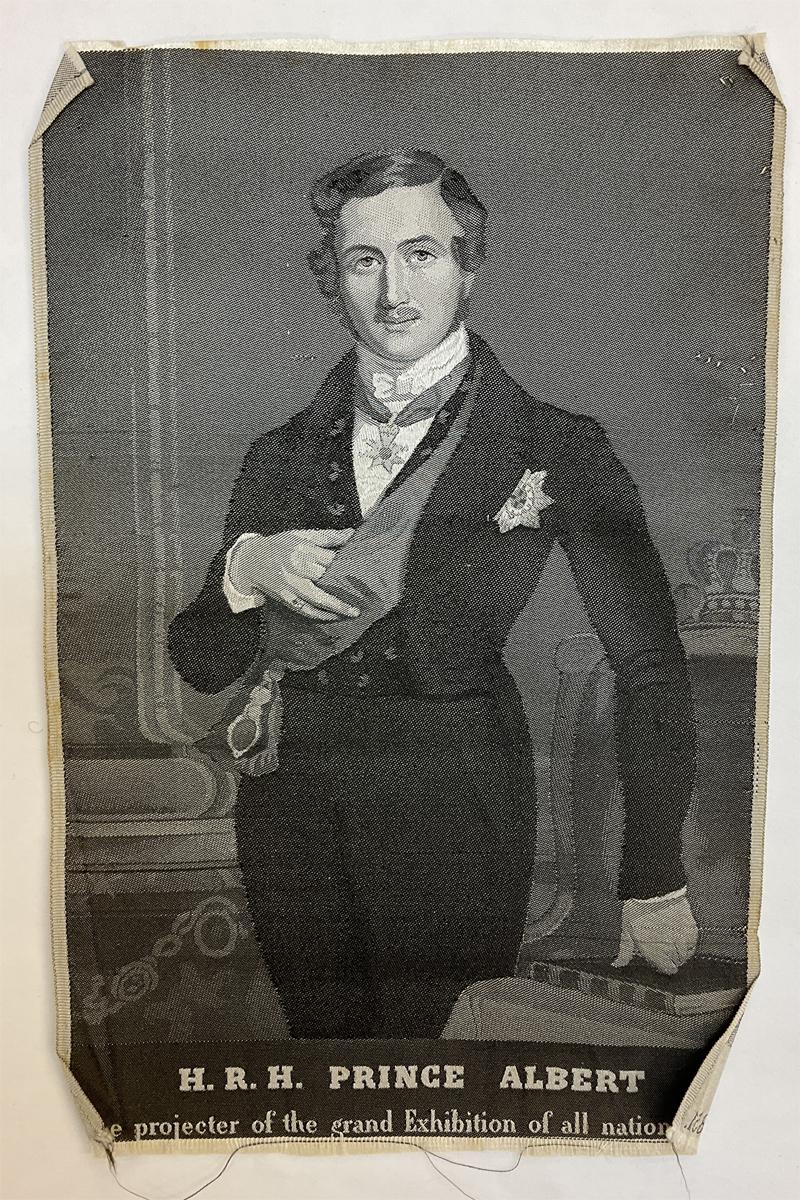
This woven silk portrait was created for the Great Exhibition of the Works of Industry of All Nations, also known as the Crystal Palace Exhibition, which was held in London in 1851. This textile was probably woven in France. The image, based on an 1840 miniature portrait by English painter William Charles Ross, depicts the Exhibition’s host, Prince Albert. It was created using a loom with a Jacquard attachment, a machine able to weave complex designs by following instructions fed into the device on a series of punch cards. The machine is named after its inventor, French weaver Joseph Marie Jacquard, who patented it in 1804. Looms with Jacquard attachments could be nearly as tall as ceilings, and particularly elaborate designs required tens of thousands of punch cards to make. To create the designs, an artist would plot the picture to be woven onto grid paper – a sort of early version of pixel art – which was then translated onto punch cards by a card maker. Many weavers submitted Jacquard woven pictures of the British royal family to the Crystal Palace Exhibition. While the subject matter may have been chosen to flatter the judges, the medium demonstrated the skill of the weavers and the technological sophistication of their looms. This object is one of a large group transferred to Winterthur from the American Textile History Museum when it closed in 2017.
Category
Textiles
Creator/Artist/Maker
William Charles Ross (after)
Place of Origin
Probably France; Europe
Materials
- Silk
Museum Object Number
2017.0019.016.002
Credit Line/Donor
American Textile History Museum Collection, gift of Essex Institute
Share Object
Complete Details
Object Number
2017.0019.016.002
Object Name
Textile, woven
Category
Textiles - American Textile History Museum Collection
Creator (Role)
William Charles Ross (after)
Place of Origin
Probably France; Europe
Date
1851
Mark/Signature/Inscription/Label
Type: Inscription
Location: below image
Inscription: H. R. H. PRINCE ALBERT / the projecter of the grand Exhibition of all nations. 1851
Mark/Signature: No
Subject(s)
- Crystal Palace Exposition
Materials
- Silk
Techniques
- Woven (jacquard)
Dimensions (inches)
5.38 (W) x 8.25 (L)
Dimensions (centimeters)
13.665 (W) x 20.955 (L)