//
For internal use only
Not On Display
Jacket
1905-1920
Description
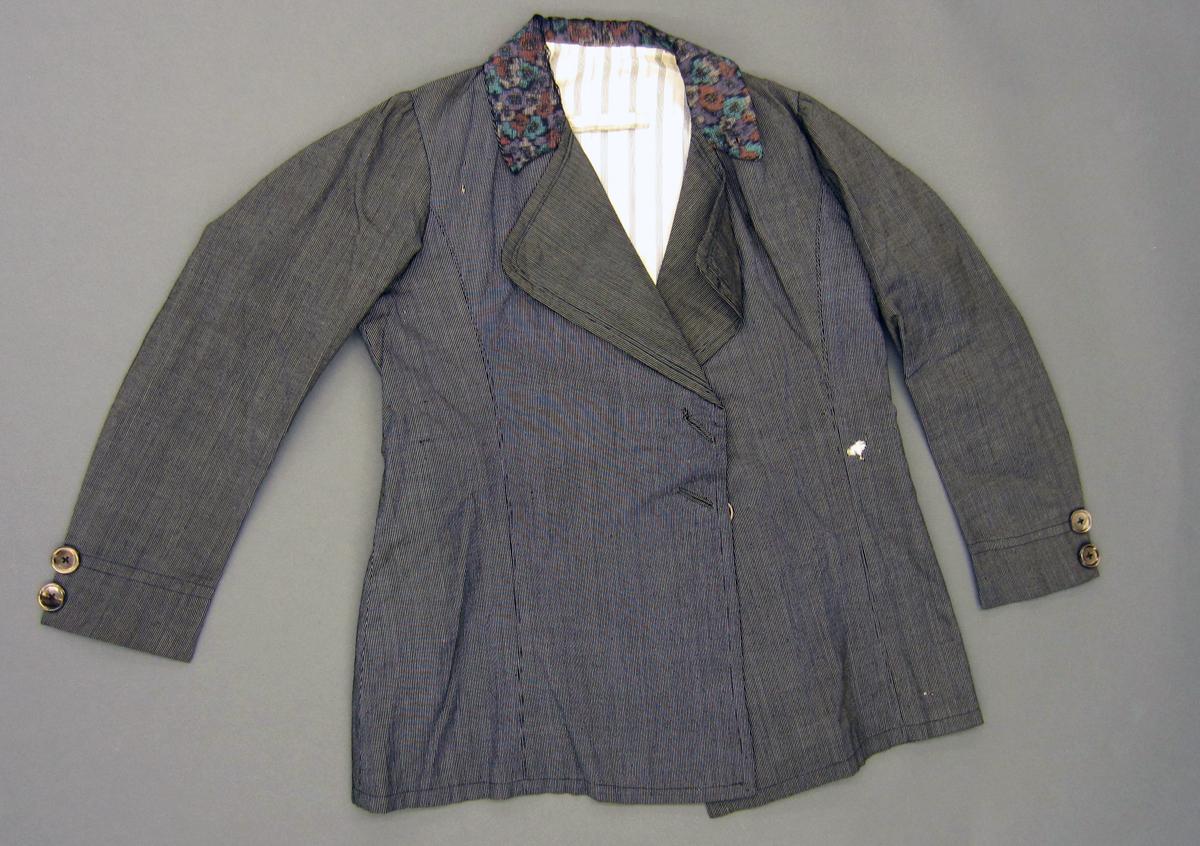
A wool (or wool blend) walking jacket. A single breasted women's walking jacket made of wool (or wool blend) gabardine (angled black and white twill) fabric. The collar is lined with buckram and covered in a multicolored corded fabric with a floral pattern and a black cord. This appears to be created with a complex weave structure and also a weft dyed silk process, similar to ikat. Weft dying is a specialized dying method used on the weft threads, which creates a repeated pattern of soft geometric forms when woven. The two button holes on the front of the jacket are slanted. Abalone shell buttons (all are 2.5 cm diameter) are set in pairs on the jacket front and each cuff. Two buttons are set in a row on each cuff. The cuff buttons are not functional.The jacket is fully lined with a plain weave cotton fabric woven with yarn-dyed thread to create repeated sets of navy blue vertical stripes (with five vertical pin stripes in each set) on cream ground fabric. A square pocket, made from the lining material is sewn to the inside left section of the jacket. A strip (sewn to create a tube) of the lining fabric has been attached at the back of the interior to create a loop for hanging. The length of this jacket would fall past the wearer's hip. This may be missing the original belt. This type of ensemble was a walking suit, commonly known during the period as a "Suffragette Suit." This style of suit, with the long skirt and elongated jacket made from suiting fabrics and worn with a relaxed blouse or shirtwaist and a cravat (or tie) with a feminine style was popular with active women during the Edwardian period. It is an example of the relaxed garments that were created in response to the late19th and early 20th century movement for dress reform. Women were moving into new roles outside of the home and this change created a need for clothing that would be practical and more comfortable than previous styles. This was worn with 2013.0048.025 B-E.
Category
Textiles (Clothing)
Place of Origin
England; Europe
Materials
- Wool
- Cotton
- Silk
- Shell
- Buckram
Museum Object Number
2013.0048.025 A
Credit Line/Donor
Gift of Sandy Lerner
Share Object
Complete Details
Object Number
2013.0048.025 A
Object Name
Jacket
Category
Textiles (Clothing)
Place of Origin
England; Europe
Date
1905-1920
Materials
- Wool
- Cotton
- Silk
- Shell
- Buckram
Dimensions (inches)
28 (W) x 27.4 (L)
Dimensions (centimeters)
72 (W) x 69.5 (L)
Bibliography and Bibliographic Notes
Book: Cunningham, Patricia. 2003 Reforming Women's Fashion, 1850 - 1920.
• pg. 52,55,76-77, 96 also Chapter 7Book: Waugh, Nora. 1987 The Cut of Women's Clothes: 1600-1930.
• pg 264 - 274