//
For internal use only
Not On Display
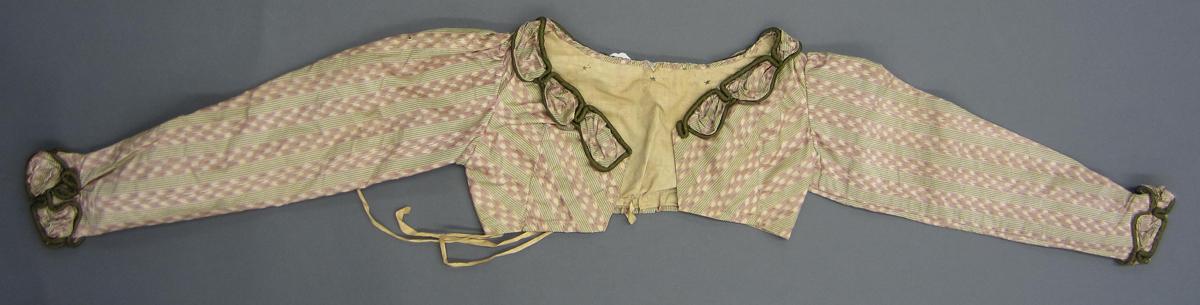
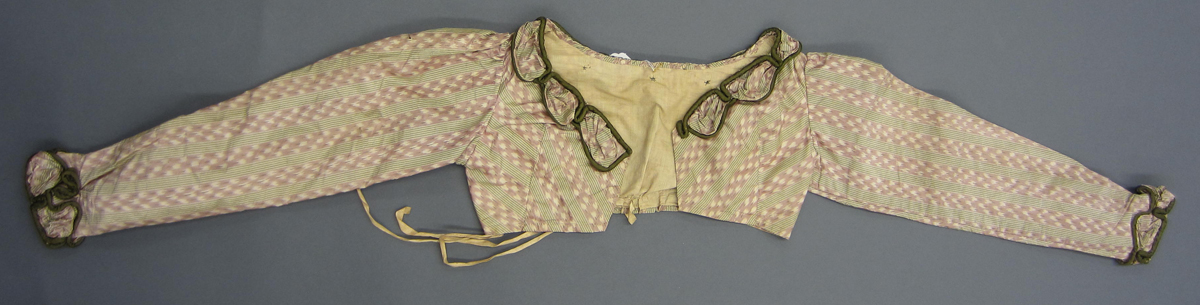
Jacket (Spencer)
1790-1830
Description
A short silk jacket with long sleeves, known as a spencer. A spencer jacket is a short jacket without tails. The earliest spencers date to the 1790s. The name originates from the 2nd Earl of Spencer who (as legend would tell) is credited with inventing the style when he cut his own jacket short because the lower portion became damaged in some way. This style was widely adopted by women of the period and spencers were considered to be a functional and stylish alternative to cloaks. The bodice is open and trimmed with a decorative collar composed of gathered sections of the primary fabric, framed within a border of "wadded rouleaux" green satin strips, stuffed and sewn to create lengths of corded trim. It is often found on garments from the 1820s. This decoration is repeated around each sleeve cuff with four framed segments of equal size. An additional length of corded trim is attached above the gathered decorations in a trefoil form on the outer side of each cuff.The jacket is lined with a fine, undyed plain weave fabric, possibly cotton or linen. The primary fabric is plain weave silk that has been warp dyed (a technique known as Chiné à la branche; developed from ikat, a resist dying method). Warp dying is a specialized dying method used on the warp threads, which creates a repeated pattern of soft geometric forms along with groups of well defined vertical stripes when woven. This particular fabric was very likely produced in France.The colors of the primary fabric are rose pink, cream, black and green.The secondary fabric is solid green silk satin. The satin fabric is cut into a strip, wrapped around wool batting and stitched closed along one side to create a stuffed silk cord with a diameter of about 1/4 inch. The exterior of the back of the jacket appears to be stitched with two rows of roughly executed running stitches along the entire length of the back panel. One row is stitched in cream thread and the other row is stitched in green thread. A long linen tie, affixed to the the back of the jacket lining appears to have been attached with these two rows of running stitches. This may have been a rough alteration. The decorative elements on this jacket appear to have been added later, most likely as a fashionable update for the original wearer, or to freshen this up in preparation for a new owner a few years after the original creation date. This style of rolled trim was popular during the 1820s. The green thread stitching used to secure the trim in place throughout is stitched over the lining (with roughly executed stitches) and evidence of original pleats or fine gathers of the primary fabric at the edges of the cuff suggest that the original trim for this jacket was composed of ruffles made from the primary fabric. That fabric has been refashioned into the filler for the framed segments.
Category
Textiles (Clothing)
Place of Origin
France; Europe
Materials
- Silk
- Linen
- Thread
- Wool
- Cotton
- Silk taffeta
Museum Object Number
2013.0048.013
Credit Line/Donor
Gift of Sandy Lerner
Share Object
Complete Details
Object Number
2013.0048.013
Object Name
Jacket (Spencer)
Category
Textiles (Clothing)
Place of Origin
France; Europe
Origin Notes
The striped chine a la branche (ikat) silk was probably woven in France. A similar example of fabric (dating from 1820) can be found in the collection of Metropolitan Museum 1971.242.1a-e
Secondary Place of Origin
England; Europe
Secondary Origin Notes
This may have been sewn in England from French fabric.
Date
1790-1830
Materials
- Silk
- Linen
- Thread
- Wool
- Cotton
- Silk taffeta
Techniques
- Chiné à la branche
Dimensions (inches)
11 (H) x 61 (L)
Dimensions (centimeters)
27 (H) x 155 (L)
Measurement Notes
Height is measured from top of shoulder to waist. Length from cuff to cuff with the sleeves outstretched.
Bibliography and Bibliographic Notes
Book: Wass, Ann Buermann & Fandrich, Michelle Webb. 2010 Clothing Through American History: The Federal Era through Antebellum, 1786-1860.
• pg 78-80Book: Waugh, Norah & Woodward, Margaret. 1968 The Cut of Women's Clothes: 1600 -1930.
• pg 133, 136, 214Book: McClellan, Elizabeth. 1977 Historic Dress in America.
• Wadded rouleaux discussed 156-57