//
For internal use only
Not On Display
Fraktur (Drawing)
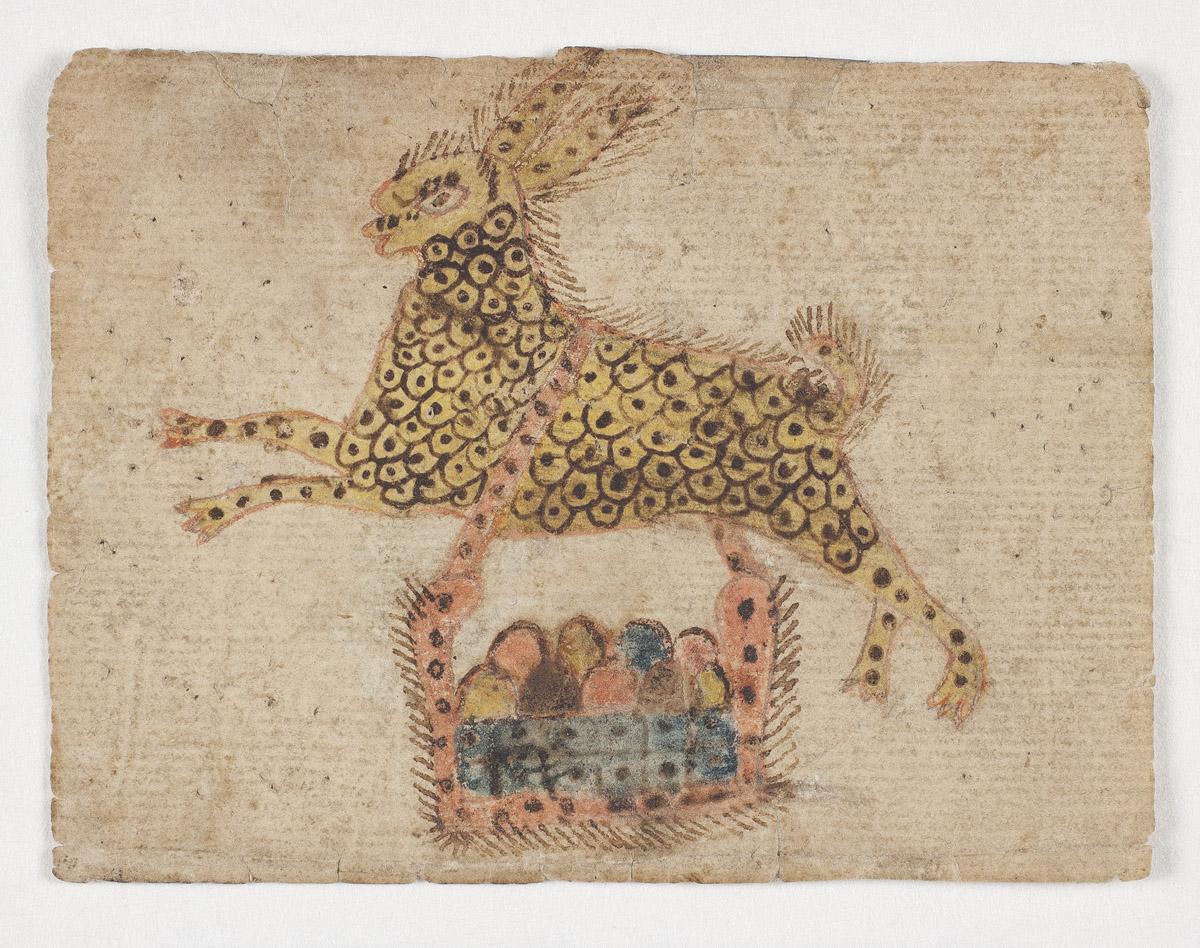
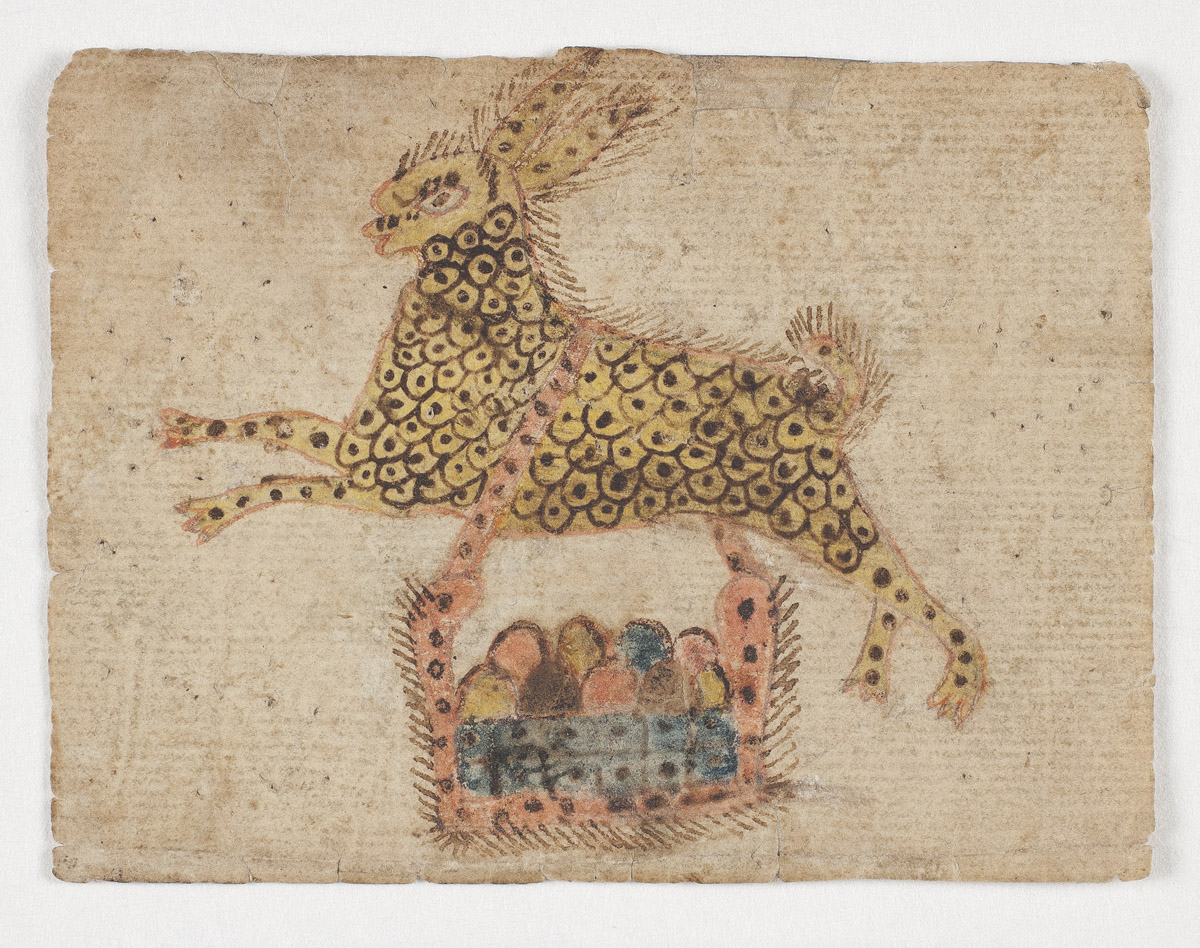
Easter bunny with eggs
Johann Conrad Gilbert
1800-1810
Description
The Easter rabbit or bunny and colored eggs are traditions brought to America by culturally Germanic immigrants during the 18th century. In the German language, the Easter rabbit or bunny was known as the Oschter Haws (Easter hare). This small colorful watercolor is one of the earliest known depictions of the Easter bunny in America. A closely related drawing is in the collection of the Abby Aldrich Rockefeller Folk Art Center at Colonial Williamsburg (59.305.3). That drawing had long been celebrated as the earliest known American depiction, but the example now at Winterthur can vie for the title. It is unknown which drawing was made first, but both are firmly attributed to the same schoolmaster Johann Conrad Gilbert, who emigrated from Germany in 1757 and settled in Montgomery County, Pennsylvania. About 1780, he moved to Berks County, where he lived until his death in 1812. He painted Winterthur's Easter bunny on laid paper with the watermark “PU,” used by paper maker Peter Ulrick who worked during the late 1700s and early 1800s in Cocalico Township, Lancaster County.
Category
Works on Paper
Creator/Artist/Maker
Johann Conrad Gilbert (Artist)
Place of Origin
Pennsylvania; Berks; Mid-Atlantic; United States; North America
Materials
- Watercolor
- Ink
- Paper (laid)
Museum Object Number
2011.0010
Credit Line/Donor
Museum purchase with funds provided by the Henry Francis du Pont Collectors Circle
Share Object
Complete Details
Object Number
2011.0010
Object Name
Fraktur (Drawing)
Title
Easter bunny with eggs
Category
Works on Paper
Creator (Role)
Johann Conrad Gilbert (Artist)
Place of Origin
Pennsylvania; Berks; Mid-Atlantic; United States; North America
Date
1800-1810
Subject(s)
- Easter
Materials
- Watercolor
- Ink
- Paper (laid)
Dimensions (inches)
3.0625 (H) x 4.0625 (W) x 0.007 (D)
Dimensions (centimeters)
7.779 (H) x 10.319 (W) x 0.018 (D)
Bibliography and Bibliographic Notes
Article: Weiser, Frederick S. 1982 "His Deeds Followed Him: The Fraktur of John Conrad Gilbert". Der Reggeboge: Journal of the Pennsylvania German Society. 16 (2)
• See fig. 17 on p. 45 for an image of the related Easter rabbit.Article: Minardi, Lisa. 2012 Easter at Winterthur: The Pennsylvania German Origins of an American Tradition. Antiques and Fine Art. 11 (6): 218-219.
• Published: fig. 1 on p. 218.Book: Shoemaker, Alfred L. 2000 Eastertide in Pennsylvania.
• More info.Catalogue: Garvan, Beatrice B. & Hummel, Charles F. 1982 The Pennsylvania Germans: a celebration of their arts, 1683-1850. An exhibition organized by the Philadelphia Museum of Art and the Henry Francis du Pont Winterthur Museum.
• See fig. 116 for an image of the related drawing.Article: 04//2018 Natural Dyes for Easter Eggs. Early American Life Magazine. 30-33.
• Published: p. 33