//
For internal use only
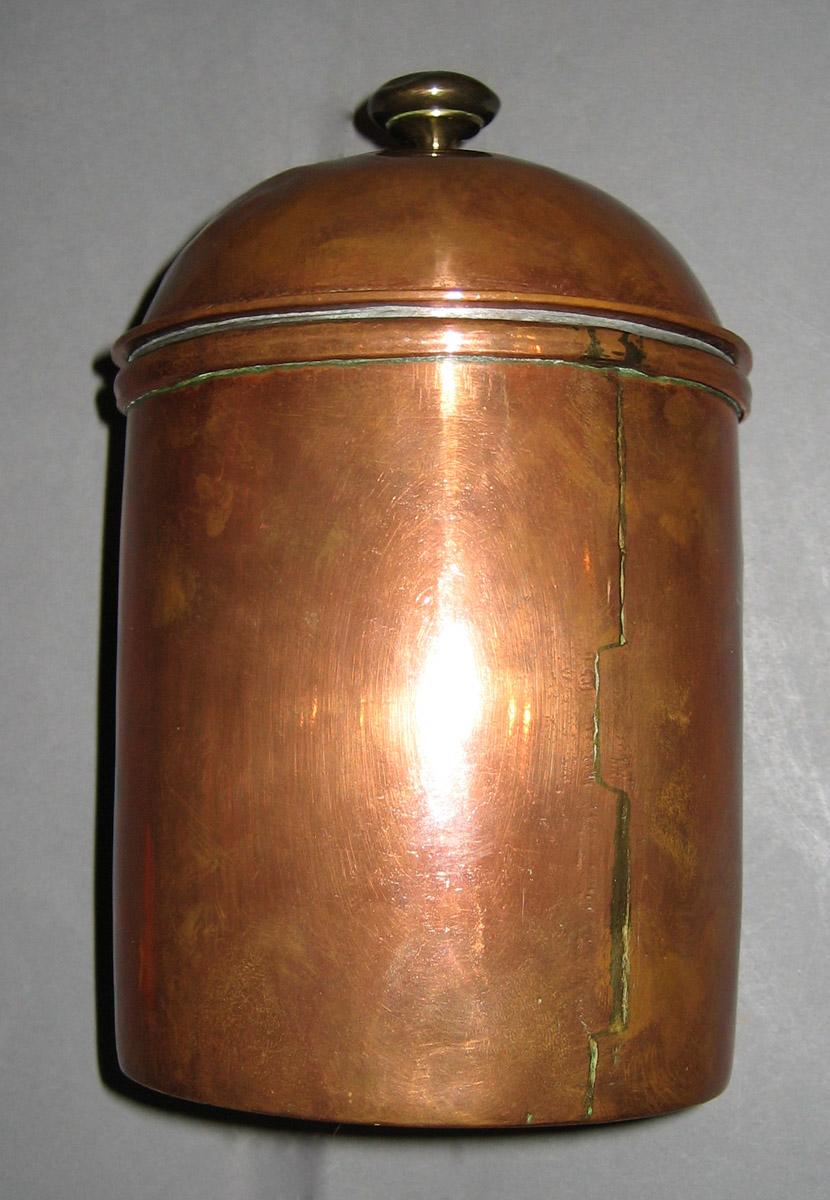
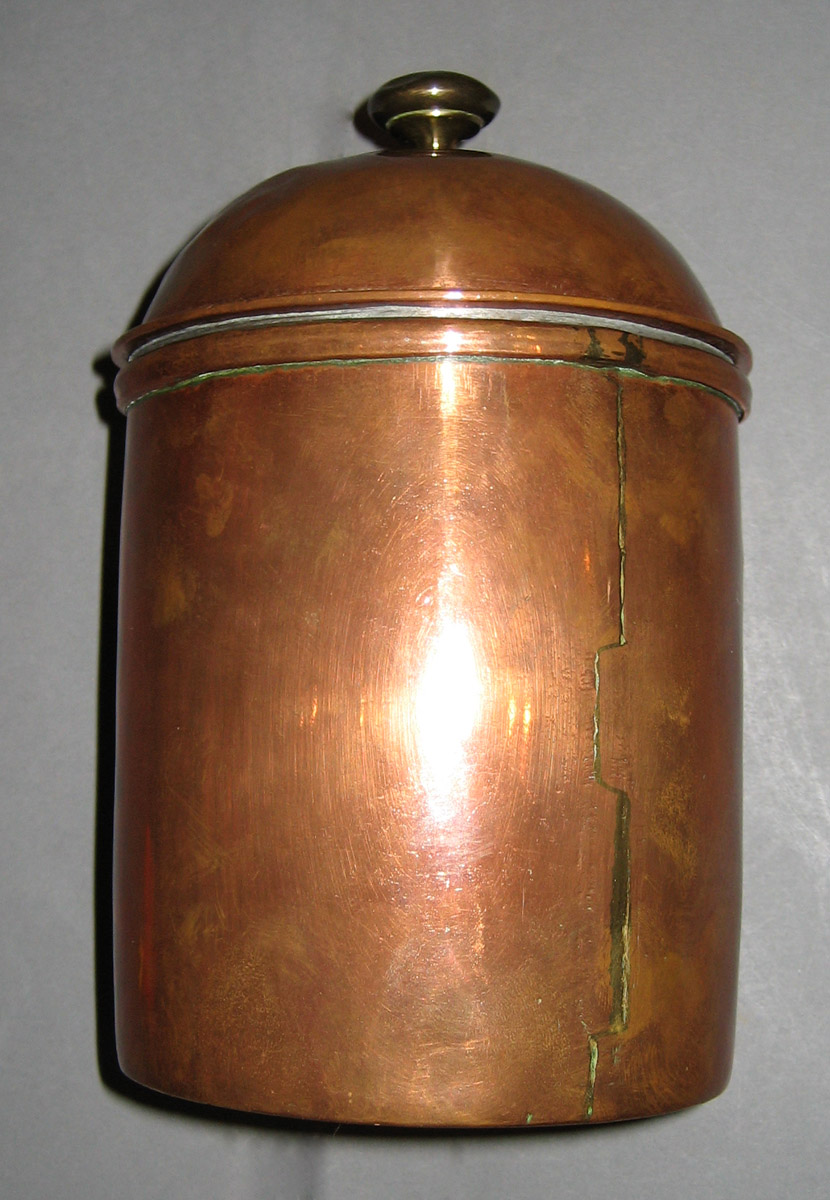
On Display: House - End Shop
Canister and cover (Food vessel)
1780-1820
Description
Composed primarily of copper, this unmarked cylindrical lidded canister bears signs of construction techniques favored by late eighteenth and early nineteenth century coppersmiths with tapered, cramped seams, iron wire reinforcement at the opening, and folded seams brazed together. The high lid has a finial with a hollow, domed, wrought upper portion brazed to the spool-shape cast base which encloses an iron shank penetrating through the lid. The interior is fully tinned. A common household item, canisters stored a variety of sundries such as tea, tobacco, gunpowder and other dry goods. The shape of this particular container is consistent with examples of European tobacco jars produced during the late 1700s and early 1800s. A survey of one American coppersmith's probate inventory dated 1801 recorded his possession of at least 51 canisters of varied sizes and unspecified purposes. (See: Charles Miller Inventory, The Joseph Downs Collection of Manuscripts and Printed Ephemera, Winterthur Library, MS 54.37.79).
Category
Metals
Materials
- Copper
- Brass
- Iron wire
Museum Object Number
1958.3008 A, B
Credit Line/Donor
Bequest of Henry Francis du Pont
Share Object
Complete Details
Object Number
1958.3008 A, B
Object Name
Canister and cover (Food vessel)
Category
Metals
Date
1780-1820
Materials
- Copper
- Brass
- Iron wire
Dimensions (inches)
7.752 (H) x 4.874 (Diam)
Dimensions (centimeters)
19.69 (H) x 12.38 (Diam)